Home » Downtown » Recent Articles:

Central Valet Zone Now On Tucker

I’ve been writing about valet parking since July 2005. Years ago valets would take every on-street parking space on the block in front of the restaurant that hired them. leaving no spaces for the public to use. They’d place valet signs in bike lanes.

Finally the city to placed signs on the meter of the spaces that were permitted for valet service, including days of the week and hours of operation. The valets continued to take more spaces than given, again inconveniencing the general public. For example, until recently, we had three different valet stands in the two city blocks of Washington Ave between 10th and Tucker (12th), two were directly across the street from each other!

The city has permitted valet on Thursday-Saturday evenings after 6pm. Lately the city did something it should’ve done 8 years ago — created a central valet zone to cover these two blocks. So now on Tucker from St. Charles St to Washington Ave you have a bus stop and a valet zone. This area didn’t have any on-street parking before, it was just excessively wide.

Half the block from St. Charles St to Washington Ave is now designated for valet parking 3 nights per week after 6pm.

Half the block from St. Charles St to Washington Ave is now designated for valet parking 3 nights per week after 6pm. Copia, Prime 1000 & Mosaic customers now valet here.

Valet problems are solved, right? Wrong! The valet companies still feel they have the right to take public parking whenever and where ever they like.

Valets covered two meters in front of Prime 1000 on Monday May 13th, I took this photo at 3:50pm.

Valets covered two meters in front of Prime 1000 on Monday May 13th, I took this photo at 3:50pm.

Empty spaces mean the city isn’t getting revenue to pay off bonds to cover parking garage debt. Since it was before 5pm I was able to email the above pic to the appropriate people so they could come out and tell them they couldn’t do this.

I personally don’t care if valeting happens 7 days a week, as long as it is in the central spot on Tucker so the public spaces remain available for the public to use.

– Steve Patterson

Two-Thirds of Readers Opposed Decision to Raze Cupples 7 Warehouse

Cupples 2 (left, renovated) and Cupples 7 (right, slated for demolition by the city)

Cupples 2 (left, renovated) and Cupples 7 (right, slated for demolition by the city)

No surprise in the poll last week, readers are opposed to the city razing the Cupples 7 warehouse building, here are the results from the poll last week:

Q: The city plans to raze Cupples 7; support or oppose?

  1. Strongly oppose 65 [44.52%]
  2. Oppose 31 [21.23%]
  3. Support 24 [16.44%]
  4. Unsure/No Answer 10 [6.85%]
  5. Strongly support 9 [6.16%]
  6. Neutral 7 [4.79%]

Nearly half “strongly opposed” to razing the building. If they’re like me, they’d risk collapse while holding out for a developer with deep pockets.

When we simplify the results the contrast becomes even stronger: two-thirds are opposed.

2/3rds of readers were opposed to demolition

2/3rds of readers were opposed to demolition

Yesterday I met with Treasurer Tishaura Jones and Cupples 7 was one of the topics we discussed. Per the previous treasurer, that office must buy the bank note on the property if the city demolishes the building. Jones told me they don’t have any definitive plans for the site once it is cleared. I suggested a transparent process to get the community involved in brainstorming ideas.

I want to see a building, not parking or green space.

– Steve Patterson

Potential Development Sites Along Proposed Streetcar Line, Part 2: Olive 16th-18th

This is part 2 of a multipart series looking at potential sites for development along the proposed streetcar line that’d run along Olive/Lindell from downtown to the Central West End and the BJC hospital complex as well as north on 14th Street . In Part 1: Olive 15th-16th a week ago I looked at one city block on the north side of Olive between 15th-16th.

That block is underused surface parking, the Campbell House Museum, YMCA and 100 vacant apartments over the YMCA. Potential for both new construction and rehab. The south side of Olive is the 1950s Plaza Square high rise apartments, these will become more desirable after the streetcar line opens.

For this post I want to look at parts of five city blocks rather than just one; they’re bounded by 16th Street on the east, St. Charles St. on the north 18th on the west and Pine on the south. These blocks have a mix of buildings including rehabbed/occupied, non-rehabbed/occupied, vacant buildings, vacant land, a church, a non-public library building, etc.

I’ve organized them by City Block and listed the property addresses.

City Block 509

1700-1706 Olive was built in 1918, it is for sale

1700-1706 Olive was built in 1918, it is for sale. The facade on the base appears to have been modified later, possibly to fit in with the adjacent buildings. Click image for map.

1708 Olive, built in ???, is less than 24ft wide.

1708 Olive, built in 1951, is less than 24ft wide.

1710-1714 Olive, built in ???

1710-1714 Olive was built in 1946

1718 Olive (left) and 1720 Olive (right) are both occupied.

1718 Olive (left) and 1720 Olive (right) are both occupied. 1718 was built in 1900, 1720 in 1926.

1728 Olive was built in 1929

1728 Olive was built in 1929

I like variety & scale of the buildings on this block facing Olive, but with the exception of 1700-06 Olive the density is too low to be on a streetcar line and not tall enough relative to the width of Olive. The two 3-story buildings in the middle might be able to be kept with new construction on either side. However, most of these buildings contribute to the Washington Ave national historic district so rehabilitation should be considered.

The rest of the block is surface parking for the Blu Condominium Association and a dumpy 7-11.

Even though the 7-11 faces 17th, the property address is 1701 Pine.

Even though the 7-11 faces 17th, the property address is 1701 Pine.

City Block 510

1717 Olive occupies the entire block. Originally the Butler Brothers warehouse built in 1908

1717 Olive occupies the entire block. Originally the Butler Brothers warehouse built in 1908, later renamed Plaza Square.

The building does have a few business tenants but overall it is in need of a major rehab. Because of the condition, the rents are low. Care should be taken to not price businesses out of the building/neighborhood. On the other hand, those of us living nearby would appreciate it if it was maintained to a higher standard.

This building has potential to house offices and residential.

City Block 511

1601 Olive

1601 Olive is a 2-story office building built in 1965, it is vacant and for sale. I’d rather see a larger structure on this corner.

1613 Olive is a vacant lot owned by the city, used for parking.

1613 Olive is a vacant lot owned by the city, used for parking for the building to the west.

1621 Olive is owned by the city, used for parking enforcement offices right now

1621 Olive is owned by the city, used for parking enforcement offices right now

1625 Olive is privately owned and is occupied.  Built in 1948, it has an interesting facade. Retain the facade but build up?

1625 Olive is privately owned and is occupied. Built in 1948, it has an interesting facade. Retain the facade but build up?

1624 Locust is part of the St. Louis Library system

1624 Locust is part of the St. Louis Library system

The 2-story building at 1610 Locust was built in 1917, next door is The Leather Trades Artist Lofts.

The 2-story building at 1610 Locust was built in 1917, next door is The Leather Trades Artist Lofts.

With the exception of the Leather Trades Artist Lofts, the block to very low in height and density. Although I don’t like the building heights, I do like the facades. Those facing Olive should probably be razed for taller structures.

City Block 828

1601 Locust is a privately-owned surface parking lot next to Printers Lofts (1611 Locust). Loftworks had planned new construction to attach to Printers.

1601 Locust is a privately-owned surface public parking lot next to Printers Lofts (1611 Locust). Loftworks had planned new construction to attach to Printers. A great site for new construction.

Although I live in the Printers Lofts building, shown above, I don’t know the legality of building on the lot with respect to the four condos and our common space that face east. Presumably this is addressed in our condo documents and in the recorded information on the vacant lot. I’d love to see new construction on this corner, though my neighbors might object. The beautiful Blackwell-Wielandy building occupied the corner until it burned down in 1988.

City Block 829

1701 Locust is a handsome 4-story building built in 1926. It has had several owners in the last decade. It is vacant.

1701 Locust is a handsome 4-story building built in 1926. It has had several owners in the last decade. It is vacant.

1711 Locust was a power station for the original streetcar system, it is vacant and in disrepair.

1711 Locust was built in 1903 as a power substation for a private streetcar company, it is vacant and in disrepair. It was #5 on the Landmark’s 2010 Most Endangered List, click to view

Both of these buildings are among my favorites. The substation is a creative challenge, but I’m sure someone could come up with a creative use for the space.

Closing thoughts…

Just in this small area there is room for lots of potential development over the next 10-20 years. In this type of exercise you look long-term at what the potential is for the coming decades. Some development will open before the streetcar line does, but most will come after that time. Developers will be eyeing the locations I’m highlighting in this series.

– Steve Patterson

No Parking Means No Parking

Ninth Street in front of Culinaria has many free short-term angled parking spaces, but the area in front of the door is a no parking zone. A driver of a Cadillac found this out recently…

Warning sticker on Cadillac parked in no-parking area

Warning sticker on Cadillac parked in no-parking area

I wonder what the owner of the car thought as s/he tried to remove the sticker? My guess is the city is no good, downtown sucks, etc. Some feel entitled to break rules then blame others when caught.

What’s the big deal about parking here?

Well, my guess is to make sure drivers leaving a space don’t back into the crosswalk or cause congestion problems in the 9th & Olive intersection. Enforcement only goes so far, design also plays a role.

A curb bulb could eliminate this problem, it wouldn’t have cost much when the 9th Street Garage was being built. Now it would be very costly to modify the area. A bulb out would be nice because it would give Culinaria more sidewalk space when they sell food & drink on the sidewalk during games, plus it would provided room near the entrance for bike parking. When the current bike parking is used the sidewalk becomes too narrow.

Don’t expect to see any change though, drivers will see an opportunity and then bad talk the city when called out.

– Steve Patterson

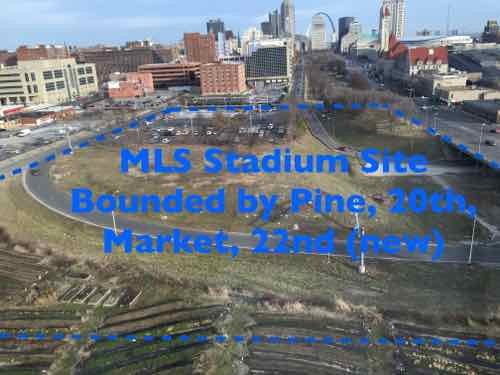
Transit-Oriented Planning Eliminates 22nd Street Interchange, Reconnects Street Grid

For years I’ve been accused of being a naive dreamer, coming up with big plans without the existing market to implement. I’ve just smiled and continued sharing my long-term vision for St. Louis.

In June 2007 I wrote:

The 22nd Street Interchange, part of an abandoned highway concept from a few decades ago, needs to be ripped out with the land returned to active tax-paying use. The Missouri Dept of Transportation (MoDOT) should rework the interchange at Jefferson Ave to allow for on/off ramps in both directions and therefore eliminating the need for the current ramps at 22nd. MoDot could sell the land to fund the revisions to the highway ramps. (St. Louis Should Abandon Linear Gateway Mall Concept)

Then in December 2008 I wrote:

I picture a new bridge at I-64/40 and Jefferson Ave — one with a single point urban interchange (SPUI) and both East & West on/off ramps. Build that and then remove the 22nd interchange completely. Bring in form-based zoning codes to require a denser urban environment. Make a strong connection through the back of Union Station (between the shed & highway) so that pedestrians from this newly developable land have the opportunity to walk to Metrolink and the 14th street transit station beyond that. The fact that much of this area is already excavated and free of utility lines would simplify the construction of underground parking in new buildings. (MoDOT Needs To Put The 22nd Street Interchange On Any Wish List For Funding)

By May 2009 I noted that St. Louis’ 22nd Street Interchange Part of McKee’s Plan so it elimination would need to be worked out with him. Presumably MoDOT agrees with McKee because they’re replacing the Jefferson bridge over I-64/40 with no plans for on/off ramps to/from the east.

Then, last month, at an St. Louis Regional Transit Oriented Development Study presentation around the Union Station & Civic Center Metrolink stations the Denver-based consulting firm suggested largely what I had outlined years earlier.

Preliminary plan around Union Station, the Drury (former YMCA) and other existing buildings should be shown in the final presentation.

Preliminary plan around Union Station, the Drury (former YMCA) and other existing buildings should be shown in the final presentation.

Ok, they still have on/off ramps for I-64/40 to the east, but they are compact and feed into the reconnected street grid I had advocated. The above image is preliminary, I pointed out it was missing buildings like the Drury Inn on 20th, formerly a YMCA and later a gay bar/hotel/bathhouse. Hopefully their final will be more accurate than the draft shown at the last meeting.

Still they see what I and others saw, the need to repair the street grid and fill in the gaps in the urban fabric.

Only part of a planned highway loop around downtown was built, a huge waste of land to the west of Union Station.

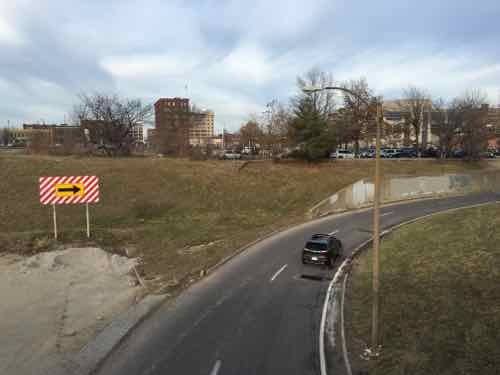
The 22nd Street interchange is just on/off ramps.

1958

1958 aerial of the area west & north of Union Station

This is not about trying to recreate the buildings and feel of the area prior to the demolition for the highway interchange. This is a forward-looking vision to create a walkable/urban environment for those interested in such. Some prefer the look & feel of new buildings, new sidewalks, new trees, etc. This is an opportunity to create an entirely new neighborhood largely from scratch yet have access to existing transit.

Per McKee’s plans, a few new employers could anchor the neighborhood. Workers & residents would attract restaurants, dry cleaners, and other services.

None of this is rocket science, it’s Urban Planning 101. St. Louis still needs lots of basics to rebuild the connections that were ripped out in the 20th Century.

– Steve Patterson

Potential Development Sites Along Proposed Streetcar Line, Part 1: Olive 15th-16th

The proposed streetcar from St. Louis’ central business district (CBD) to the Central West End (CWE) along Olive/Lindell is moving forward. Regular readers know I’m a streetcar advocate because of how it can increase development activity in a way no bus route ever can. I thought I’d take a close look at potential sites along the proposed route, starting with the area nearest my loft.

The block on the north side of Olive between 15th and 16th is nothing but two surface parking lots.

Looking west from 15th Street

Looking west from 15th Street, YMCA at right

The larger lot with entrance on 15th serves the building the occupies the block to the east. This building contains the administrative offices for the St. Louis Public Library and the Confluence High School. That building contains parking underneath as well as some surface parking within that block. The library owns the building and this surface parking lot.

The surface lot, shown above, doesn’t get much use. Once the streetcar line starts running there won’t be as much need for automobile parking, hopefully the library can sell the large surface overflow parking lot to a developer for new construction. This is currently subdivided into 4 parcels with addresses 1501 Olive, 1507 Olive, 1509-1529 Olive, and 1527 Olive with a total area of 26,964sf or 0.62 acres. See map.

The west end of the block is a smaller privately-owned public surface parking lot, legally divided into two parcels with addresses 1531-1533 Olive and 1535-1537 Olive. The total area of these two parcels is 11,676sf or 0.27 acres. Combine all six parcels owned by two entities and you have 38,640sf or 0.89 acres.

Purple is the smaller privately-owned lot, blue the lot owned by the library and the red outlines the building with library offices and charter high school.

Purple is the smaller privately-owned lot, blue the lot owned by the library and the red outlines the building with library offices and charter high school.

The only structures on this city block are The Campbell House Museum and the 10-story YMCA. The 100 upper floor apartments have been vacant for at least 5 years now, hopefully a streetcar line will get someone interested in taking on the project. Other buildings in the area range from 1-10 floors, but most are greater than 5.

A stop is highly unlikely at 15th because the streetcar line will have a major connection at 14th, but I’d like another stop at 16th or 17th.  Even if the next stop isn’t until 18th or 19th I can see this block filled in with apartments and/or condos along with new ground-floor restaurant/retail space.

– Steve Patterson

Omni Majestic Hotel Protects Pedestrian Route

In February I posted about a problem I had observed, see Bollards Needed to Protect Pedestrian Route Into Omni Majestic Hotel on Pine Street. I contacted the manager of the hotel about the problem, along with a link to my post. 

ABOVE: The problem is this leaves very little of the walkway for pedestrian use.

One of the five pics I used to illustrate the problem of vehicles parking on the pedestrian route.

I’m happy to report the hotel has corrected the situation in a very simple manner: two planters.

Two simple planters tell motorists this isn't a parking space.

Two simple planters tell motorists this isn’t a parking space.

Thank you to the Omni Majestic for taking action to protect the pedestrian route to your hotel.

– Steve Patterson

Why I Use Washington Avenue Rather Than A More Direct Route

When I leave my loft at 16th & Locust to go east into our downtown central business district I often go north to Washington Ave to head eastbound even if I plan to end up on Locust, Olive, Pine, etc. Why go out of my way rather than a more direct path? Why not just stay on Locust or go down to Olive? Here’s why…

ABOVE: The city cites "health and safety reasons" for closing the sidewalks.

Besides accessibility problems, the city has closed Locust sidewalks between 14th-15th.

blah

Olive has many accessibility issues as well, like this one between 11th & Tucker.
This photo was taken two years ago today at 6:19pm on April 20, 2011

I’ve reported the above problem but like so many others downtown it remains an obstacle.  There are blocks I avoid completely because of a lack of a curb ramp (such as SE corner of 11th & St. Charles, SE corner of 9th & St. Charles).

I’m surprised these have remained for so long.

– Steve Patterson

Five Years Since Pyramid Properties Ceased Operations

Five years ago today major St. Louis developer Pyramid Properties, led by John Steffens, collapsed, leaving a long trail of unfinished properties.  From May 2010:

City leaders and Pyramid’s former partners say the transfer of properties is remarkable given the size and scope of the properties involved and the timing of the deals in the midst of the Great Recession.

“It has worked out far better than I expected,” said Jeff Rainford, Mayor Francis Slay’s chief of staff. “The fact that people were willing to not race to the courthouse steps is the only reason this didn’t end up a total disaster.”

Instead of filing lawsuits or filing for foreclosure, many of Steffen’s lenders, investors and former partners suspended disbelief and instead participated in a workout process that began days after Pyramid closed its doors. (St. Louis Business Journal)

With the properties untangled many have since been completed by others, including, but not limited to:

ABOVE: Art display windows facing 16th Street

Leather Trades, building completed as artists apartments, shown above: art display windows facing 16th Street

The Metropolitan, now artists lofts

The Metropolitan, now artists lofts

South Grand Senior Apartments finished and occupied

South Grand Senior Apartments finished and occupied

Former Dillard's became The Laurel Apts, Embassy Suites Hotel and Robust Wine Bar

Former Dillard’s became The Laurel Apts, Embassy Suites Hotel and Robust Wine Bar

St. Louis Centre became the MX. Pi Pizzeria was the first to open.

St. Louis Centre became the MX. Pi Pizzeria was the first to open.  MX Movies, Snarf’s Sandwiches, The Collective, and Takaya New Asian have since opened for business.

One City Centre got a new entrance and a new name reflecting the address change to 600 Washington

One City Centre got a new entrance and a new name reflecting the address change to 600 Washington

The former Carter Carburetor Company headquarters building is now the Grand Center Arts Academy.

The former Carter Carburetor Company headquarters building is now the Grand Center Arts Academy.

The above properties show that even in a down economy projects can happen. Still, the future of a few other former Pyramid projects remains unclear or just getting started:

The Jefferson Arms remains vacant although different developers are trying to  put together a deal to rehab the property.

The Jefferson Arms remains vacant although different developers are trying to put together a deal to rehab the property.

The Arcade-Wright buildings

Dominium Development, the Minneapolis-based company behind the Leather Trades & Metropolitan artists loft apartments hopes to repeat the formula in the attached Arcade-Wright buildings

The Mercantile Library is now at UMSL, the former building remains vacant.

The Mercantile Library collection is now at UMSL, the former building downtown remains vacant.

River Roads Mall was razed before Pyramid collapsed, the site remains vacant. This former bank, adjacent to the mall site, also remains vacant. More on River Roads next week.

Considering how much property Pyramid had tied up in complicated financial transactions it’s remarkable what has been accomplished in the last five years. Hopefully the  remaining projects will be completed in the new few years.

– Steve Patterson

Saving Cupples 7: The Importance of Urban Context

The Cupples Station complex is historic:

Name: Cupples Station Complex

Address: 7th to llth, Clark Avenue to Poplar Street

Architectural Firm/Architect: Eames and Young

Alterations: Several of the original buildings were razed for construction of Busch Stadium and Highway 40.

Designation: City Landmark, National Register of Historic Places,

History:

After the completion of Eads Bridge and the tunnel which connected the bridge with the Union Depot railway yards, Samuel Cupples and Robert S. Brookings saw an opportunity to locate warehouses with ready rail access to the yards. Their new warehousing idea saved considerable time in freight handling and was enthusiastically adopted by the local shipping interests. The resulting large group of multi-story buildings transformed a previously useless part of the city into a highly productive area. Since all of the warehouses were not accessible by rail, they were connected by a system of tunnels and bridges. A system of hydraulic elevators was provided for vertical access. The buildings were massively constructed and made as fire resistant as was possible.

Cupples Station played a major role in maintaining the preeminence of St. Louis as a railroad center in the first half of the twentieth century.

Architecturally, the Cupples Station buildings are of national importance. Although treated in the Richardsonian Romanesque style, the buildings are strikingly modern in feeling. Rounded brick cornices and soaring arches are common features of all of the buildings and serve to unify them. Each building, however, is different from the others in detail. Originally, there were 20 buildings in the complex. (source)

More important than being historic, the remaining buildings have a nice urban feel to them.

South wall of the Cupples 7 warehouse

South wall of the Cupples 7 warehouse

Another view of the south wall

Another view of the south wall

Residents sit on their balcony in the loft building to the east (right)

Residents sit on their balcony in the loft building to the east (right)

The narrow walkway between the buildings is now closed.

The narrow walkway between the buildings is now closed.

From my post Thoughts on Cupples #7 from December 2011:

In 2000 when Bank of America owned several of the Cupples buildings a tank collapsed causing a hole in the roof of #7. The hole was known five years later when McGowan & Walsh bought three of the warehouses, including #7. They attempted to tarp over the roof, right?

Wrong, they did nothing! Water poured in a small hole in the roof for five years prior to their ownership causing structural damage to get to the point where it is today — which is mostly in the basement. They’ve been irresponsible owners for years and now they are maneuvering to blame the city if this historic structure collapses.

The city certainly has failed, I’ve had to resolve issues like peeling paint or end up in court! Where has the city been? They condemned the structure in 2008 and that then did…nothing. Everyone has been covering their own ass, but nobody has been trying to stabilize the building.

If this building collapses or is razed it will be a huge loss to the area. Walking east on Spruce St it helps from the street when you cross 11th Street (map)

– Steve Patterson

Advertisement


Recent Comments

Powered by Disqus

National Partner


Archives

Categories