Home » Homeless » Recent Articles:

Interco Plaza, An Ugly Reminder of Past Mistakes

St. Louis, like many other older industrial cities, has made numerous mistakes in the past decades. One of those is a city park, known as Interco Plaza, located at Tucker and Dr. Martin Luther King. The city’s lists of parks simply indicates it is 0.71 acres and has a single fountain. However, the fountain no longer exists. From the City Journal on May 14, 2002 I see the Board of Public voted to approve “Demolition of the High Wall of Interco Plaza Fountain, Tucker Street & Dr. Martin Luther King.”

When proposed I’m sure the artist rendering showed many people conversing around the now-removed fountain. Politicos probably wax poetically about how this new investment in the city was going to do wonders for the area as nothing else had. It may have worked, for a while. Today it stands (barely) as a relic of the brutalist concrete movement.
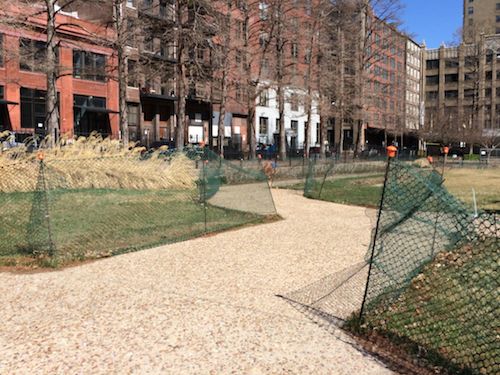
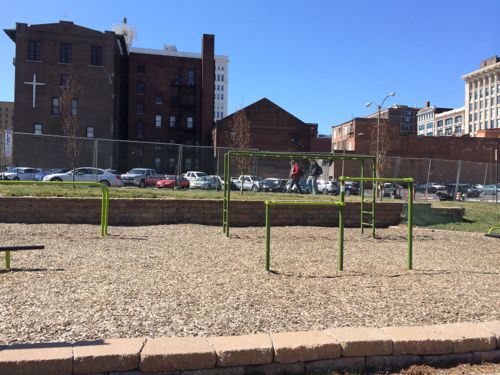
Although I had been past it hundreds of times I had never stopped and taken a closer look. On a hot day this past August, I did stop and take in the beauty of all the broken up concrete:

IMG_2188.JPG

So who is this Interco Incorporated? Their long standing name was the International Shoe Company and currently they are known as Furniture Brands. Furniture Brands is based in Clayton, in the Interco Tower which opened in 1985. Click here for a company history.

interco_plaza2

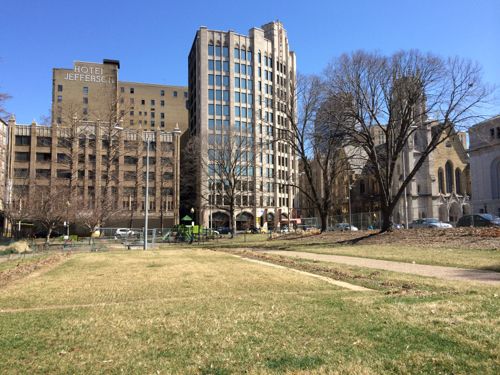
Interco Plaza is located at the SE corner of Tucker and Dr. Martin Luther King — between the St. Louis Post-Dispatch to the North, the St. Louis Public Schools HQ to the East and St. Patrick Center to the South. The balance of the area is parking. Hadley Street to the East was cut off to through traffic and Dr. King Drive between Hadley and 10th were also removed. Just as well, the Convention Center cuts off through access on Dr. King.
interco_plaza1

Getting in closer we see the Plaza before the removal of the fountain and the high wall near it. The green spaces (left & bottom) shown above are holes to the tunnel below. The balance of the green, basically the NE corner, are at grade. Still doing research but I guess that a building and basement were razed at this site and the plaza was the replacement.

A few images:

IMG_2187.JPG

IMG_2184.JPG

IMG_2176.JPG

IMG_2174.JPG

IMG_2146.JPG

IMG_2167.JPG

IMG_2164.JPG

IMG_2160.JPG

IMG_2157.JPG

IMG_2156.JPG

IMG_2155.JPG

This park is such a horrible space, even the homeless will not use it! Well, at least not the top. Homeless do use the space underneath and the tunnel under Tucker for shelter. A Post-Dispatch article from October indicated the city estimates the cost to replace Tucker (either by filling in the tunnel or building a new tunnel) will cost $30 million, they are seeking federal assistance. Unclear to me is the future of Interco Plaza.

It really needs to go away.

Does Furniture Brands still own the land under the air rights? Can we re-open the closed streets in the area? What about building an SRO (Single Room Occupancy) on a portion of the land? What will become of those living underneath?
I just watched a documentary, about the homeless in an abandoned Amtrak tunnel, filmed in the late 1990s in NYC. The film, Dark Days, was very moving. The homeless themselves were the film crew. This documentary, the first for Marc Singer, received several awards, including a couple at the Sundance Film Festival in 2000.

Here is a brief intro:
[youtube]http://www.youtube.com/watch?v=UpXHCRYXP7s[/youtube]

Like the rest of our city, we have many forgotten areas between areas being revitalized. We need to learn what we can from past mistakes such as brutal concrete plazas and resolve to reconnect and heal the entire city.


Homeless Mission Forced Out of Downtown Chicago Gets New ‘Green’ Digs by Famous Architect

Solar power, green roofs mix with dorm bunks for hundreds of homeless — a bold step toward more sustainable shelters for Chicago’s homeless. From Sunday’s Chicago Tribune:

Located at 1458 S. Canal St., the $27 million, privately funded mission is part of that move toward sustainability, as indicated by the rows of ungainly rooftop solar panels that resemble spiky hair. Its exterior is also adorned with three large signs, including a large white cross proclaiming “Jesus Saves,” which for decades advertised the mission’s former home for men at 646 S. State St. The new 152,000-square-foot building consolidates and expands the facilities in that run-down structure, which dates back to the time when Al Capone whizzed up and down South State Street, with those in a Pacific Garden building for women and children at 955 W. Grand Ave. Despite the presence of the familiar signs, the mission’s new surroundings may prove dislocating to the homeless people it serves. Its old home was within steps of transit lines as well as prospective employers. But the new site, to which city officials forced the mission to move to make way for the expansion of Jones College Prep High School alongside the old building on State, is a hefty walk from nearby transit stops. And those hikes will seem long indeed when the wind lashes the skin come December.

“It’s certainly less convenient, less centrally located,” said Ed Shurna, executive director of the Chicago Coalition for the Homeless. The city, he said, has for years been moving shelters out of downtown. The Pacific Garden Mission, Shurna added, was the last to go.

The article includes a video report on the facility — including talk of the large cafeteria, hair salon and other consolidated services near on Chicago’s near southside.

On Chicago’s near northside is a recently completed SRO designed by famed Architect Helmut Jahn, a 96-unit green building that includes wind turbines and a green roof. Last year a New York Times article indicate, “the units in the five-story building average about 300 square feet, and all are equipped with private baths and kitchenettes. Although finishes are basic, the overall feel is closer to a hip hotel than the numbing blandness one associates with subsidized housing.” At $18 million it should be nice — a cool million of that total was green features. Looking at the photos of the project it is indeed quite nice and the roof turbines are very interesting in their arrangement along the top of the roof.

St. Louis is already following the Chicago model by encouraging homeless services to locate on the fringes of downtown, rather than inside the core. I must admit, the lack of immediate transportation concerns me. Still, I’d like to the community come together and help fund a nice facility (or multiple facilities) that can provide the homeless in our society places to sleep peacefully and hopefully get the support they need (showers, laundry, etc…) so they can be fully (or at least more) self sustaining. I think we can find ways to co-mingle so long as well-intentioned suburbanites stop turning our public parks into mobile food pantries.

Homeless-Staffed Renewable Energy Center Seeks Approval for 38-Car Surface Parking Lot

Missouri Renewable Energy (MORE), operated by Larry Rice’s New Life Evangelistic Center, is seeking a zoning change to allow them to create a 38-car asphalt parking lot in the middle of a residential block. Yes, the group that “believes in caring for creation by learning, teaching, and implementing clean energy (solar, wind, and water power, biodiesel), environmentally friendly housing structures, going organic, and consuming less” wants to put down a big chunk of paving among a residential neighborhood (see map).

IMG_3524.JPGFrom where I stand it would seem that creating large paved parking in the midst of residential areas is not exactly “caring for creation.” Before getting into the zoning specifics of the proposed parking area, we need to look at how we got to this point.
For decades the area in question was part of Held Florist and Nursery. The commercial building was built in the 1950s and had been used continuously as a florist since that time. However, a few years ago it stopped being used commercially and sat vacant. For decades this business had been grandfathered in — what is more technically known as a “non-conforming use.” That is, the use (commercial) doesn’t fit in with the zoning for the area (residential). But you can’t just tell a business they must close up shop when you change zoning so existing places became grandfathered in. And to permit someone to sell their property as a commercial entity the city allows that such non-conforming use can continue provided the property doesn’t go vacant for a period of greater than 12 months. But once the non-conforming use lapses for a period of 12 months the grandfather provision goes away and the zoning reverts to whatever it is for the area. Someone purchasing real estate anywhere needs to understand this very basic concept and exercise due diligence before assuming they can do as they please. Perhaps Mr. Rice got bad legal advice on this purchase?

All over the city we do have commercial properties that are in the midst of residential areas. We can’t very well expect these all to be converted to residential or razed to build residential. This small commercial building with greenhouse does have value which should be permitted to be used. But this doesn’t mean that someone can buy the building and do as they please. A nightclub, for an extreme example, in an old greenhouse could be pretty cool but not the most ideal in the middle of a residential street. The florist shop brought virtually no traffic to the area — most business was deliveries. Any enterprise that can potentially overload a residential block, as opposed to a commercial block, with too many cars at a very specific time is something which should only be permitted in extremely rare cases. I don’t think this is one.

Let’s take a look at what is proposed. The following plan was distributed by Larry Rice at City Hall a couple of weeks ago when he was to have a hearing on his request for rezoning. That decision has been delayed until October 18th which allows for a public meeting on the issue — to be held tonight (more info at the end).

nlec_site

The buildings shown on the plan are all existing. The area marked “demonstration area” is a greenhouse from the many decades as a neighborhood florist and nursery. The asphalt parking lot, however, is new. In fact, the only structures ever built on this land were some makeshift greenhouses. To the left is this site is the two-family building I owned from 1994-2006. Residential properties surround this in all directions.

For a moment let’s focus on the parking lot. Given the few “energy fairs” already conducted by Rice at this site it is clear they are a big draw — the street gets packed with cars of people visiting the site. But do we really want a 90ft x 113ft section of asphalt to handle cars once a month? This is certainly not very environmentally friendly.

And what about those dimensions? Rice shows 38 spaces, certainly a lot of cars. But does this work? Well, no it does not. City ordinances and common sense require certain sizes for parking spaces (view zoning code). For 90-degree spaces they need to be eight and a half feet wide and eighteen feet deep. In terms of width the idea works so far — 10 spaces across the back only requires 85 feet. But it is the other direction where we run into issues. The plan shows four rows of cars — four times eighteen is 72ft. OK, good so far but in order to do this he needs two drive lanes to actually access the parking. The city says drive lanes must be 22ft wide — each. So you add another 44ft onto our 72ft and now you are at 116ft. This doesn’t even account for required landscaping or accessible parking spaces.

The depth of the lots in this block are 142ft-6inches. Let’s say 143ft just to make it easier to discuss. So we’ve got 143ft from the sidewalk to the alley — the depth of the lot. To get his parking in there you need 116ft — leaving only 27ft. Well, the old frame house the Preservation Board (thankfully) says cannot be torn down is set a good 10ft or so back already and is likely close to 20ft deep itself. Basically, Rice’s plan doesn’t work — he is showing a paved area set at the back of the lot far from the street but the reality is to accommodate 38 cars he’d need to pave pretty much the entire section of open land — including where the frame house is located.

To complicate matters even further, a new parking lot in a residential area requires setbacks from the property lines — you cannot just pave up to neighboring property or the alley. Rice is showing 3ft at the back but nothing on the north side (to the left). Also not show is how he plans to address water run off issues — how will the parking lot be drained. Will this cause more water runoff to the neighboring property to the left? Will this cause more water to run down the alley? What is the anticipated flow of water in a storm and can existing sewers/drains handle this increased volume? These are all normal considerations when considering such a massive parking area.

In July a developer was seeking to build three houses on the land where Rice seeks his asphalt parking lot. The Preservation Board told them the old house could not be razed. They quickly sold the property to Rice. So what was his plan for his center if the new houses had been built?

For an organization that purports to be supportive of the environment to propose an asphalt parking lot is certainly a bit questionable. Water run off, as opposed to ground absorption, is an issue as is the heat island affect. Truly environmentally friendly places have pervious parking such as paving blocks or the block grid that allows you to grow grass through the paving — both allow rainwater to be absorbed into the ground. The latter doesn’t contribute to heat island issues. Impervious surfaces like asphalt and concrete are part of our environmental problem.

Some people I’ve talked to are concerned about the homeless or formerly homeless that will staff the place. I’m not concerned so much as I am puzzled. The concept is to train these individuals for jobs in the growing energy field but that seems far fetched. From a Post-Dispatch editorial from the 2nd:

We also question the wisdom of training the homeless for these sorts of jobs. “We are an agency that places 1,000 [homeless] people a year, and I’ve never heard of a placement in renewable fuels,” says Dan Buck, chief executive at the St. Patrick Center, which operates a wide range of training programs for homeless people. They are much more likely to find work, Mr. Buck notes, in restaurants, call centers, building maintenance and the like.

So while the idea of training the homeless for a career in alternative energy is appealing, I’m just not sure how practical it really is. While there certainly are exceptions, many of the homeless are not the best educated. I wonder what the extent of the training program really is? Will these persons receive any pay? How does this fit with labor laws?

IMG_1857.JPG

And what about the production of biodiesel at the site? Rice mentions the use of waste vegetable oil being converted to use as fuel in diesel cars like his Volkswagen Jetta TDI, shown above, on the residential block where he seeks zoning approval. So my question would be what quantities of fuel might they be making at this site? Just a few drops here and there during his fairs? Or will he have free homeless labor churning out the fuel to keep his ride going? Is there a point where the making of fuel for personal use differs from the the manufacturing of fuel for the market — involving state regulation and conditions conducive to the production of motor fuels? We already have meth labs blowing up, do we need experimental biodiesel manufacturing facilities doing the same?

IMG_3647.JPG copyRice has intimated that if he doesn’t get his zoning he will want to use the area to house the homeless. Nice. Of course as part of the “B” two family zoning district there are numerous guidelines that, if actually followed, would make it difficult to run a shelter on the order of the one he has downtown. Even transitional housing, something the city does need, would have to conform with the zoning code.

Publicly there seems to be very little opposition to the energy center, the zoning changes and even the parking lot. The most visible opposition comes from the gas station a block away at Grand & Delor (see photo at right). The 25th Ward Alderman (whom I lost to in March 2005 by 117 votes), Dorothy Kirner, has reportedly written a letter of support for the project. This is interesting as she earlier opposed a parking lot for the exact same site when a Muslim church on Grand owned the land. Did Kirner apply a double standard?

Local neighborhood groups are taking a Swedish like position — publicly neutral. Privately many in the immediate area as well as throughout south city are more than a bit upset.
An informational meeting with a chance for public questions/comments is scheduled for this evening. Given all the issues and personalities at play this is a must see in my view. The meeting will be held at 7pm at Gretchen’s Inn — the one-story place behind the Feasting Fox on the corner of Grand & Meramec (see map).

I’m not in favor of large surface parking lots anywhere. I’m certainly not a fan of them on otherwise residential blocks. The parking lot should not be allowed regardless of any issues around the homeless, Larry Rice or the intended use of the property. This is just not a wise move to allow a parking lot in such an area.

Prior posts:

Note: Headline changed at 10:25am from “Homeless-Run…” to “Homeless-Staffed” to more correctly reflect the stated intent.

“Two Hours of Pushin’ Broom Buys an Eight by Twelve Four-Bit Room”

September 5, 2007 Downtown, Homeless 16 Comments

The times Roger Miller wrote about in his classic song, King of the Road, are long gone.

Trailers for sale or rent
Rooms to let…fifty cents.
No phone, no pool, no pets
I ain’t got no cigarettes
Ah, but..two hours of pushin’ broom
Buys an eight by twelve four-bit room
I’m a man of means by no means
King of the road.

Miller wrote King of the Road in 1965 at the age of 29. Using an online inflation calculator I found that $0.50 (aka four bits) in 1965 is equal to $3.14 in 2006 dollars. In 1965 you may not have been able to get a room for such a rate but the point is that today it is likely harder to find a cheap room for a couple hours of work. I checked St. Louis area room rates on some online sources and the best deal I could find is $45/night — if you are able to drive there. Ninety 360 bits plus tax. I’m sure cheaper places exist but you’ll likely need a credit card to check in.

Miller, born during the Great Depression, grew up in the next county over my father in very rural Western Oklahoma. My father was born seven years earlier in 1929. My dad rented a room briefly in the late 40s until he and my mom got married after she graduated from high school. These were the dust bowl days with families packing up and leaving for greener pastures further west. In these years and later you always had mostly single men that were drifters, vagabonds, and such — traveling from town to town working jobs here and there to get by.

Interestingly, one of the great names of St. Louis has just such a history: former St. Louis Mayor A.J. Cervantes. Cervantes, born on the city’s south side in 1920, became mayor in 1965 as Miller’s song was hitting the charts. Cervantes’ 1974 book “Mr. Mayor” talks about growing up in St. Louis, getting kicked out of St. Louis University High School and hitch hiking toward California “with a quarter and a few dimes in my pocket”. He continues:

Thumbing my way through the Dust Bowl offered few hardships. Motorists were usually friendly to a neatly dressed teen-age hitchhiker, and aside from suspicious farm wives in rural Arkansas, enough housewives who responded to my knock on the back door were ready to trade a meal for cutting the grass or some other odd job. I learned other tricks, too. A firehouse usually offered a place to sleep, and sometimes a meal as well. Firemen seemed always ready to interrupt a card game for a few words with a young wayfarer. And if all else failed I could always try the parish house next to the church.
Cervantes made it as far as Dallas but it was only a few months before he was back with his family on Juniata St. The next spring, however, he would venture out on his own again as he had had his “first taste of freedom.” Cervantes talks about hopping on freight cars and how they’d stop the train sometimes to toss off the free loaders — he describes learning to “ride the suspension rods underneath the cars – a dirty, precarious business. When I was sneaking rides over the Rockies in unheated boxcars, I used to wrap myself in newspapers to keep warm.

Cervantes, a 2-term Mayor of our city, had lived for a brief time as a homeless drifter trying to find his way. Eventually he did find his way to a mansion on a private street and to Room 200 at City Hall. A future mayor may not be among our homeless today but you just never really know who is out there.

Rooms to let…fifty cents.
No phone, no pool, no pets

In those days rooms were plentiful and available throughout every major and minor city. Ironically our efforts to provide better housing cleared many of these places located on skid row. The arch grounds, 40 city blocks cleared. East of Soulard, cleared. Blocks along Market near Union Station — all cleared. The free market naturally provided housing at many price ranges, including two bits. But by the time Miller’s song became popular many of the rooms were gone. But one type still existed, the rooming house.

Former mansions had been cut up into apartments of varying quality . Sometimes people would share a single bathroom and kitchen. Codes required fire escapes, many can still be seen today. Cities were naturally responding to market conditions, providing housing that people needed. Many a beautiful staircase, for example, were ripped out to be replaced with a wall to create separate units. The wealthier continued to move out of their once fashionable mansions to new digs on the edge — not really caring about what they left behind.

But in popular culture we could also see the old mansion divided up into apartments as something cool and modern. The perfect place for a single gal at age 30: Mary Richards. Mary Tyler Moore’s character lived in a former mansion turned apartments. Cloris Leachman played Moore’s landlady — at least the building was owner occupied, right? Some rooming houses still exist but they are very hard to find. Do you think any respectable associate producer for a local TV station would live in such an apartment? Getting permission to rehab an existing rooming house is not likely given today’s climate of people only wanting neighbors just like themselves.

IMG_2659.JPG Today few choices exist for those seeking the four-bit room. Downtown’s Mark Twain Hotel is one such choice, an old fashioned residential hotel (pictured at right). I called them earlier in the week to ask about rates, terms and availability. Rates start at $113/week for a room, $118/week for room with a bath (others have shared baths), a $50 deposit and $15 application fee for a background check — no felonies in the last 3 years and no drug convictions in the last 7 years. Doing the math you’ll see that someone could rent an apartment for what it takes to live at the Mark Twain but leasing an apartment usually requires a steady job, good credit, a 12-month lease and the ability to get utilities. For those on the edge of being homeless, the cheap residential hotel rented by the week is an excellent option to keep them out of the parks & shelters. When I called the Mark Twain all 238 rooms were full.

The new term for the residential hotel is the SRO — single room occupancy. The idea is to rent a room to someone at a very low rate. Hostels are similar although they usually serve a somewhat different clientele. Like the tiny cold water flat and rooms of the past, we’ve razed or otherwise done away with buildings that once served a useful need to a segment of the population. Other cities, working on real solutions to homelessness, are building new SROs. Having a place where someone working can put their few possessions and have a good night’s sleep is an important part of a city’s housing mix. St. Louis, like most cities, have unknowingly eliminated a housing option that would keep many homeless from being homeless.

We need to increase our housing options for the working poor. This doesn’t mean a hand out, just not forcing out viable choices via zoning or other methods. To me it is in our best interests to catch people with such housing on the way down — a far better way to solve the problem than pulling them up from park benches after several years on the streets. For more on this subject read a piece called A Place in the Sun written a few years ago by my friend Robert E. Lipscomb.

Downtown Reverend Speaks Up on Feeding the Homeless in Public Parks

September 5, 2007 Downtown, Guest, Homeless, Religion 23 Comments

A guest editorial by Rev. Karen Fields:

Over the past year or so, I have been a part of the St. Louis Downtown Residents Association’s meetings that have focused on the safety issues that face those who have chosen to make downtown their home. Recently, I attended a similar meeting convened by Alderman Kacie Starr Triplett. As a clergyperson whose church has opened the doors to the homeless, I went to these meetings already on the defensive. I had an idea of how the residents might feel about the population that walks through our doors everyday looking for a meal, a restroom, or a phone. I knew that they didn’t know me, my motivation, our program, or even very much about the people we serve. I didn’t say much at these meetings. I wanted to assess the prevailing sentiment.

I have to admit that I did hear some of what I went expecting to hear. I heard the voices that said that the presence of the homeless in the parks and on the streets was hurting their property values. I heard the voices that said that there needed to be more security measures in place to protect residents and their investments. But I have to also admit that these voices were dwarfed by the voices of those who were looking for safety and security for all downtown residents, not just the ones sleeping in a loft. There was evidence of compassion for those with whom they share their neighborhood. It is hard, however, to hold compassion and the desire for safety and security in tension; especially when you have compassion for those whom you feel threaten your safety and security. It was obvious that it is in that tension that most of the St. Louis downtown residents live.

None of the homeless service providers created homelessness nor did they bring homelessness to downtown St. Louis. This population was downtown long before the first developer decided to invest in gentrification. They made their homes in abandoned warehouses, in tunnels under the city, in the parks, and along the riverbank, long before the warehouses were reclaimed for profit or there were pets to walk in the parks. The service providers responded to a human need that existed. They are still responding to human need.

Working with this population, I have learned a great deal about the human condition. There is no one definition of the characteristics of a homeless person. Stereotypes are as wrong for them as they are for any other minority. I have learned that they are a microcosm of the larger society from which we all come. Just like in any neighborhood across the metro area, some of the members of the homeless population are extremely intelligent. Some are intellectually challenged. Some are creative and artsy. Some are linear and analytical. Some need to be on medications to maintain a balanced temperament. Some are diabetic. Some have high blood pressure. Some have families that love them. Some are estranged from their past. Some have criminal tendencies. Some try to be model citizens. Not one wants to be a failure. Not one dreamed of someday living on the streets. Not one of them wants to be invisible. All of them want to love and be loved. Not all of them know how.

As part of the neighborhood, Centenary Church decided two years ago that we have a responsibility to step into the tension and become part of the solution. No matter how well intended a suburban group might be, it is not a safe and healthy practice to feed people in our parks. There is no control over how the food is prepared, served, or disposed of. The homeless population risks illness and the parks suffer from trash and rodents. Centenary has a large dining hall with an inspected kitchen and lots of trash cans.

No matter how much downtown residents and business owners dislike the problem of public urination, the fact remains that there are few public restrooms available for a homeless person to take care of this most basic human need. Centenary is in the process of completing the construction of new public restrooms that will be available for anyone’s use. It is the hope that in the near future, we might be able to acquire the funds necessary to also offer showers.

No matter how hospitable the library is to the homeless population, most are not using it for the purpose for which a library is intended. Centenary will be open from breakfast to dinner most days, so that the homeless have a place of respite from the elements – to get in out of the rain or snow or to escape the heat, a place to get a cold drink of water or a hot cup of coffee, a place to rest feet or wait for an appointment.

I have heard rumor that some have said that we are nothing more than a City-sponsored Methodist jail. I have been asked how I feel about the City requiring people to join Centenary in serving evening meals or they will be ticketed. Neither one of these accusations could be further from the truth. Centenary Church has opened its doors to help ease the tension and help find ways that diversity can co-exist. Nobody is required to join us “or else.” Nobody is being forced to spend their day in our building.

The re-development of downtown St. Louis is exciting. Dry bones are beginning to come to life. Downtown living offers something that can be found no place else. Centenary Church has been a downtown church since 1839. It has chosen twice in its history to remain a downtown church; even as other churches have packed up and moved west. It did not go to the suburbs and decide to move back downtown. It has always been here. Centenary knows what a great place downtown St. Louis can be and is committed to being a place of hospitality and grace to all of the residents of the neighborhood.

At the last meeting I attended, the question was asked about what people could do “right now” to address the issues that homelessness causes for the community. I said it then, and I will say it again. Come join us at Centenary. Help us build bathrooms. Help us provide a safe place to eat. Come help us serve a meal. Come have a conversation with one of your neighbors. You might find that they are more human than you thought.

Reverend Fields is an Associate Pastor with Centenary United Methodist Church located at 1610 Olive and is the Program Director of Centenary CARES. For more information go to centenarystl.org. To volunteer time and/or money please contact Rev. Fields at 314.421.3136 ext. 106 or k.fields at centenarystl dot org.

New Signs for Gym Loom Over Sidewalk in St. Louis’ Loft District; Downtown Talk on Homeless

New businesses, such as gyms, are welcomed additions to loft districts such as the vibrant area in the 1300 block of Washington Ave in downtown St. Louis. We’ve seen some really great new signs of late at places such as Windows on Washington, The Dubliner, The Gelateria, Red and so on. St. Louis’ sign ordinance is about as modern as our 1947 zoning code so pretty much anything except uniform letters on the ends of boring awnings requires a variance. I’m quite pleased the city has worked with so many local businesses to allow the interesting variety of quality new signs.

But when it comes to the new signs at The Fitness Factory I am just scratching my head to think how anyone thought this was a good idea:

IMG_0693.JPG

From the above angle you can’t even see the interesting sign for Flannery’s neighborhood pub to the west of the Fitness Factory.

IMG_0692.JPG

To make matters worse, these are a matching pair!
IMG_0695.JPG

From the opposite view, in front of Flannery’s, you can see the sign’s relationship to the buildings and sidewalk.

IMG_0699.JPG

While the vinyl makes them look temporary (and cheap) the securing hardware makes them look more permanent. If I lived in the 2nd floor loft next door I’d be more than a tad upset about having my view up the street blocked to such an extent.

Ald. Kacie TriplettI’m going to see if Ald. Kacie Triplett (D-6th), shown at right, can take a look at these in person before her Downtown Talk on the homeless which starts at 7pm Monday August 13, 2007 at the beautiful St. Louis Central Library.

UPDATE 8/14/07 @ 7:30am:

The banners/signs for Fitness Factory are gone as one of the comments below indicates.  This was not due to my argument against them but the storm that passed through town in the hours before I posted this.

Last night’s talk was very good.  We didn’t really accomplish a whole lot other than have a pretty open and frank discussion about the needs of the homeless vs the quality of life for residents — but that is a huge step forward.  Hats off to Ald. Triplett for handling such a controversial topic so well.

Book Review; “Down Town, True Tales of Trial & Triumph on the Mean Streets” by Robert E. Lipscomb

I’ve never been homeless and hope that is the case throughout my life but one should never assume they will never be in that situation. Author Robert Lipscomb takes the reader through his journey from the good life (penthouse apartment overlooking Forest Park) to, at 51, living homeless living in various shelters downtown.
After talking with a priest at the suburban church where his father was a founding member, Lipscomb prepares to be homeless:

“I’m heading into society’s version of Hell, called poverty and invisibility. The living ghost existence. But I am encouraged. I feel stronger than I have felt in a very long time. As I have virtually nothing, how can this be? Choosing not to examine this too closely right now, I begin selecting which items can fit in my backpack, which will contain the sum total of my earthly possessions for the future to come.”

Lipscomb’s strength turns to fear and anger and back to strength through his “adventure” on the streets. Along the way we learn how the “normal” homeless make fun of the ones who are crazy, the best wearing brand of shoes, and where to get a meal. Lipscomb’s writing was very engrossing, making me want to continue through to the end without a break.

Down Town is preachy only to the extent of the importance of “God” to Lipscomb, a perfectly reasonable expectation given the circumstances. The book’s intent is not to make those of us with homes feel guilty so that we give to charities. Furthermore, the book does not make out the homeless to be a homogeneous society we should all pity. Instead, Lipscomb shares his experiences and mindset as he goes from being new on the streets to being more seasoned.

Lipscomb also talks about What’s Up Magazine, the street newspaper sold by homeless to raise money, and its program director Jay Swoboda. Swoboda, if the name sounds familiar to you, is the main person behind the EcoUrban modular green housing project. Lipscomb was an original writer & vendor for What’s Up when Swoboda started it.

There were many times in the book where I could not keep from getting watery eyes. This book is an emotional roller coaster ride — a ride all of us would just as soon never experience in person.

I don’t want to give away any more information but I do highly recommend this book. You can order the book directly from Lipscomb at Eagle’s View Press, I bought my copy at local independent Left Bank Books. Or if you must, Amazon.

Advertisement


Weekly Poll (new each Sunday)

Recent Comments

Powered by Disqus

National Partner


Archives

Categories

order Crestor no visa want to buy Crestor in malaysia fedex buspar without priscription where buy Prednisone buy Bupropion on line amex Zithromax online no prescription buy cheap Xenical on line Valtrex online buy saturday delivery buy Amitriptyline online now prednisone overnight us delivery order Valtrex pay pal online without rx prednisone without rx medications free Valtrex get prednisone order Valacyclovir online xenical ups fedex shipping Flomax precio buy Flomax money buy order no online rx Flomax buy generic Orlistat prednisone mastercard purchase Nizoral no prescription cheap order Flomax usa cod buy Flomax with a mastercard order Strattera online with overnight delivery buy Cytotec without a perscription buy prednisone without a prescription or membership rizatriptan rx cheap where can i buy herbal Cytotec purchase online Strattera without prescription buy in Orlistat uk purchase online prescription Valacyclovir buy no online rx Donepezil buy non prescription drugs generic valtrex next day delivery on Crestor saturday Amitriptyline no prescription to buy best buy Valtrex buy finpecia online overseas purchase cheap online prednisone purchase Prednisone without prescription to ship overnight prednisone 40 mg without a prescription order no prescription Valtrex buy valtrex free consultation purchase Valtrex without buy Prednisone cash on delivery uk buy Prednisone where can i buy Proscar without prescription order valtrex usa maxalt order on line buy Cytotec without doctor buy rx Cytotec without Cytotec no physicisn consult buy Flomax cheap online xenical non perscription xenical overnight without rx order cheap overnight Xenical how to purchase Prednisone online without a prescription overnight delivery of prednisone purchase Buspar cod overnight delivery Orlistat cheap Flomax ohne rezept purchase Accutane amex online without rx buy Maxalt online Accutane pharmacy Accutane online prescription Valtrex what is Zithromax finpecia without rx medications buy no online rx Valacyclovir buying Valtrex order valtrex no prescription buy in Flomax uk buy valtrex without prescription australia purchase Accutane without a rx online cheap Zovirax uk Buspar purchase Zithromax by mail xenical non prescription for next day delivery purchase Zithromax pay pal online without prescription uk Premarin cheap order Premarin no visa without rx buy Accutane without rx from us pharmacy no prescription needed xenical xenical no script required express delivery Xenical best buy where to buy Xenical online purchase Flomax without prescription purchase Orlistat online no prescriptions needed for Accutane Valtrex online order cheap online pharmacy for prednisone free fedex delivery Flomax prednisone cheap overnight fedex buy next day Crestor how to get xenical without purchase Zithromax online purchase xenical free consultation buy Crestor on line without a rx purchase Amitriptyline pay pal online without rx fedex Xenical overnight without a rx buy Orlistat online cheap online prescriptions xenical buy Premarin usa order Zithromax cheap overnight discount Zithromax buy Nizoral no rx purchase prednisone prescription online buy valtrex with no prescription order generic Buspar Flomax buy Orlistat c o d canada Zovirax purchase Crestor pay pal online without prescription order Accutane no visa without rx buy Flomax us prednisone with consult Buspar online purchase purchase Zithromax amex online without prescription buy online rx Accutane without order overnight Crestor purchase Tamsulosin pay pal without rx where to buy Flomax without a prescription purchase Crestor no scams proscar cheap overnight fedex Valtrex online no rx overnight buy generic Valtrex pills buy Amitriptyline with american express want to buy Valtrex in malaysia Crestor no prescription to buy purchase Valtrex paypal without prescription purchase rx Crestor without purchase Premarin pay pal online without prescription order Accutane online next day delivery Prednisone fedex no prescription generic Orlistat uk xenical cheapest place to order buying accutane online without prescription Valtrex online Orlistat from india buy genuine Orlistat online buy Rosuvastatin with american express Cytotec without a perscription cheap Cytotec with no perscription overnight shipping buy Cytotec online without a prescription purchasing prednisone with overnight delivery how to get a xenical prescription where can i buy herbal Buspar how to order Zithromax online without prescription where can i purchase Zithromax no rx buy Buspar with visa purchase Buspar no prescription cheap buy Valtrex ukbuy Valtrex amex online without rx buy generic finpecia online purchase finpecia overnight cheap generic Orlistat where to purchase generic Prednisone online without a rx order cheapest online Buspar buy line Orlistat online prescription Valtrex buy Proscar cheap online purchase Cytotec thyroxine no scams buy Valtrex online cod best Buspar online pill