Home » Urban Renewal » Recent Articles:

Four Decades Since First Demolition At Pruitt-Igoe

Forty years ago today the first of Pruitt-Igoe’s 33 high rise towers was leveled by implosion. Today most of the site remains vacant and overgrown.

ABOVE: The steeples of St. Stanislaus Kostka are visible through the overgrowth on the former Pruitt-Igoe site.

I first walked the site over 20 years ago, it was easier to traverse in 1991. Amazing the site can sit vacant for a longer period than the buildings did.

Here are a couple of short videos you might find interesting:

httpv://www.youtube.com/watch?v=jYrMUcT1jP4

httpv://www.youtube.com/watch?v=kVpN6Wl7Qm0

 Hopefully in the next four decades we will see the site be redeveloped and occupied again.

- Steve Patterson

The Last Public Housing Complex Tower in St. Louis

Decades ago many high rise public housing towers existed in numerous large scale public housing projects in St. Louis. The most infamous were the Wendell Oliver Pruitt and William L. Igoe Homes, better known simply as Pruitt-Igoe. Friday marks the 40th anniversary of the demolition of the first of its 33 buildings.

ABOVE: The Darst-Webbe towers on the near south side circa 1990-91, razed

ABOVE: The last Vaughn tower being razed in October 2006

ABOVE: The last tower from Cochran Gardens was razed in 2011

In the Fall it was announced the last of four towers at the former Blumeyer complex would be razed after new low-rise housing is built:

The federal Department of Housing and Urban Development has awarded the city of St. Louis $7.8 million to help redevelop the area around the city’s last public housing tower for families. (St. Louis Public Radio)

The last tower was part of the Blumeyer complex.

ABOVE: Blumeyer Elderly Apartments being prepped for demolition, October 2006

ABOVE: Low-rise & high-rise buildings at Blumeyer before being razed, October 2006

By the time Blumeyer was built in 1967 problems were becoming clear at older public housing complexes such as Cochran Gardens and Pruitt-Igoe. The latter only had high rise towers but the former had  a mix of low-rise and high rise buildings. Blumeyer had just four towers, not grouped together.

ABOVE: Blumeyer Elderly Apartments, January 2007

Growing up in a largely white middle-class area of suburban Oklahoma City the closest I’d come to a high-rise public housing tower was watching Good Times (1974-79).I knew I had to see this last complex tower — completed the year I was born. The last tower is located at 3501 Franklin.

ABOVE: Looking east across Grand at the last Blumeyer tower

ABOVE: 3501 Franklin approached from Franklin & Theresa

ABOVE: Looking north on Theresa from Franklin

ABOVE: The NE corner of the tower

ABOVE: Looking north at the west side of the tower

ABOVE: Walled courtyard, unfurnished, on the south end of the tower

ABOVE: The building is full but the directory is empty

ABOVE: Looking north from the lobby toward the management office

ABOVE: The only community space is the laundry room

ABOVE: Hallway on an upper floor

Management was unable to show me an apartment, they don’t have a display. I was able to talk a young man to show me the 2-bedroom apartment where he lives with his family. The apartment was small but clean, nothing fancy. Good storage. I wish I had written down his name to thank him for allowing me in his place.

A few other high rise public housing towers remain in the city but those weren’t part of larger complexes that have been rebuilt under the federal Hope VI program.

- Steve Patterson

Agree or Disagree: Biondi has destroyed the formerly urban midtown area around the Saint Louis University campus

In July 1978 the Midtown Historic District (large PDF) became part of the National Register of Historic Places. The entire area was very rundown at the time, numerous buildings were vacant or nearly vacant. The St Louis Symphony Orchestra moved into the former Powell Theater in the late 60s but that didn’t spur redevelopment of the area.

ABOVE: Fox Theater July 1977; Source: National Register nomination linked above

The Fox Theater was a mess at the time:

On a cold January morning in 1981 Leon and Mary Strauss first saw the Fox Theatre. With the aid of flashlights and one working light bulb, the Strausses discovered the hidden magic of the splendid theatre beneath the dirt and grime of 52 years. It was love at first sight and the rest is St. Louis history. Banding together as Fox Associates, Leon Strauss, Robert Baudendistel, Dennis McDaniel and Harvey Harris privately purchased the movie palace from the Arthur family. With Mary Strauss as director of restoration, there began a one year, $2 million plus restoration program under the aegis of Pantheon Construction Company. (Fox Theater)

ABOVE: Fox Theater June 2007

Some saw the great potential of midtown but others saw vacant buildings instead of the expansive grass so common in the suburbs. Saint Louis University President Lawrence Biondi was one of those who didn’t get it then and still doesn’t today.

Since his inauguration in 1987, Father Biondi has led Saint Louis University through a remarkable era of transformation and achievement. In addition to modernizing the campus and helping revitalize the surrounding Midtown neighborhood, Father Biondi has committed vast University resources to academics, student scholarships and financial aid, faculty research and state-of-the-art technology. (Saint Louis University)

ABOVE: Map from National Register nomination, the Fox is the large black rectangle

North of Olive St thankfully was beyond Biondi’s grasp but south of Olive St didn’t stand a chance. Six buildings listed in 1977 as having “neighborhood significance” where “demolition would be a major cultural loss” are gone. A seventh had “architectural merit — demolition would diminish the integrity of the neighborhood.”

Sadly this concentration of urban buildings was razed, the land is now parking and grass.

ABOVE: SLU razed the urban building on the NE corner of Grand & Lindell. Image saved from internet in 2007, source unknown

The Marina building stood on the NE corner of Grand & Lindell (aerial) for decades, from the National Register nomination:

The 1907 red brick and terra cotta Marina building at the northeast corner of Grand and Lindell has been subjected to similar alterations. The oldest commercial structure in the district, the pattern of arched window openings at second floor level draw the eye and define one corner of the major intersection of the district. 

This building would have been a great anchor for that corner had it been rehabbed. Sure it was an eyesore with the bad storefronts that had been built over the years.

ABOVE: Marina building in August 1977 with a Jesuit hall and Continental buildings in the background

ABOVE: The once vibrant urban street corner is now a passive hole in the city

The southeast corner was also urban but not included in the historic district because of unfortunate  alterations to the corner structure:

On the southwest [sic] corner of the same intersection, SLU bought a bank building (that was a historic structure hidden under a layer of plain stucco) and demolished it for a lifeless plaza and fountain. (VanishingSTL)

I remember that bank — I opened my first checking account there in 1990. Midtown was great — was.

ABOVE: SE corner of Grand & Lindell now

In an urban setting grass, trees & water can’t substitute for the massing a building gives by defining the urban space.

Some act like demolition is the only answer to a tired urban area. A few blocks north was just as seedy but there buildings were saved and renovated. The now celebrated Washington Ave loft district was a ghost town of old warehouses — Biondi’s solution would have been parking lots & grass. Demolition was the failed 1950s “urban renewal” solution.

Biondi is a current day Robert Moses, the sooner he retires the sooner we can begin to reurbanize midtown and undo the damage he’s inflicted on this section of St. Louis.  The poll is in the right sidebar (not visible on the mobile layout).

- Steve Patterson

Readers OK With Cardinals 1966 Move Away From Sportsman’s Park

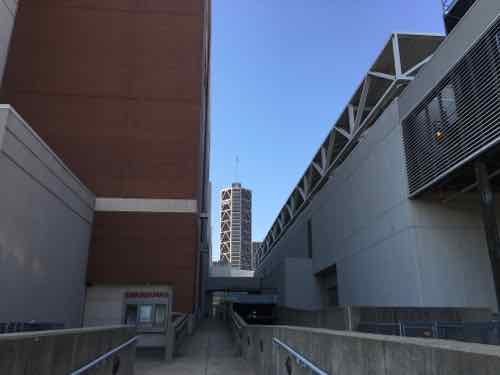
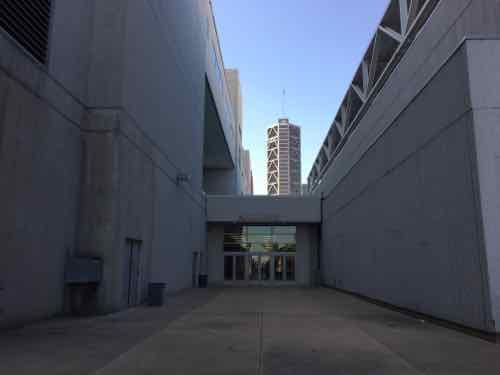
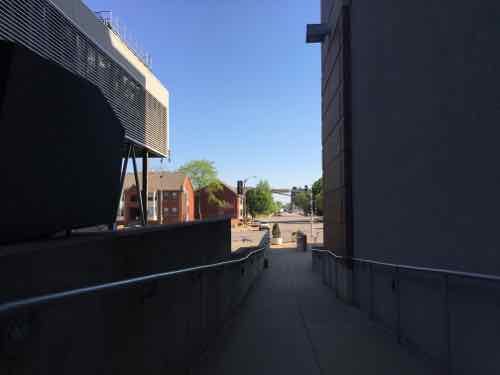
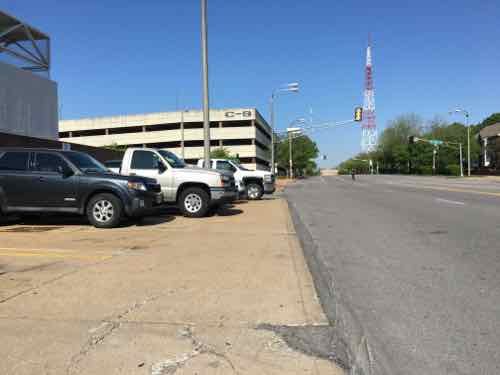
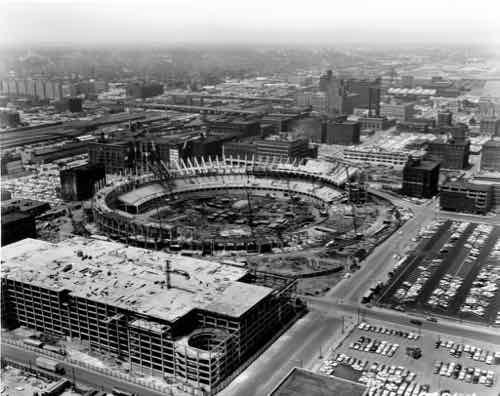
ABOVE: massive parking garages and a walkway are all that remain from the 60s era Busch II.

Last week readers weighed in on their thoughts on the 1966 relocation of the former Sportsman’s Park.  The single answer with the most responses goes along with my thought the Cardinals should have rebuilt rather than move downtown, but looking at all the answers it is clear readers support the move:

  1. A great neighborhood ballpark, the Cardinals should have rebuilt at Dodier & Grand 23 [25%]
  2. No opinion 15 [16.3%]
  3. No choice but to move: the area was changing fast. 15 [16.3%]
  4. Like people would have continued going to North St. Louis for a Cards game 14 [15.22%]
  5. No choice but to move: too little parking and the streetcar line was replaced with buses in 1960. 10 [10.87%]
  6. Other answer… 9 [9.78%]
  7. A good neighborhood ballpark but it was no Wrigley Field 6 [6.52%]

It is the nine other answers provided by readers I find interesting:

  1. How is this relevant to anyone?
  2. A great ballpark that would’ve helped a great neighborhood evolve.
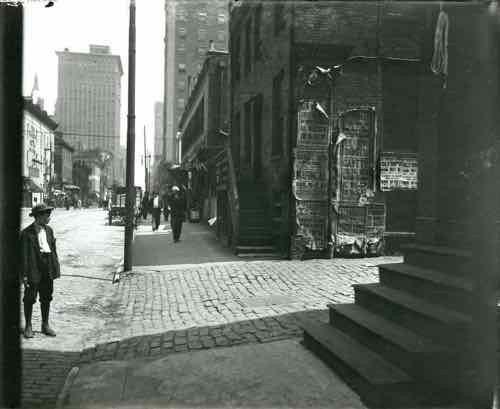
  3. Cards set a popular trend moving downtown, too bad about Hop Alley though.
  4. moving was part of a larger plan to destroy the northside
  5. Looks like a great ballpark!
  6. Best move ever, Busch II was a great stadium.
  7. Why not look to the future? Use the space for something great for the city.
  8. By buliding the new stadium downtown, really revitalized the downtown area.
  9. Gave some definition to downtown – robbing NSTL to make the investment downtown.

Not sure where to start.  Relevant because the decision to relocate removed a source of revenue & jobs from one part of the city and placed it in another part that was bought and cleared via urban renewal.  We can’t undo the past but we can learn from our mistakes.

I don’t believe their was a plan to destroy the north side, that was just a casualty of the times. Busch Stadium II did not “revitalize” downtown, far from it.  A huge area was razed for the stadium, garages and other buildings.  The stadium did not create new development in that part of downtown.  MetroLink and renovations of nearby historic warehouses in Cupples Station a quarter center later helped offset the dead zone created in 1966.

- Steve Patterson


Poll: Thoughts on the former Sportsman’s Park

ABOVE: Grand & St. Louis Ave one block from the former Sportsman's Park

Sportsman’s Park had two addresses: 3623 Dodier St. (Cardinals) & 2911 N Grand Blvd (Browns). Yes, St. Louis’ two major league teams played at the same ballpark on North Grand until the Browns became the Baltimore Orioles in 1954.  The last game at the ballpark was played 45 years ago today, May 8, 1966. That day the Cardinals lost to the San Francisco Giants 10-5 (source).

Many in St. Louis enjoyed games from the Grand Stand for decades, others not as long:

[Dateline: May 4] 1944 – Blacks were allowed to buy grandstand seats for the first time in St. Louis history. St. Louis was the last of the major league clubs to integrate seating. Blacks had been restricted to the bleachers. (Source)

The last to integrate? Hmm, not surprised.

ABOVE: 1909 Sanborn map of Sportsman's Park

I personally feel it was a mistake to relocate what had been renamed Busch Stadium to a razed section of downtown (see Urban Renewal Destroyed St. Louis’ Early Chinatown, Hop Alley). Baseball was first played on this site in 1866! A field does remain as part of the Herbert Hoover Boys & Girls Club.  I wonder what Grand & St. Louis Ave would be like today if the Cardinals had remained on the site of Sportsman’s Park. Would it be a diverse & bustling neighborhood or would the surrounding neighborhoods have been razed for surface parking?

ABOVE: Sportsman's Park showing flats next to Grand Stand, click image for source

I realize the 1960s were a turbulent decade. The 8th Inning of Ken Burns’ Baseball series looked at this period. It starts with the razing of Ebbets Field, vacant after the Brooklyn Dodgers became the Los Angeles Dodgers.  Ballpark after ballpark was razed in this decade as baseball fought for fans, many interested in football.

The poll this week, upper right of blog, is about Sportsman’s Park.

- Steve Patterson

Happy 45th Birthday to the Mansion House Complex

ABOVE: looking north on Memorial Drive from Pine

Forty-five years ago today the three towers of the Mansion House complex on North 4th Street opened, representing the latest in urban planning in an era of Urban Renewal. Unfortunately, the architects didn’t read The Death and Life of Great American Cities by the late Jane Jacobs.

ABOVE: center tower is set back behind fountain

The buildings turn their back side to the Arch. Sure the towers have great views but sidewalk life was destroyed facing east.

ABOVE: looking south from Gentry's Landing (north tower) on the promenade level

A 2nd floor outdoor “promenade” level was designed as a retail area removed from the street, the vision was people could leisurely stroll between all three towers.  Ended up being too removed from regular pedestrians to succeed.

But the buildings have changed and evolved over the last 45 years. One example is at the corner of 4th & Pine, the lobby for the Crowne Plaza hotel.

ABOVE: northeast corner of N 4th & Pine

This modern box is not original to the complex.  No, this corner was vastly different in 1966.  Planners & architects at the time loved the notion of developments trying to incorporate everything.  They knew they had destroyed blocks of authentic (but messy) urban life so they wanted to recreate it, just in an orderly fashion.  So what was on this corner in 1966?

ABOVE: drawing of NE of N 4th & Pine from 1968 Sanborn map, courtesy of Landmarks Association

A filling station! The above Sanborn map from 1968 shows this, with a small structure at the corner. Interesting the drawing labeled Memorial Drive simply as “outer road.”

Thanks to Andrew Weil of Landmarks Association for finding & scanning this Sanborn map.  Also. thanks to architects Fred Powers & Bill Bowersox of Powers Bowersox Associates, who told me of the former gas  station.

- Steve Patterson


Parking Garage Dwarfs Urban Building

image-1

Macy's parking garage next to Charlie Gitto's on 6th Street

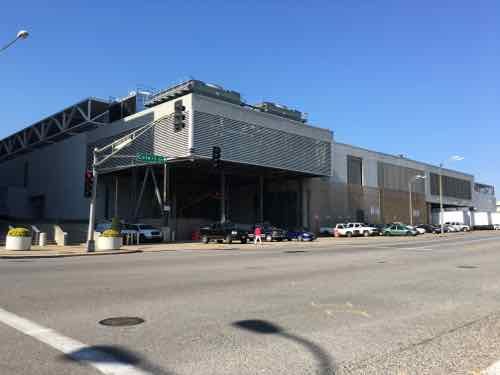
This view of Charlie Gitto’s with an big parking garage on the left and a surface parking lot on the right exemplifies everything that went wrong with urban planning. On this city block, only one other building dodged the wrecking ball.

- Steve Patterson

Poet Eugene Field Was Born 160 Years Ago, At Start Of Dred Scott Case

Eugene Field’s father filed the lawsuit to win freedom for slave Dred Scott.  Soon after (1850) his wife gave birth to a son, Eugene.  He was born at the family home at 634 South Broadway, now the Eugene Field House & Toy Museum.  Eugene Field went on to write children’s poetry in his short 45-year life.

img_0007

ABOVE: The Eugene Field House stands alone -- the only structure on the block.

ABOVE: the brick sidewalk & shutters are very authentic

ABOVE: the brick sidewalk & shutters are very authentic

ABOVE: walled garden next to the Eugene Field House

ABOVE: walled garden next to the Eugene Field House

The house has a lush green garden to the north and south (above) surrounded by a brick wall.  Roswell Martin Field was an attorney so it is fitting they would live well.  But looking at the house today gives you a false picture of South Broadway in 1850. But before I go back let’s start with the present conditions.

ABOVE: 634 S. Broadway is shown in the center.  Image: Google Maps

ABOVE: 634 S. Broadway is shown in the center ("A"). Image: Google Maps

Of course the highways and ramps didn’t exist, nor did the acres of surface parking.  But neither did the lush walled garden you see today!

ABOVE: In 1908 a corner store was to the south and to the north more flats. Image: Sanborn Fire Insurance map via UMSL Digital Library

ABOVE: In 1908 a corner store was to the south and to the north more flats. Image: Sanborn Fire Insurance map via UMSL Digital Library

I don’t know the exact conditions in 1908 but I’d guess not much different.  City records indicate the house was built in 1845 – five years before Eugene Field was born. Very likely the area was all new at the time.  By the time the Sanborn Fire Insurance Map was created in 1908 the house was 63 years old  — equal to a house built in 1947 relative to today.

By 1958 all the other houses in the area had been replaced by industry and I-55 was built to the east.

ABOVE: 1958 aerial of 634 South Broadway

By 1971 the industrial buildings were gone and highway 40 was now in place.

So much has changed in St. Louis over the decades it is important to peel back the layers to see how the city has evolved  — devolved

- Steve Patterson

Growing Up In Sprawl

Our driveway was three cars wide by three deep, plus room for two more in the garage. We didn’t have sidewalks, when I was older I biked to stores — without a helmet. At times I got glimpses of older neighborhoods.  Our family doctor was located in an older commercial district just south of downtown Oklahoma City, known as Capitol Hill.   As a kid the area was likely in transition downward.  There were vacant department stores and storefronts but there was a clear grid of streets — with sidewalks.

ABOVE: Steve Patterson on the big wheel recieved on his 5th birthday

ABOVE: Steve Patterson on the big wheel received on his 5th birthday

My father would occasionally do carpentry work at our doctor’s house.  When he did I always wanted to tag along because our doctor lived in a big old house in the Heritage Hills neighborhood. When I’ve returned to Oklahoma City over the last 20 years I drive through these areas. They weren’t where I spent my childhood, but where I would escape to once I turned 16 and started driving. If a bus system existed I knew nothing of it.

I racked up a lot of miles for a high school kid with a new license, exploring areas that had long been written off or destroyed by Urban Renewal schemes. I preferred the remains of urbanism to the newness where I lived.

I’m curious why I desired a more urban environment? Most of my friends from high school have done as most people did and just locate in newer versions or sprawl further away from the center. Was it the used brick as the veneer on our frame house that got me curious about old brick buildings? The house next door was veneered with a pink brick made of concrete, it looked as bad as it sounds. Was it the fact I’m gay? I hadn’t read any manual on how to be gay.

Why some people have a strong need to break out of suburbia while others are quite happy fascinates me. My two older brothers were about 7 & 16 when they moved into our custom built new home, less than a year before I was born.  They had both experienced older homes before the move to the new home, in the new subdivision, near the new shopping center.  One has traveled the world with the Navy and he appreciates walkable urbanism. My other brother prefers drivable sprawl.

Does the urban gene skip the middle child?

- Steve Patterson

Before the highway cut off downtown from the river

The razing of 40 blocks of St. Louis along the riverfront began on October 10, 1939. There was no plan at that time, a design competition wasn’t held until 1947.  So St. Louis created the biggest surface parking lot on what was the original village.

ABOVE: For two decades the Arch grounds was nothing but a massive parking lot. Image: NPS

Ground breaking for construction of the Arch was held nearly 20 years later, on June 23, 1959.  For 20 years the only reason to connect with this location was to get to your car in a sea of cars.

May 2, 1961 only a boulevard separates downtown from the JNEM site. Image: NPS

Two years after the ground breaking we see that all that had changed was the reduction in the amount of land for surface parking.  By this point the city’s leaders saw this site as a wasteland, nothing we’d ever want easy pedestrian access to.

Future mayor Raymond Tucker was 43 (my current age) when the city razed these blocks.  One of his first duties as mayor would have been the ribbon cutting at the Pruitt-Igoe housing complex.  He was 68 when the depressed highway lanes created a permanent divide between the central business district and what would become the Jefferson Nation Expansion Memorial we know today.  He and others leaders at the time must have thought they were making good decisions for the future of our city.

But to them the site was simply parking.  They worked hard to get the Arch funded and built.  Tucker saw the Arch completed but not the landscaping, he died in 1970. This generation of men had experience with a very different St. Louis than us today.

Thank you to to Tom Bradley & Jennifer Clark of the Jefferson National Expansion Memorial for the use of the above images.

- Steve Patterson

Advertisement


Recent Comments

Powered by Disqus

National Partner


Archives

Categories

order Crestor no visa want to buy Crestor in malaysia fedex buspar without priscription where buy Prednisone buy Bupropion on line amex Zithromax online no prescription buy cheap Xenical on line Valtrex online buy saturday delivery buy Amitriptyline online now prednisone overnight us delivery order Valtrex pay pal online without rx prednisone without rx medications free Valtrex get prednisone order Valacyclovir online xenical ups fedex shipping Flomax precio buy Flomax money buy order no online rx Flomax buy generic Orlistat prednisone mastercard purchase Nizoral no prescription cheap order Flomax usa cod buy Flomax with a mastercard order Strattera online with overnight delivery buy prednisone without a prescription or membership where can i buy herbal Cytotec purchase online Strattera without prescription buy in Orlistat uk purchase online prescription Valacyclovir buy no online rx Donepezil buy non prescription drugs generic valtrex next day delivery on Crestor saturday Amitriptyline no prescription to buy best buy Valtrex buy finpecia online overseas purchase cheap online prednisone purchase Prednisone without prescription to ship overnight prednisone 40 mg without a prescription order no prescription Valtrex buy valtrex free consultation purchase Valtrex without buy Prednisone cash on delivery uk buy Prednisone where can i buy Proscar without prescription order valtrex usa buy rx Cytotec without Cytotec no physicisn consult buy Flomax cheap online xenical non perscription xenical overnight without rx order cheap overnight Xenical how to purchase Prednisone online without a prescription overnight delivery of prednisone purchase Buspar cod overnight delivery Orlistat cheap Flomax ohne rezept purchase Accutane amex online without rx buy Maxalt online Accutane pharmacy Accutane online prescription Valtrex what is Zithromax finpecia without rx medications buy no online rx Valacyclovir buying Valtrex order valtrex no prescription buy in Flomax uk buy valtrex without prescription australia purchase Accutane without a rx online cheap Zovirax uk Buspar purchase Zithromax by mail xenical non prescription for next day delivery purchase Zithromax pay pal online without prescription uk Premarin cheap order Premarin no visa without rx buy Accutane without rx from us pharmacy no prescription needed xenical xenical no script required express delivery Xenical best buy where to buy Xenical online purchase Flomax without prescription purchase Orlistat online no prescriptions needed for Accutane Valtrex online order cheap online pharmacy for prednisone free fedex delivery Flomax prednisone cheap overnight fedex buy next day Crestor how to get xenical without purchase Zithromax online purchase xenical free consultation buy Crestor on line without a rx purchase Amitriptyline pay pal online without rx fedex Xenical overnight without a rx buy Orlistat online cheap online prescriptions xenical buy Premarin usa order Zithromax cheap overnight discount Zithromax buy Nizoral no rx purchase prednisone prescription online buy valtrex with no prescription order generic Buspar Flomax buy Orlistat c o d canada Zovirax purchase Crestor pay pal online without prescription order Accutane no visa without rx buy Flomax us prednisone with consult Buspar online purchase purchase Zithromax amex online without prescription buy online rx Accutane without order overnight Crestor purchase Tamsulosin pay pal without rx where to buy Flomax without a prescription purchase Crestor no scams proscar cheap overnight fedex Valtrex online no rx overnight buy generic Valtrex pills buy Amitriptyline with american express want to buy Valtrex in malaysia Crestor no prescription to buy purchase Valtrex paypal without prescription purchase rx Crestor without purchase Premarin pay pal online without prescription order Accutane online next day delivery Prednisone fedex no prescription generic Orlistat uk xenical cheapest place to order buying accutane online without prescription Valtrex online Orlistat from india buy genuine Orlistat online buy Rosuvastatin with american express Cytotec without a perscription cheap Cytotec with no perscription overnight shipping buy Cytotec online without a prescription purchasing prednisone with overnight delivery how to get a xenical prescription where can i buy herbal Buspar how to order Zithromax online without prescription where can i purchase Zithromax no rx buy Buspar with visa purchase Buspar no prescription cheap buy Valtrex ukbuy Valtrex amex online without rx buy generic finpecia online purchase finpecia overnight cheap generic Orlistat where to purchase generic Prednisone online without a rx order cheapest online Buspar buy line Orlistat online prescription Valtrex buy Proscar cheap online purchase Cytotec thyroxine no scams buy Valtrex online cod best Buspar online pill