St. Louis voters have selected their candidates for our new 14 wards, cut in half from the 28 wards for more than a century.
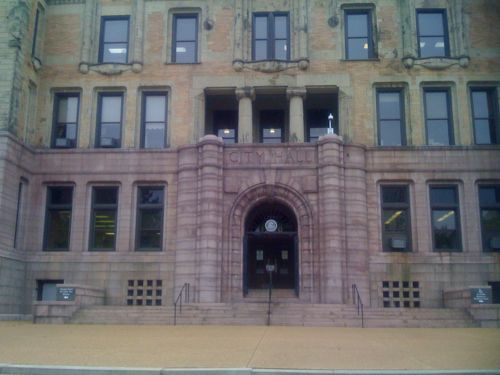
St. Louis City Hall
Of the 28 the following aldermen didn’t run this year:
Dwinderlin Evans (4th ward)
Christine Ingrassia (6th ward)
Jack Coatar (7th ward)
Annie Rice (8th ward)
Dan Guenter (9th ward)
James Lappe (11th ward)
Bill Stephens (12th ward)
Carol Howard (14th ward)
Jesse Todd (18th ward)
Marlene Davis (19th ward)
The following aldermen ran, but were defeated in the March primary:
Michael J. Gras was the 28th ward alderman, coming in a very close 3rd in a 3-way primary in the new 9th ward.
Lisa Middlebrook was the 2nd ward alderman, but was defeated in a 3-way race against two other existing aldermen in the new 13th ward.
Brandon Bosley (3rd ward) and James Page (5th ward) were defeated in a 4-way primary race in the new 14th ward.
The following aldermen were defeated in Tuesday’s general election:
Joe Vaccaro, longtime conservative alderman in the 23rd ward, was defeated by 24th ward alderman Bret Narayan in the new 4th ward.
Tina Pihl was 17th ward alderman, losing to Michael Browning in the new 9th ward.
In the new 13th ward Norma Walker, recently elected to fill the 22nd ward seat, was defeated by 27th ward alderman Pamela Boyd.
Two former aldermen lost in their attempts to return to the board: Ken Ortmann & Jennifer Florida.
State Rep Rasheen Aldridge thankfully defeated Hubbard dynasty candidate Ebony Washington. Aldridge will resign as state rep to be sworn in as 14th ward alderman. A special election will be held to fill the state rep seat — hopefully a Hubbard won’t be elected.
The new 14-member board of aldermen will be:
1) Anne Schweitzer* (13th)
2) Thomas Oldenburg* (16th)
3) Shane Cohn* (25th)
4) Bret Narayan* (24th)
5) Joseph Vollmer* (10th)
6) Daniela Velazquez
7) Alisha Sonnier
8) Cara Spencer* (20th)
9) Michael Browning
10) Shameem Hubbard* (26th)
11) Laura Keys* (21st)
12) Sharon Tyus* (1st)
13) Pamela Boyd* (27th)
14) Rasheen Aldridge
So ten of the fourteen aldermen were reelected (marked with *, followed by their pre-2023 ward number), with only four being entirely new to the board. With Aldridge, the board will now have two openly LGBTQ members, joining Cohn.
Fifty percent are people of color (PoC), and one more than half are women. When you include the board president, comptroller, and mayor this is the first time in the 259-year history of the city that women and people of color will be in charge — long overdue!
I believe it is the new aldermen representing the even-numbered wards that will start with 4-year terms — those representing odd-numbered wards will initially have only a 2-year term. In 2025 the odd-numbered wards will hold elections for 4-year terms.
Voters also approved Proposition C establishing a Charter Commission to propose charter amendments to voters. I strongly recommend language changes to eliminate the March primary — with instant runoff/ranked-choice voting in every April in races with 3+ candidates. We shouldn’t have to go the polls just 4 weeks apart!
A 3% tax on recreational/adult-use cannabis was approved in the city, and in St. Louis County. Though I’m a supporter of legal cannabis, I’m among those who voted yes because these jurisdictions will need to provide city services.
Sadie Weiss and Tracy Hykes were elected to the board of education, Nicole Robinson defeated incumbent Pam Ross for a trustee seat on the community college board. Voters approved the DeBaliviere special business tax district.
— Steve ———————————————————————— St. Louis urban planning, policy, and politics @ UrbanReviewSTL since October 31, 2004. For additional content please consider following on Facebook, Instagram, Mastodon, and/or Twitter.
The St. Louis general election is just around the corner, Tuesday April 4, 2023. Early (no excuse absentee) voting is open now. I’ve voted absentee by mail.
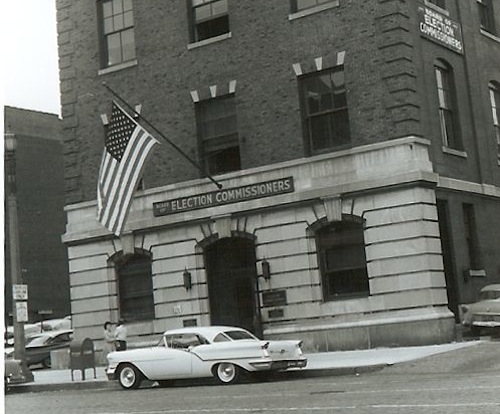
Vintage photo of the former offices of the St. Louis Board of Election Commissioners. From my collection
In the March 7th primary we all had the one candidate race for President of the Board of Aldermen and races for all 14 wards — the first reduction from 28. The election has those races, plus two propositions, school board, and community college trustee. You can view the sample ballot here.
I’m not going to go through the aldermanic races, you probably know those. Instead I want to draw your attention to the other races you didn’t see during the primary. First, two propositions:
PROPOSITION C CHARTER AMENDMENT Shall Article V of the City of St. Louis Charter be amended to establish a Charter 17 Commission which shall:Consist of nine registered city voters free of conflicts of interest recommended by members of the Board of Aldermen, nominated by the Mayor of the City of St. Louis, and confirmed by the full Board of Aldermen.
Be appointed on August 15, 2023, and every ten years thereafter, or upon the certification of a petition signed by five percent of city registered voters who voted in the last general election for mayor, and discharge its duties and cease to exist within one year of its first public meeting.
Solicit public input and consult experts to consider revisions to the City Charter, and, in accordance with the provisions of the Missouri Constitution, submit proposed amendments to the qualified voters for approval, which amendments shall go into effect subject to a three-fifths vote in favor. YES – FOR THE PROPOSITION NO – AGAINST THE PROPOSITION
From sample ballot
I think it makes sense to continually look at the charter for areas to improve. If approved they could start with replacing our every other year primary & general elections with a single ranked-choice/instant runoff election for races with 3+ candidates.
The other proposition on the ballot is related to Missouri’s new adult-use recreational cannabis sales — specifically a local tax.
PROPOSITION (Additional Sales Tax on Retail Sale of Adult Use Marijuana) Shall the City of St. Louis impose an additional sales tax of three percent (3 percent) on the retail sale of adult use non- medical marijuana? YES – FOR THE PROPOSITION NO – AGAINST THE PROPOSITION
From sample ballot
Again, I voted yes because 3% is a small amount and it’ll help pay for local municipal services. This tax isn’t applicable to those of us with medical cannabis cards.
Lastly there’s three candidates for two 4-year terms on the St. Louis Board of Education and two candidates for one 6-year term as a trustee of the St. Louis Community College. Voters in DeBaliviere Place are also voting on a special taxing district.
For more information on this election and early/absentee voting see the Board of Elections. Another great source is Ballotpedia.
— Steve ———————————————————————— St. Louis urban planning, policy, and politics @ UrbanReviewSTL since October 31, 2004. For additional content please consider following on Facebook, Instagram, Mastodon, and/or Twitter.
The 2023 spring municipal elections in St. Louis will be very different than any of us have every experienced. There’ll still be a March primary and an April general — but the primary will be non-partisan, both will begin the change from 28 wards to 14. The primary is 8 weeks from tomorrow.
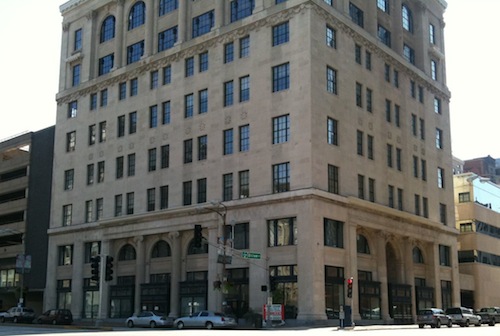
The St. Louis Board of Election Commissioners is on the first floor at 300 N. Tucker (@ Olive)
We’ve had the nonpartisan primary for one or two elections, but with 28 total wards. This being the first election downsizing to 14 there are no incumbents — all 14 seats are new and up for election. Seven will be elected to an initial 2-year term, the other 7 to a 4-year term. This will make future elections staggered, with only half the seats up for election every two odd years.
Until changed, races with only 1-2 candidates will be the same for primary & general elections — rather silly. Races with 3+ primary candidates will have the top 2 primary finishers on our general election ballots.
Remember— nearly everyone in the city has a new ward number. The March 7th & April 4th elections are both important — at least wards with 3 or more candidates in the primary.
Okay, let’s look at each race. The number in parentheses is the number of candidates in the primary, the areas listed are some/all of the neighborhoods in this ward. The President and ward headings are all links to relevant maps.
Incumbent Megan Ellyia Green only recently won a challenged special election to finish the term of disgraced Lewis Reed, so it’s no surprise she’s not challenged now. I suspect this will not be the case in 2027.
This southwest ward has three candidates — one of several races pitting current aldermen against each other: – Bret Narayan, current 24th ward alderman – Joseph (Joe) Vaccaro, current 23rd ward alderman – Casey Otto
This south ward has only two candidates, so both will appear on the March & April ballots: – Joseph (Joe) Vollmer, current 10th ward alderman – Helen Petty
This central corridor ward has three candidates, including 2 current aldermen: – Tina (Sweet-T) Pihl, current 17th ward alderman – Michael Browning – Michael J. Gras, current 28th ward alderman
Pihl and Browning live in the 63110 zip code, Gras in 63108.
This north central ward has only two candidates: – Laura Keys, recently elected 21st ward alderman, finishing term of John Collins-Muhammad. – Carla (Coffee) Wright
At five, this north ward has the most candidates of any! Seven filed, but one didn’t meet the signature obligation and the other withdrew. The remaining five on the ballot are: – Darron M. Collins-Bey – Tishara T. Earl – Yolanda (Glass) Brown – Walter Rush – Sharon Tyus, currently the 1st ward alderman
Collins-Bey, Brown, and Rush live in the 63115 zip code, Earl in 63147, Tyus in 63113.
This far north ward has three candidates — all three currently serving on the Board of Aldermen: – Norma J. Walker, recently elected 22nd ward alderman, finishing term of Jeffrey Boyd – Pamela Boyd, current 27th ward alderman – Lisa Middlebrook, current 2nd ward alderman
Walker lives in the 63120 zip code, Boyd in 63136, Middlebrook in 63147.
This north ward is my ward, I’ll have four candidates to choose from in the primary: – James Page, currently serving as 5th ward alderman – Brandon Bosley, currently serving as 3rd ward alderman – Rasheen Aldridge, currently serving as 78th district state representative – Ebony M. Washington
James Page lives in the 63103 zip code, Bosley and Aldridge in 63107, Washington in 63106.
Current aldermen not running in 2023
The following ten aldermen are not candidates (current ward): – Dwinderlin Evans (4th) – Christine Ingrassia (6th) – Jack Coatar (7th) – Annie Rice (8th) – Dan Guenther (9th) – James Lappe (11th) – Bill Stephens (12th) – Carol Howard (14th) – Jesse Todd (18th) – Marlene Davis (19th)
Additional thoughts
All this means at least fifteen of the current 27 (there’s one vacancy) ward Board of Aldermen will end their service in a few months. Given that 28 wards are being cut in half to 14 this isn’t a surprise. As many as 25 of the current 27 could be out of office after the general election in April — that number is shocking!
Two former aldermen, Florida & Ortmann, are hoping to return to the board. Both previously lost a reelection bid to a challenger in a democratic primary. Again, city elections are now nonpartisan. Florida will face the same person in the primary and general, Ortmann is in a 3-way race that includes a current alderman so his immediate goal is to finish in the top two in the March 7th primary so he can try to win the April 4th general.
Voter information
I want to leave you with helpful resources to help make your decision and voting easier. I’m very curious if we’ll see any significant change in voter turnout. Analysis will be a challenge since we can’t compare the 14 new apples to apples, but we can see citywide as well as compare old vs new in the same part of town.
— Steve ———————————————————————— St. Louis urban planning, policy, and politics @ UrbanReviewSTL since October 31, 2004. For additional content please consider following on Facebook, Instagram, Mastodon, Threads, Bluesky, and/or X (Twitter).
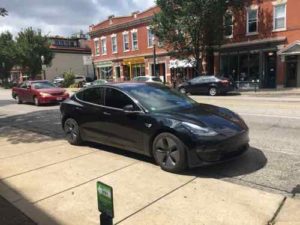
A friend’s Tesla Model 3 on South Grand, October 2019
Last month the California Air Resourses Board (CARB) voted to approve new statewide regulations that will gradually reduce the number of passenger vehicles powered solely by gasoline or diesel in their state. They drafted these regulations after California Gov. Gavin Newsome issued an executive order a year ago to make this happen.
”California regulators voted Thursday to ban the sale of all new gasoline-powered vehicles by 2035 as the state looks to aggressively tackle the climate crisis.” (NBC News)
So what will this mean for the St. Louis region? In the short term, very little. In the long term, however, it will greatly impact St. Louis and the rest of North America. Possibly the world.
First we must understand it’s the federal government, through the Environmental Protection Agency (EPA) that sets nationwide standards for emissions and such. However, unlike the other 49 states and the District of Columbia, our most populous state is allowed to set standards that are stricter than federal policy. The EPA must first issue a waiver for California’s new regulation. It’s highly unlikely the Biden administration will attempt to block it. Still, a GOP lawsuit is challenging California’s right to set a stricter emissions standard.
As the most populous state California is also the biggest car market in the nation, its population is more than double Missouri & Illinois combined! In the past the following states have opted to follow California’s stricter standards: Connecticut, Delaware, Maine, Maryland, Massachusetts, New Jersey, New Mexico, New York, Oregon, Pennsylvania, Rhode Island, Vermont, Washington state and Washington D.C. So far two stated, Massachusetts and Washington, have already indicated they will follow California’s lead. The combined vehicle sales in this states is huge! Combined with future ICE vehicle bans in Europe and the world’s largest car market (China) that is pushing EVs it’s clear new internal combustion engines will be rare before 2035 arrives.
It will be very challenging, but auto manufacturer’s line ups will meet these higher standards…for everyone, essentially becoming a national standard. Some have suggested by 2035 there will be nearly zero consumer demand for ICE vehicles. This new rule will rapidly accelerate the transition to electric vehicles.
Let’s look closer at California’s 2035 ban on fossil fuel vehicles. First, it doesn’t mean they’re banning existing gas powered vehicles — they can be driven, and used models can be bought & sold.
“Starting with 2026 models, 35% of new cars, SUVs and small pickups sold in California would be required to be zero-emission vehicles. That quota would increase each year and is expected to reach 51% of all new car sales in 2028, 68% in 2030 and 100% in 2035. The quotas also would allow 20% of zero-emission cars sold to be plug-in hybrids.” (CNN)
While 2035 model year vehicles are still a dozen years away, 2026 models are will be here in just 3 years! To scale up production manufacturers will need to sell EVs beyond states with an EV mandate, though if supplies are limited the inventory will go to those states so they meet the requirements.
By 2025 plug-in hybrids (PHEVs) must achieve 50 miles in pure electric mode — a substantial increase from the 18-25 miles seen in current PHEVs. In the last decade a lot of PHEVs were only available in California, going forward expect more to be nationwide. Motorcycles and large trucks will be regulated separately, with a longer time frame.
Dealerships in the St. Louis region will offer more EVs, and fewer fuel burning vehicles. They’ll also need to renovate their facilities to be able to charge & service the electric cars they’ll be selling. The selection of EVs will rapidly increase, just as the selection of new gas vehicles will decline. Municipalities like St. Louis with many residents parking on city streets will need a way to charge their vehicles.
Businesses that depend on gas vehicles will need to reinvent themselves. For example, places that do oil changes, radiator flushes, and transmission work will consolidate — fewer will be necessary. Something else will occupy that real estate in the future.
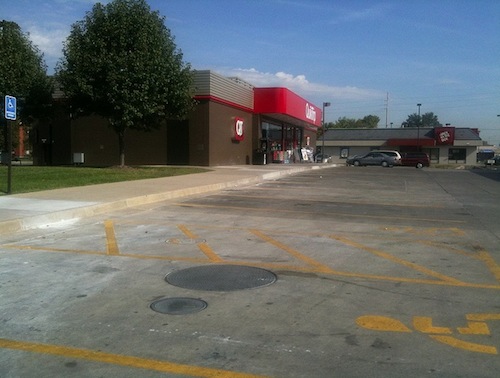
QuikTrip in Granite City, IL. February 2011.
Gas stations make very little money from fuel, their profit comes from the convenience store portion of the business model. Many are owned by individuals living in our region, not corporations in other states. Those located near interstates can add high speed charging points to lure travelers to stop and spend money while replenishing their batteries.
Some gas stations will close. Eventually we’ll see gas deserts with few options for filing up that classic 2020 Toyota Corolla you’re driving until it dies. Auto parts stores will still be around for a long time, but they can’t survive on selling wiper blades.
At the start of the 20th century a major restructuring happened as the change from horse & buggy to cars took place. Jobs building carriages, caring for horses, etc went away. Such a restructuring is beginning now, with this mandate.
Those of you alive in 2040, 2050 will be part of a different St. Louis. It’s impossible to predict how it will all play out, but rest assured things won’t be static. The combination of vehicles going electric and the temperatures getting hotter will necessitate physical changes.
I hope the region will occupy less total land in the future, with considerably less impervious surfaces per capita. Hopefully the entire region will see a much higher use of public transit. And yes, our electrical grid will need to improve. Users will also need to learn to minimize using electricity during periods of peak demand.
July 5, 2022Featured, Politics/PolicyComments Off on Missouri Primary Four Weeks Away on August 2, 2022
Seven states, including Missouri, will hold primary elections on Tuesday August 2, 2022 — just four weeks from today. My goal in this post is to make you aware of all items on your ballot, not just the high-profile U.S. Senate race.
First, with redistricting and ward reduction from 28 to 14 it’s very likely you’re ward and precinct numbers are different than they were on the previous election. I’ve been in the 5th for a decade, now it’s the 14th!
City voters have two propositions on their ballots:
PROPOSITION S Shall The Board of Education of the City of St. Louis borrow money in the amount of One Hundred Sixty Million Dollars ($160,000,000) for the purpose of acquiring, constructing, renovating, repairing, improving, furnishing and equipping school sites, buildings and related facilities in the District, including but not limited to (1) removing lead paint, fencing and other hazardous materials at affected schools, (2) upgrading mechanical systems to include replacement of outdated or obsolete equipment, temperature controls, and duct cleaning to increase ventilation, (3) upgrading building infrastructure by replacing roofs, tuck-pointing, waterproofing and window replacements, (4) improving security systems to increase student safety by installing fire alarm systems and replacing interior and exterior doors, (5) upgrading technology to modernize classrooms and improve academic performance, (6) improving building conditions by renovating restrooms and other ADA improvements, and (7) increasing learning opportunities by creating outdoor learning spaces and making improvements to playgrounds and athletic fields and facilities, and issue general obligation bonds for the payment thereof?
If this proposition is approved, the adjusted debt service levy of the school district is estimated to remain unchanged at the current rate of $0.6211 per one hundred dollars assessed valuation of real and personal property.
YES – FOR THE PROPOSITION NO – AGAINST THE PROPOSITION
And…
PROPOSITION F Shall Section 24 of Article IV of the City’s Charter be changed to increase the maximum fine for violations of City ordinances regarding preservation and protection of environmental conditions for preventing harm to the health, safety, and comfort of City residents or harm to private or public property such as unauthorized dumping of waste or debris on private or public property, prohibited refuse, waste tire disposal, and the like from $500.00 to $1,000.00?
YES – FOR THE PROPOSITION NO – AGAINST THE PROPOSITION
The only contested citywide county office in the primary is two candidates running for Recorder of Deeds on the Green Party. Republican, Democratic, and Libertarian ballots all have only one candidate each for Collector of Revenue, License Collector, and Recorder of Deeds.
However, voters in the current 21st ward will also vote to select an alderperson to fill the vacant seat. Four candidates are running: Laura Keys (D), Joann Dyson Williams (I), Melinda L. Long (I), and Ebony Moore (I). See official list of candidates here.
St. Louis County has three propositions on their ballots: A, M, and V — see the full language linked on the county ballot page, here. You can also enter your address for your specific ballot.
There are no statewide propositions on our August primary ballot, but there will be quite a few on our general election ballot in November.
Elections for the state house and state Auditor are pretty boring, most in the St. Louis area unchallenged. Republican voters will need to select one of two candidates for state auditor.
In Missouri’s first congressional district it’s more interesting. Three republicans want the GOP nomination. On the democratic ballot incumbent Cori Bush has four primary opponents! (Cori has my vote)
The big race in Missouri this year is to fill the U.S. Senate seat held by retiring senator Roy Blunt (R). Anytime you have an open seat with no incumbent a lot of candidates toss their hats into the ring.
The republican ballot has 21 candidates, yes 21! Many of dropped out or been disqualified, but still. Former governor Eric “RINO hunter” Greitens is currently leading in the polls.
The democratic ballot has 11 hopefuls that want to flip the seat from red to blue. I’m actually Facebook friends with one of the 11, but I’m not sure how I’ll vote — I’ve got to decide before my absentee ballot arrives. Lucas Kunce is the most likely democratic nominee.
It’s very likely the Republican and Democratic nominees will face at least one independent challenger in November. One potential outcome is a conservative-minded independent splitting the vote, helping the democratic nominee get elected.
AARP Livibility Index
The Livability Index scores neighborhoods and communities across the U.S. for the services and amenities that impact your life the most
Built St. Louis
historic architecture of St. Louis, Missouri – mourning the losses, celebrating the survivors.
Geo St. Louis
a guide to geospatial data about the City of St. Louis
 Seven states, including Missouri, will hold primary elections on Tuesday August 2, 2022 — just four weeks from today. My goal in this post is to make you aware of all items on your ballot, not just the high-profile U.S. Senate race.