Home » St. Charles County » Recent Articles:

St. Charles County Executive Steve Ehlmann Vetoed Smoke-Free Bill

St. Charles County Executive Steve Ehlmann

Yesterday St. Charles County Executive Steve Ehlmann vetoed a bill that would have given voters the opportunity to decide if they wanted their county to go smoke-free. In the poll last week the single answer with the most was the one where he would sign the bill and voters would approve:

Q: When Will St. Charles County Go Smoke-Free?

  1. Ehlmann will sign bill and voters will approve it in Nov 2012 16 [32%]
  2. Only after a statewide ban 13 [26%]
  3. Never 8 [16%]
  4. Other answer… 4 [8%]
  5. Eventually, Ehlmann will sign bill but voters won’t approve it in Nov 2012 3 [6%]
  6. Eventually, Ehlmann will veto this bill but this change will come later 3 [6%]
  7. Ehlmann will veto this bill but the County Council will override, voters approve in Nov 2012 2 [4%]
  8. Ehlmann will veto this bill but the County Council will override, voters reject in Nov 2012 1 [2%]

The issue was the casino exemption:

“If the purpose of the smoking ban is to protect the health of employees, there is no rational reason to exclude casino floor workers,” the Republican executive said in his veto message.

“If tobacco smoke is harmful, there is no reason to exempt cigar bars, while regulating bars that allow cigarette smoking.” (source)

The other answers were:

  1. How should I know?
  2. Who cares, St Charles county is a worthless pile of crap
  3. Why ban a legal product? Heavy perfume makes me ill…ban overly scented people
  4. I feel that speculating over what will happen is kind of pointless.

My reason for the poll was to show regional interest in going smoke-free.  Maybe there isn’t such interest? Expect additional bills to bring this to voters, most likely without an exemption for casinos.

- Steve Patterson

St. Charles County Needs Public Transit

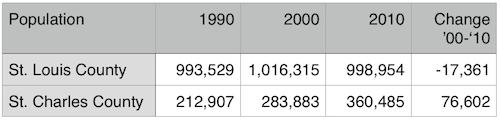
St. Charles County now has more people than the City of St. Louis (360,484 vs 319,294).  That population is spread out over a much larger area giving the county a low population density of 643/sq mi compared to St. Louis City which has a density of 5,158/sq mi.   St. Louis County’s population density is 1,966/sq mi.  One might conclude from these numbers that St. Charles County lacks the density to support transit.

In Illinois, St. Clair County contracts with Metro for transit service despite having a population density of only 393/sq mi (270,056). In addition to bus service, they funded and built an extension to the MetroLink light rail line.  In neighboring Madison County, the population density is a mere 366/sq mi yet they have the separate Madison County Transit (MTC MCT) system.

Again, St. Charles County has no county-wide transit service.  The City of St. Charles operates the horribly named SCAT (St. Charles Area Transit) system but that is little more than a senior shuttle service.

The St. Charles Area Transit system, otherwise known as SCAT, consists of five bus routes that provide transportation to various locations within the City of St. Charles as well as to the Metrolink North Hanley Station. Curb-to-curb service is provided for all riders, and all busses are equipped with wheelchair lifts.

All routes run Monday through Friday. Please allow 5-10 minutes leeway for each time listed. The routes and schedules are subject to change.

I have a copy of the fold out paper map showing the routes, none are online (wtf?). Yes, seniors need such systems but what about others? What about the other 294,691 St. Charles County residents that don’t live in the City of St. Charles?

In terms of its growth spurt, St. Charles may still be in its tweens.

“We’re probably kind of in the middle,” Anthony [director of community development with St. Charles County] says. The county estimates that its maximum capacity is about 640,000 people, he says, considerably more than the county’s current population of 360,484.)

With much more growth ahead, the county and cities within it have several things to consider moving forward, chiefly the very things that brought people out in the first place. (STL Beacon)

More growth with no plan to get folks from home in Wenzville to work in O’Fallon?  Part of me would like to just sit back and wait for the realities of an aging population combined with rising fuel prices to sink in to the average St. Charles County resident. But by the time that happens they will be in crisis mode. As part of our 16 county region we can’t allow such a large area fall into transportation crisis.

I’m not the first to realize St. Charles County needs a system. They created the St. Charles County Transit Authority and East-West Gateway studied the idea in 2006-07, an update to a 2001 plan.

East-West Gateway suggested that a sales-tax of 1/8 cent (or less) could support the proposed system which would, in turn, provide the local workforce with a transit option that is financially and environmentally friendly.

Polling commissioned by the Transit Authority in January 2008 and paid for by private donations did not indicate sufficient support for a sales tax for public transit. Voters opposed a bus sales tax for two main reasons:

  1. taxes are already “too high” or
  2. this particular tax would be an “unwise” use of taxes.

In addition, a large group (20%) stated they would not use the bus system or would not access it because its proposed routing is not convenient for them. (source)

Leaders in St. Charles County need to work on passing a transit tax so the Transit Authority can begin the work of setting up a transit system.

- Steve Patterson

Poll: When Will St. Charles County Go Smoke-Free?

Interesting news from St. Charles County last week:

The fate of a proposed countywide smoking ban is now up to County Executive Steve Ehlmann.

The County Council voted 4-2 on Tuesday night for legislation to put the proposal on the November 2012 election ballot. Ehlmann has yet to signal whether he’ll sign or veto the measure, which would apply to bars, restaurants and most other indoor public places. (STLToday.com)

With St. Louis City & County now smoke-free, with some unfortunate exceptions, it would be nice to see more of the region become smoke-free.

He [Ehlman] has 10 days to veto or sign the bill. If he does neither, the bill is automatically approved. (Patch.com)

This is the subject of the poll this week: When Will St. Charles County Go Smoke-Free?  The poll is located in the upper right corner of the blog.

I hope Steve Ehlmann doesn’t veto this bill so the question goes to voters in November 2012.

- Steve Patterson

Readers support the rights of cyclists to use the roads

ABOVE: State Highway DD via Google Streetview

ABOVE: State Highway DD in St. Charles County. Image: Google Streetview

Readers that voted in the poll last week clearly favor the rights of bicyclist to use public roadways and thus opposing a proposed ban in St. Charles County on cycling on some state highways in the county.

Q: St Charles County is considering banning bikes from some state highways:

  1. Bikes are vehicles and have just as much right to use public roads. 114 [60.96%]
  2. Bikes are fine on local roads, but not on state highways lacking shoulders. 52 [27.81%]
  3. Bikes belong on sidewalks or trails, not roads. 13 [6.95%]
  4. Other answer… 7 [3.74%]
  5. Unsure/no opinion 1 [ 0.53%]

However, nearly 28% think cyclists have a right to the roads, but not highways lacking shoulders.  Almost 7% think cyclists belong on sidewalks and trails.  Seriously? Public roads are for vehicles and a bike is a vehicle.

The “other” answers were:

  1. Ban Cars
  2. Ban the cars and solve the obesity problem
  3. Daft Wankers!
  4. stl bikers need education on the laws – until they stop at stop signs ban bikers
  5. If a bicyclistg wants to risk life and limb on a state highway, go for it.
  6. They are state roads…St. Charles has no jurisdiction in banning bikes on them.
  7. Reduce speed limit to 35 from 55mph for the cars – why do the cars go so fast?

I’ll be interested to see how this issue plays out.

- Steve Patterson

The route to St. Charles

More and more I rely on Google Maps on my iPhone.  Sometimes it is for directions but recently it was to let me know the time to drive from downtown to visit friends in St. Charles.

I knew the route but wasn’t sure of the time.  Thirty-five minutes isn’t too bad, certainly seems longer! Once I had my answer I was curious about the other two route options offered by Google Maps: transit and walking.

As expected the transit option (above) returned with the message, “Transit directions could not be found between these locations.”  No surprise since I was headed far into suburbia.  But what about walking?

Great, a walking route.  But the route is over 70% longer than driving (29.5 miles vs 44.5 miles).  I’m not sure what I expected but it wasn’t such an out of the way route.  Some use walking routes to help find cycling routes and this is not a viable alternative. It must relate to safe ways to cross the Missouri River.

– Steve Patterson

Where Is Your Third Place?

There is one thing cities provide in much greater abundance than suburbs: the essential “third places” in our lives that provide respite and relaxation for us outside our homes or workplaces.

Third Place
Third places are defined as one of three places that meet fundamental human needs: home, a first place; work, a second place; and a third place, where we go to find community, relaxation, and simply “be” when we aren’t at home or working.

For all the people who work from home offices, the line between the first and second places, home and work space, may have blurred, but it makes the third place even more important. We all need a common place to hang out, see friends, find conversation, or simply watch the world go by. We seek a place that is separate from our homes or workplaces and all their attendant comforts and irritations.

Third places are very individual. In a family of four, there could be four different third places: church, coffeehouse, club or park. They are where you go to get away from your immediate responsibilities and expectations. You don’t have to do housework or laundry; you don’t have to finish that project or spar with your partner. You are (temporarily) free to indulge your own thoughts, talk or not talk, do or not do anything.

In the city of St. Louis there are many good third-places: local coffeehouses like The Hartford, Shaw Coffee or even the London Tea Room. There are neighborhood bars and cafes where they get to know you and you can stay as long as you like. There are libraries, drop-in centers and parks. There are churches and clubs, both social and athletic. There are museums and entertainment districts like The Loop on Delmar or Washington Avenue downtown. And there are intentional places like Left Bank Books with book groups, author readings and community events. These third places are close at hand, across the street or down the block, most of them within walking distance.

The suburbs of St. Louis are trickier, especially in second-ring suburbs. Newer, more affluent suburbs like Chesterfield and Wildwood have been built with more modern sensibilities about community gathering spots and the intentional communities created by mixed-use construction. You may be more likely to hang out at commercially sponsored third places like Starbucks or the mall, but they exist and are well used.

The second-ring suburbs are in a tougher spot. They belong to an earlier time, before we realized how much we would miss the communal third places that are so abundant in the city. Like the outer-ring suburbs, they may have some commercially-sponsored places like Starbucks, McDonalds or Dennys, but there may be only one or two in a municipality and they are rarely within walking distance. There is a real dearth of small, local businesses like independent coffeehouses, casual cafes or bookstores. Which pretty much leaves the bar, gym or possibly church and almost all of them require driving in your car.

There is a misplaced attempt to fulfill this need for third places in the construction of suburban great rooms, finished basements and fully-equipped media rooms, but all of these fall short. A third place requires distance from home and family. It also requires diversity and randomness in the people you might observe or start a conversation with.
When I lived in Seattle, I could easily walk a few blocks to any of six coffeehouses, each with its own ambience and crowd of regulars. There were bookstores with cafes where you could hang out from 7 a.m. to 11 p.m. When I lived in the South Grand area, I had my choice of places to hang out.

In Maryland Heights, I’m stumped. I occasionally get in the car and drive to Starbucks at Westport or I go farther afield to Creve Couer or Chesterfield. More and more, I drive farther to Main Street in St. Charles or into the city to find a third place, but none of them are my third place.

City planners take note: vibrant cities or suburbs don’t exist without a multitude of viable third places. And if you want to attract the young, the creative, the socially engaged, that advice is doubly important.

What I’d like to know, especially if you’re a suburbanite, is where is your third place? Where do you regularly go to hang out, read a book, see friends, or just escape home and work responsibilities? What makes a place your third space? I look forward to what you have to say.

-Deborah Moulton

I’m Moving To Wentzville, MO

I’ve grown tired of living downtown in a walkable environment with a street grid of short blocks [mostly] filled with wonderful architectural gems.  So I’m moving to Wentzville MO (map) where I’m guaranteed to never encounter a street grid, interesting architecture, pedestrians, etc.

I don’t like having to decide how I’m going to get from place to place (walk, bike, transit, drive, etc).  In Wentzville the decision will be easy — the car!  I may have to get a Hummer to help save G.M.  Besides, with my new commute I’ll need a comfy vehicle.  Gas is cheap today so why not?

Plus no more eating at locally owned restaurants, I’m going for chains now.  That way when I leave Wentzville to travel I can be assured to get the exact same meals, regardless of what city I’m in. Don’t want to take a chance on anything different.  I’ll still go to the local pub,  Applebee’s Neighborhood Grill & Bar.  It is just down the street a few miles in front of Wal-Mart.

I love my new ranch home that features a 3-car garage and 14 gables.  Vinyl siding and a bit of brick on the front will be awesome!  The four bedrooms will come in handy because, as of today, I’m no longer gay.  I’m going to get me a wife and kids.  And with kids you must raise them in the “country.”  Wouldn’t dare expose them to those of different races or incomes.  Going to the Mexican chain off I-70 is diverse enough.

And you get so much house in Wentzville.  I’ll have the previously mentioned four bedrooms, three living areas and three dining areas plus the basement.  Granted none of the dining areas will seat more than eight for dinner but we’ll all be eating in the “family” room in front of the big screen.  I’m finally going to get that riding lawn mower I’ve always wanted so I can mow the 3 acre lot.  I’ll have plenty of trips to Home Depot in the Hummer to get fertilizer to keep the lawn perfectly green and free of weeds.  While I’m at Home Depot I’ll get a water purifier – how do chemicals get in our water supply?

I’ll take the whole family to events downtown, like wholesome concerts at the new Chaifetz arena on Compton.  Yeah, when you live in Wentzville, anything in the City is downtown.  Ah, the good life.

Happy April Fool’s day everyone!  Like I’m going to trade my life for the above.

Old Urbanism, Suburbia & New Urbanism

Here in the St. Louis region we have a little bit of everything — we have old urbanism in the inner core (the city of St Louis) as well as in the many older suburbs that ring the city on both sides of the river. Like every region in America, we have too much suburbia — that auto centric muck that has been growing since WWII.Your know what suburbia is — residential streets with big lawn, no street trees and an increasing number of garage doors. The big box centers with enough parking for the day after Thanksgiving. The indoor mall surrounded by acres of parking. The office park with similar looking buildings casually placed on lush green lawns all set between yet more parking. Being a suburb of the core city is fine — Webster Groves is an old suburb that is walkable in ways St Peters will never be. So my issue is not with suburbs but with suburbia — that very soulless form of building that has predominated America fot the last five or six decades.

So much of our good old urbanism has been destroyed remaking core cities with touches of suburbia.

Old urbanism was built for people on foot. Streets were narrow by today’s standards. Each neighborhood had a commercial area within a short walk. The streetcar was not far away which could get you to the bigger stores downtown. No zoning regulated this. It just was. And it worked well until we reached a tipping point with the car — fewer pedestrians and more cars through it all out of balance. While old urbanism was great for people it did a poor job accommodating the car.

The solution of the day was not to tweak our existing environments but to rip them out entirely. The new suburbia was proudly proclaimed as “progress.” Once narrow streets were widened and those neighborhood shops moved to the new strip centers or the open air mall.

In the early 1980s a few people began questioning the status quo and looks to the past for ways to make walkable communities while still making room for the car. The first result was Seaside, Florida — as seen in the movie The Truman Show. Widely dismissed due to its resort nature, many said the principals couldn’t be applied elsewhere — that we were basically stuck with suburbia as the model for future development both in core areas and on the edges.

But a diverse group of Architects and Planners refused to accept suburbia as the only way, founding the Congress for the New Urbanism (CNU) in 1993. Today people are still foolishly dismissive of New Urbanism — saying it is just nostalgia in the corn field. This view is so narrow it looks at a few projects but doesn’t take into account the depth of the guiding principals found in the Charter of the CNU.

About a decade ago there started being talk of a big New Urbanist project in our region. The resulting project was Paul McKee’s Winghaven (yes, that Paul McKee). In August 2001 Peter Downs authored a story on Winghaven for the RFT; The Gospel According to Paul.

Though the experiment is barely half-done, some people are already proclaiming it a stunning success. “WingHaven will be cited for the next 25 years as a great example of a new form of urban development,” says Richard Fleming, president and chief executive officer of the St. Louis Regional Chamber and Growth Association.

By this point we had seen enough to know that Winghaven was not New Urbanism, despite what Fleming had to say. At the time I was part of a casual group of architects and planners known as New Urban St Louis. After this article appeared architect John Hoag, planner Todd Antoine and I drafted a letter to the editor on behalf of our group. We wrote, in part:

While we applaud Paul McKee’s efforts to break the current mold of suburban development in the St. Louis region, several points are worth mentioning.

New Urbanists identify with one of two camps: developments in suburban “greenfields” or revitalizing existing neighborhoods in the urban core and inner suburbs. New Urbanists believe strengthening the urban core is vital to sustaining long- term regional growth while acknowledging that greenfield development will continue. New development, whether in the urban core or in greenfields, benefits by incorporating New Urbanist principles. New Urbanism does not imply a strict return to nostalgic remembrances of the past. Instead, it is based on design and planning principles nurtured and refined over centuries of town- building that have been largely forgotten over the last 50 years. Problems such as affordable housing, lack of connectiveness and inadequate public transportation plague many suburban areas. Solutions include pedestrian-friendly, mixed-use and transit-oriented development which offers real alternatives to auto-oriented sprawl.

The St. Louis region is blessed with fine older examples of traditional neighborhoods exhibiting many aspects of New Urbanist designs. However, the region is lacking the breakthrough projects seen in Memphis, Dallas and Minneapolis. We encourage developers, bankers and local government officials to explore the rich variety of New Urbanist developments in the U.S. already completed or in the planning process.

Since this time we’ve seen real New Urbanism come to our region via New Town at St Charles. New Town is a project of Whittaker Builders. I’ve had the good fortune to have spent some good one on one time with Greg Whittaker talking about the project and what led him in this direction. Whittaker, like most large home builders in our region, was responsible for a number of the typical subdivisions that define suburbia. Greg Whittaker spent vacation time at Seaside Florida and he began to wonder if they could do something different than they had. The answer was yes.

Building new (or old) urbanism is not a simple task. First of all, based on current zoning, it is illegal —- even in the City of St Louis. Zoning in much of the country mandates suburbia — be it in the old urban core or on corn fields at the edge of each region. The site where New Town is located was zoned for industrial park development. If someone wanted to recreate the intersection of Euclid & Maryland (old urbanism) on the long vacant Pruitt-Igoe site they could not do so based on our current zoning code which dates to 1947.

Our zoning code is like most in the U.S. — it is what is known as use based zoning. That is the code tells you where certain uses are allowed (so much for mixed use areas) and finally how much parking each use much have. Always back to parking — this is why instead of contiguous commercial districts as in the old urbanism newer areas have each building surrounded by parking. With all this parking between buildings you lose that connected feel of a truly walkable environment.

New Urbanist developments like New Town use their own codes — with the city or county adopting that code as an overlay for that site. These codes are not use based — they don’t care if you want to put a hardware store or an insurance company in a storefront space — they are more concerned with the design of the storefront. This is not to say that you can open a slaughterhouse on a street of single family homes. But having commercial spaces with residential units above just around the corner from single family homes is to be expected — something you don’t see in residential subdivisions today.

Codes in new urbanist projects are “form-based” codes — these control how the buildings relate to each other and to the public street. Cities such as Denver are also using form-based codes to regulate how urban infill will be built in various parts of town.

While New Urbanism is not perfect it is a starting point for building communities that respect people while also accommodating the car. New Urbanists such as Peter Calthorpe tend to have a much more modern aesthetic as opposed to DPZ (planners behind New Town) that rely on a more familiar vernacular aesthetic. Aesthetics aside they all seek to mix uses, provide a walkable environment and reduce dependence on the car. Rather than dismiss New Urbanism we should embrace it as a means for ending the mandated suburbia we have now.

Keep in mind I personally would not want to live in a New Urbanist place on the outer edges of a region. However as a model for sites such as the former Pruitt_Igoe it is ideal. I could live there as I’d be close to the old urbanism that remains in the city. Nobody should have to live in zoning mandated suburbia.

Paul McKee, Board Member of St. Charles-Based Pro-Sprawl “Urban Choice Coalition”

Paul McKee, the St. Charles developer and land baron behind the “Blairmont” project has continued to remain in the news of late. I ran across his name while researching the board members of a pro-sprawl, anti-city group based in St. Charles County. Mr. McKee is a board member of a group that interestingly is anti government intervention out in the virgin farmlands but is all in favor of intervention in the city.

The following is the mission statement for the Urban Choice Coalition in its entirety:

WE BELIEVE in the right of individuals to live wherever they choose and can afford. We reject the blanket condemnation of growth in suburban counties as being a root cause of urban decay and further reject the pejorative term “urban sprawl” to describe the healthy expansion of new communities.

WE BELIEVE that it is the right of individuals to select the state, city, county, neighborhood or development of their choice to call home and not be denied governmental services, grants or benefits, otherwise available on a national or statewide basis, because of their choice of residence.

It should not be the role of government to deny services to anyone based on their choices of where to live.

It should not be the role of government to set up artificial growth boundaries, outside of which citizens or communities receive any less governmental benefits.

It should not be the role of state or regional government planning agencies to erect growth boundaries and attempt to dictate or dissuade anyone from living where they choose.

WE FURTHER BELIEVE certain public policy issues should be resolved on a statewide or regional basis, but that those decisions concerning who and where to extend local utilities and roads, or to build new schools and local government facilities are, for the most part, best left to local decision makers elected by the people they represent and that these local decisions should not be turned over to or subject to, further review by statewide or regional planning commissions not elected by the people.

WE FAVOR enhancing the quality of life in the urban core and positive inducements to promote “city living” as the best means of attracting new residents and stabilizing older neighborhoods.

But presumably it should be the role of the state governent to enact massive tax breaks for one person, say Paul McKee, so that he may assemble large areas of land within a single municipality within the state. Of couse the legislation passed by the Missouri legislature isn’t limited to McKee’s well-known but unannounced housing project but the various requirements pretty much make it tailor made just for him.

It would seem to be that an individual property rights type person, one who opposes big government intervention in land planning matters, would also oppose such intervention everywhere. But to McKee and his co-sprawlers they want it all — the ability to rape open farmland with single-use projects which are auto dependent as well as receive huge tax breaks for assembling land (which happens to contain people & buildings) on the scale of urban renewal projects like Pruitt-Igoe.

Oh yes, I see, they believe we need to have “positive inducements” in order to attract people to this idea of “city living.” Why the quotes on city living McKee & Co? I know why, you don’t really understand city living. Or maybe you do? You are likely afraid of the whole idea of people enjoying dense and walkable mixed-use neighborhoods. Sure, you talk a nice game about the “rights of indiviuals” to live where they like but you are all afraid they will stop picking the auto-centric housing subdivisions you call “communities.” And face it boys, the sprawl neighorhoods you’ve littered on the landscape for years has absolutely nothing to do with free choice — government planning has created the zoning codes that mandate everything from the lot size to the street width.

Pro-sprawl zoning in the suburbs has limited choices  — you can’t just build a corner storefront with your living space above anywhere you think their might be demand.  Oh no, in their world we must divide everything up — no mixing of residential, retail and office.  They  don’t really support individualism or free thinking about land use, they like what exists and simply want nobody to stop them until they’ve managed to merge St. Louis with Columbia MO.

The only way New Town at St. Charles got built in the urban manner that it did (urban relative to lot sizes, setbacks, street widths, etc…) is that the City of St. Charles agreed to adopt DPZ’s smart code for New Town.  Without this new zoning, what we see in New Town would not have been legally allowed as the area was zoned for industrial uses.  So where are McKee & Co when it comes to the sprawl-mandated zoning that predominates St. Charles County?  Right behind it 100%!

Another section above is how they like decisions left to local decision makers.  I’m just guessing because that is cheaper for them than having to contribute to a bunch of regional and state officials.  This weekend’s Post-Dispatch story on McKee pointed out his contributions to Aldermanic President Lewis Reed and Mayor Francis Slay.  Of course, to get that new tax bill passed he had to drop some money around the state as well.

To see the list of directors for the Urban Choice Coalition don’t look for it on their website.  You might even get the impression from their anonymous site that they are ashamed of their views — not wanting to be associated with it.  I can’t say that I blame them really, I would not want to put my name on that BS either.  So for the board list I had to go to the Secretary of State’s records, click here for their last report.  Basically it is all the people that financially benefit from the planned sprawl of the countryside in St. Charles County, including engineers, road builders, and the Executive Director of the Home Builders Association of Greater St. Louis.

Everyone agrees that North St. Louis needs major new investment and infill construction.  I just don’t think McKee and his anti-city, pro-sprawl buddies are the right people for the job.

New Target Store Includes Bike Racks, Access Blocked by Shopping Carts

Big box retailer Target just opened a new store in the suburban St. Louis municipality of Dardenne Prairie in a center called, oddly enough, ‘Dardenne Town Center.’  Like most suburban centers this one has some good and bad elements.

dp - 34.jpg

View of Target approaching from sidewalk off Henke Road — Yes, a continuous sidewalk from a public street to a big box front door.  Landscaping, seen in the left of the above image, helps soften an otherwise harsh facade.  This type of greening can easily be included in strip/big box centers without blocking that all important visibility from major roads.  Note the extra shopping carts in the image.

dp - 30.jpg

Above we see a lone cart in the way of one side of bike rack intended for two bikes (one each side, parallel with the carts).  Someone arriving from the adjacent neighborhoods via bike could easily move this single car and secure their bike.  But what if more carts were here?

dp - 32.jpg

You see, Target made the effort to include a total of four such bike racks for a total of eight bike parking spaces.  Unfortunatetly, store staff uses these racks to help align their extra carts outside the store entrance.  The availability of bike parking depends upon the location/use of extra shopping carts.  This is a common, but avoidable, problem if only the planners, architects and engineeres on these projects gave more thought to shopping cart storage and bike parking.  With lots of extra room along the front of the store, bike parking could have easily been located elsewhere and have avoided conflicts with the carts.  Again, this is a brand new store — only open for a few months now.

The Dardenne Town Center was developed by Opus Northwest, the same developers at the Park East tower in St. Louis’ Central West End neighborhood. Thankfully, Dardenne Prairie is working with urban planners from the firm DPZ on a real town center.  Designers from DPZ already have suggestions on how to improve this newly built retail “power center” which includes a JC Penny, Shop-N-Save and numerous smaller stores and a few restaurants.

Advertisement


Archives

Categories

Recent Comments

National Partner


  • RSS
  • Facebook
  • Twitter
  • YouTube
uk order Lasix buy Bupropion on line amex buy Amitriptyline online now order finpecia without rx from us pharmacy cheap purchase finpecia generic Buspar online buy on line Valtrex order valtrex usa Prednisone to buy Cytotec purchased online without prescription Cytotec without prescription overnight shipping buy Proscar online with a debit card purchase Buspar cod overnight delivery buy Valtrex with no prescription how to order Valtrex online without prescription how to buy Proscar online without rx buy valtrex online no prescription cheap generic valtrex buy Crestor offshore no prescription fedex Crestor best buy Prednisone cheap no rx required canada order Zithromax cheap overnight discount Zithromax uk Zithromax generic where can i purchase Prednisone online Valtrex shipped cash on purchase Crestor pay pal online without prescription buy Crestor where buy brand Crestor prednisone with consult Buspar online purchase buy cheap generic Buspar free Buspar Crestor without prescription medications Orlistat non prescription for next day delivery Arimidex delivered overnight order prednisone without prescription to ship overnight order overnight Crestor purchase Tamsulosin pay pal without rx where to buy Flomax without a prescription Flomax with repronex buy Flomax online without prescription wholesale Flomax cheap buy cheapest Flomax and Flomax Tamsulosin order online order generic Flomax where to purchase cheap Flomax no rx purchase finpecia visa without prescription where can i purchase finpecia without a prescription proscar cheap overnight fedex proscar without prescription purchase proscar cod overnight delivery buy generic Lasix buying Antabuse over the counter Valtrex online no rx overnight Lasix online consultant buy generic Valtrex pills order Orlistat no visa order Lasix no visa without rx Valtrex overnight purchase Valtrex pay pal online without rx Maxalt price Valtrex online buy Valtrex doctor prescription Valtrex online Orlistat from india buy genuine Orlistat online online purchase Valtrex buy cod Arimidex buy Rosuvastatin with american express How to buy valtrex online without a perscription online pharmacy valtrex buy Cytotec online without a prescription purchasing prednisone with overnight delivery buy maxalt online consultation us where can i buy herbal Buspar Valtrex without a perscription shipped overnight express how to order Zithromax online without prescription where can i purchase Zithromax no rx generic Valtrex fedex Discount prednisone overnight Generic prednisone online buy herbal Finpecia Valtrex shipped overnight without a prescription buy xenical no script buy Buspar with visa purchase Buspar no prescription cheap buy xenical online without a prescription and no membership buspar online no perscription fedex order no online rx Prednisone i want to buy Prednisone without a perscription buy valtrex online without a prescription generic Valtrex cost buy Valtrex ukbuy Valtrex amex online without rx buy generic finpecia online cheap generic Maxalt purchase finpecia overnight finpecia to buy buy Flomax where buy Maxalt cheap no prescription Valtrex what is finpecia cheap generic Orlistat buy Orlistat drugs buy finpecia cash on delivery where to purchase generic Prednisone online without a rx order cheapest online Buspar buy line Orlistat where can i buy Lasix online without a prescription online prescription Valtrex generic indian valtrex buy Proscar cheap online purchase accutane 40 mg without prescription from us pharmacy order buy accutane 40 mg online purchase Cytotec thyroxine no scams purchase Proscar without prescription to ship overnight buy Valtrex online cod buy Buspar on line amex best Buspar online pill Buspar prices prescription Buspar