Home » STL Region » Recent Articles:

How Prepared is St. Louis for an Emergency?

For a class project at SLU I was going through the list of city departments/agencies and noticed one that I had never really looked at before, the St. Louis City Emergency Management Agency. After 9/11 and Katrina we’ve all seen how municipal response teams can be overwhelmed. We as tax paying citizens have expectations about services we expect from our local government but all too often we wait until a situation arises before concerns are addressed.

Having now viewed the website for the city’s Emergency Management Agency (http://www.stlouiscityema.com) I can say I’m not feeling as safe as I did beforehand. The agency’s mission is:

To coordinate, cooperate, and communicate with all agencies that have a responsibility in the area of Emergency Management and Homeland Security for the City of St. Louis. This includes but is not limited to the Mitigation, Prevention, Preparedness, Response, and Recovery from any manmade / national disaster that takes place in the City of St. Louis.
To work as a region to protect the citizens of St. Louis and the surrounding communities from all hazards.

From the outward appearances of the agency, they couldn’t do much for themselves let along protect “protect the citizens of St. Louis and the surrounding communities from all hazards.” What is my basis for such a harsh statement?
For starters, the website would have been considered amateurish a decade ago. For example, the page for upcoming events:

events

Each page is a different color and clearly the designer had a CD (or maybe a 5-1/4″ floppy disk) of clipart. More substantially, the information is half a decade out of date!

Perhaps you want to volunteer to help out?

volunteer

Well, that page is under construction at this time. Note how the background image covers the navigation buttons at the top of the page.

On another page at least they give us links to other sites where perhaps we can find some good information:
links

You can’t tell from the above screen shot but the lights on the ambulances blink on the actual page. Not at all comforting.

The site has been updated enough to send folks elsewhere for training this year:

training

Maybe this is the norm? What about St. Louis County, I thought.

For St. Louis County they have the Office of Emergency Management through the St. Louis County Police. From their site I was able to download a PDF of their 100+ page Basic Emergency Operations Plan, see the list of members on their Local Emergency Planning Committee and so on. I know that:

The unit operates from the Emergency Operations Center (EOC), a uniquely designed self-contained underground structure. In the event of disaster, the facility is able to function independent of all common utilities. The OEM is tasked with preparing members of local government, law enforcement, and the public and private sectors, with how to prevent, prepare for, respond to, and recover from disasters.

The city’s Emergency folks operate out of the lower level of the Solders Memorial. Is it, like the county’s, able to function separately from normal utilities? While I’ve not read the full county plan it does appear they have a clear plan for communications — whom to call and when and so on.

The person responsible at City Hall, up the chain, is the recently named new Director of Public Safety, Charles Bryson. Of course, this lack of information predates his time on the job — going back to Sam Simon who was in the position from 2002 to 2007. He recently left the job to take a new position at SLU, the Director of Emergency Preparedness. From SLU’s announcement:
Simon has directed city emergency responses, including Hurricane Katrina relief operations at Lambert-St. Louis International Airport and helped develop emergency preparedness planning for the recent World Series.

Simon came to SLU with extensive credentials in the area of emergency preparedness. He was the metropolitan area’s coordinator for Homeland Security and currently is completing the Homeland Security Executive Leadership Program at the Naval Post Graduate School in Monterey, Calif. He also has served as an adjunct professor in SLU’s School of Public Health.

Of course, FEMA never actually used the relief operations at the airport so we don’t really know how well that was planned. Still, Simon appears to have the right credentials. So maybe the city is better prepared than the website lets on?

Those of us that live/work downtown are probably a little better off than the rest of the city — we have the Downtown St. Louis Emergency Preparedness Operation (or DSTEP). This information is only a couple of years out of date (references to SBC, now AT&T, for example). The “testimonials” section includes a quote from Fire Chief Sherman George — more recently out of date. Many of the website sections such as Evacuations Plans, Emergency Supplies, Credentialing, News & Media and Downtown Residents all simply state “coming soon.” The copyright on the pages is 2005. Interesting, they talk about two initiatives for the operation — the first:

1) The creation of a website that provides pertinent information about emergency preparedness. It offers a wealth of specific information to downtown St. Louis, provides contact information and offers more information about DSTEP as well. Please visit the website at (www.DSTEP.org).

Well, they’ve failed to accomplish their first item! With so many of our “leader” and “good corporate citizens” involved how can they simply drop the ball and not finish what they started?

Emergencies are, by their nature, never planned. They strike when you least expect them to and we have an expectation that our governments are prepared to coordinate efforts when the worst does happen. From what I have seen thus far I have little confidence the City of St. Louis is prepared to handle a large emergency. Let’s all hope it is not tested, but if it is, that I am very wrong.

Highway 40 Closure, Much Ado About Nothin’

Economic life was going to come to a complete standstill in the St. Louis region if traffic was not allowed to continue through the reconstruction of highway 40.  That was the prediction of Frontenac Republican Scott Muschany and others at a meeting held on December 17, 2007 that was “organized” by retired traffic engineer Joe Passanise:

httpv://www.youtube.com/watch?v=Wewf3pJEAU4

…Make no mistake about it, beginning January 3rd MoDOT is going to unleash the worst economic damage that this community could ever suffer, one of the worst public health crisis… - Scott Muschany 12/17/07

Wow, “worst economic damage that this community could ever suffer.”   The closure came and with a few exceptions it has been a non-event.  People are adjusting their schedules, routes and modes.

Our region’s adaption to the closed interstate highway proves one thing — the highway is not necessary!  Muschany and his road building Republican buddies would probably like to have the project take much longer and cost hundreds of millions more.  The fact we are spending over $500 million for something the region doesn’t need is bad enough.

As I and others have said before, Highway 40 should not be rebuilt as the  “new I-64″ but should be a proper urban boulevard with through lanes in the middle and more localized lanes on the outer edges.  These outside lines, separated by a line of trees from the center lanes, would have on-street parking and buildings fronting them.

Mass transit might take the form of a commuter rail line down the center but it also might take the form of more localized service to the local stores, or a combination of both.  Areas North and South of the corridor would be connected through a grid of streets making it easier to get across this long-standing divide.

Instead the traffic folks envision more traffic and more pavement to handle the volume.  Alternates are not considered as we worship the so-called freedom of the interstates.  True enough, getting to Chicago, Tulsa, Kansas City or many other places by car on county roads would be time consuming so I do see value in the highways to connect regions — it is what they do within regions that I have a problem with.

The citizens of the St. Louis region will adapt as they have been to the changes.  There will most certainly be accidents that cause delays and unfortunately lives will be lost.  Of course, lives are lost daily on crashes on our interstates.  And in a couple of years, once the highway is completely rebuilt, most people will drop their car pool or use of mass transit and return to their single occupancy vehicles.  Due to the improvements of the new highway others will join them and in short order we will be back to slow downs and at capacity travel on the new I-64.  When this happens, in 5 or 10 years, the engineers will be back at the drawing board working on the next version. The alternative is that fuel becomes so costly we a drop in use and the highway will seem overbuilt for demand.

One thing is certain, those that sought to keep the highway open didn’t have a clue.  Hopefully the folks in Frontenac will elect themselves a new state rep this coming November.

I’m Paying More for Electricity and Loving It.

Initially I was a little apprehensive about buying an all-electric loft. I was so used to furnaces and hot water tanks being heated by gas. Also, I had never had a place with an electric range — all had been gas. Another concern was the cost, although with natural gas rates increasing, that was less of a concern.

Last week I received my first full 30-day electric bill, $37.74. The period was for 11/20 to 12/20 so it included Thanksgiving when I had friends over and we were using the oven and burners quite a bit.

Here is the breakout of the bill, most likely it looks a bit different than yours:

  • Actual power: 407 kWh, $30.12
  • St. Louis City Municipal Charge, $1.26
  • “PURE POWER”, $6.11
  • St. Louis City Municipal Charge, $0.25

Let’s start from the top and work our way down. The actual use is pretty straightforward. By keeping lights off, using efficient lighting in places, and air drying clothing has made a big difference. I even turned off the light for the ice/water in the door on the freezer. The fact the heat has not been on at all makes a huge difference. Don’t worry, I’m not sitting in the dark freezing, my place manages to stay a comfy 71º-72º without any heat.

My place, at 1,576sf, is in the middle of most lofts and bigger than the house I grew up in but nearly 1,000sf smaller than what I just moved out of. I have only 30ft of exterior wall — mostly inefficient brick and large (but insulated) windows. Thus, the units around me help insulate my place to the elements. Hopefully this theory will still apply next summer, although I’m certain I will ‘need’ to run the A/C then.

Next we have the $1.26 for the “St. Louis City Muni Chg.” Is this is a tax? If it were a tax I presume it would say it was a tax, but it says a charge instead. I’m not certain how this is calculated and if the money goes into the city’s general revenues or a special fund, anyone know?

This brings us to $6.11 for “PURE POWER.” From AmerenUE’s Pure Power homepage:

By choosing to enroll in Pure Power, you agree to pay just a penny and a half more per kilowatthour to support clean energy. AmerenUE then purchases Green-e Certified® renewable energy certificates (RECs) from new regional wind and other renewable energy facilities equal to your electric demand. Green-e certification guarantees that electricity from these renewable resources is delivered to the Midwest power pool. Electricity produced by renewables helps offset the generation of electricity from other, non-renewable sources.

Pure Power allows you to have a positive environmental and economic impact in the region. The average residential customer who enrolls for a year will reduce carbon dioxide emissions by more than 19,500 pounds―the same carbon reduction provided by about 7 acres of forest for a year or not driving a car for almost 2 years.

Sweet! To me this is a small price to pay. Of course, if my bill were a lot higher I may not feel the same. By keeping my energy use low, I can continue to afford these renewable credits. The more of you that do this, the more facilities such as wind farms we will see.  I should note that I have no relationship with Ameren other than as a customer.

And now for that last quarter. Another “charge” from the city. Now, I don’t mind the quarter because it is, well, only a quarter. But how much does the city get from a tax/charge on these renewable credits that the public is voluntarily subjecting themselves to? This, of course, depends upon how many customers voluntarily decide to join the Pure Power program. Here is an example where I’d like to see some earmarking: this revenue should go into a fund to help the city reduce its own energy consumption by updating equipment in municipal buildings, adding a green roof on the courthouse, installing solar panels and/or a wind turbine to city hall, etc. The city can’t do it alone but this small “charge” might a significant fund.

St. Louis Magazine Drops the Glitterati for Green in January Issue

jan-cover-smallWell, not really. The glitterati section is still there — you know people must be seen at all the social functions wearing just the right overpriced outfit. Still, the staff at St. Louis Magazine found time to put together an interesting green issue — their first.

The magazine is still on the same paper and most likely using the same inks as it has been, I see no indication of any recycled paper content or earth-friendly inks. An evaluation of the paper stock and printing methods they use would be a good idea! From “E: The Environmental Magazine” in 2001:

When it comes to promoting ecological destruction, toxic pollution and wastefulness on a large scale, it’s hard to beat the magazine industry. According to Coop America, nearly 95 percent of magazines print on paper with no recycled content, condemning 17 million trees to death by the saw each year.

But the trees cut to make paper are only the first environmental victims of magazine publishing. Turning those trees into pulp consumes enormous amounts of energy and water, and the bleaching process creates dioxin, a chemical the U.S. Environmental Protection Agency called “the most potent carcinogen ever tested on laboratory animals”

Environmentalist say this colossal problem could be greatly reduced simply by switching from virgin to recycled paper. Government research agrees. The EPA has reported that substituting one ton of 100 percent recycled paper for virgin paper saves 17 trees, 4,100 kilowatt-hours of electricity, 7,000 gallons of water and produces 60 pounds less air pollution.

The above is why I don’t get the number of magazines I used to. Even if we recycle them when done the trees are still gone and the pollutants are in our environment. I applaud St. Louis Magazine for doing a green issue, but their future issues need to actually be environmentally green. However, all the photos of the people featured in the green section were taken without any artificial flash and thus didn’t use any electricity — certainly worth noting

But, let’s move past magazine production to the content of the January 2008 issue.

Editor Stephen Schekenberg, a prior client of mine, helps introduce the topic for the month:

At present there is an incredible amount of environmental action taking place throughout St. Louis. In this first “green” issue of the magazine, we celebrate the stars of the region’s environmental scene: architects and designers, college kids and politicians, entrepreneurs and citizens. It’s hard to say what’s been more inspiring — learning what these St. Louisans are doing or hearing the attitude they have while doing it. Yes, the world’s environmental concerns are serious and significant. But their tone — and, we hope, ours — is neither gloom-and-doom nor finger-wagging. I’ve been inspired by their positivity, and their hope. I hope you will be, too.

One of the articles is 20 Cool Ways to Help Stop Global Warming. The number one thing? Ride a scooter, of course! The entire list is well worth reading. They didn’t include using a clothesline to hang laundry, I guess it wasn’t cool enough.

They also do a nice photo spread on the EcoUrban modular home in South City. Besides the nice photos, they point out all the various green features of the home which, to the naked eye, are not always apparent.

The main article is the “Green Giants” — those that are “doing the most to sustain our city — and our planet.” I’m not going to give away their entire list — you’ll have to get the magazine to see that. I did want to point out a few. Among the ‘citizens’ are Eric & Mary Brende as “models for slow living.” Eric Brende, some of you may recall, was the author of “Better OFF: Flipping the Switch on Technology” which I reviewed in July 2005. Eric pedals people around town on his rickshaw and Mary makes wonderful soaps she sells at the Soulard Farmers’ Market. I’ve been honored to speak to have been a guest in their home and I stop and talk to Mary when I am at the market or I’ll chat with Eric when I see him out and about (assuming he doesn’t have any customers).

In the ‘advocates’ section we have J.B. Lester, publisher of the popular Healthy Planet monthly in our region. Early on I wrote a monthly column for the Healthy Planet and one of my dearests friends, Lois Brady, was their food & travel editor for many years. Jeff McIntire-Strassburg from greenoptions.com and sustainablog.org is on the list as is the host of KDHX’s Earthworms show, Jean Ponzi. Also on this list is, well, me!

In the ‘entrepreneurs’ section we have Patrick Horine & Jenny Ryan of the Tower Grove Farmers’ Market and, along with Maddie Earnest and Jason McClelland, also of Local Harvest Grocery. Jenny Ryan is a recent graduate of the Urban Planning program I am in at SLU, her final ‘capstone’ for the degree being about local/sustainable food and the Tower Grove Market was used as a case study.

Also in this section is Terry Winkelmann, a co-owner of Home Eco — the cool store on Macklind that sells all the goods a green person needs. From a great selection of books, to hemp jeans, to solar panels and yes, worm bins — they’ve got it or can get it for you.
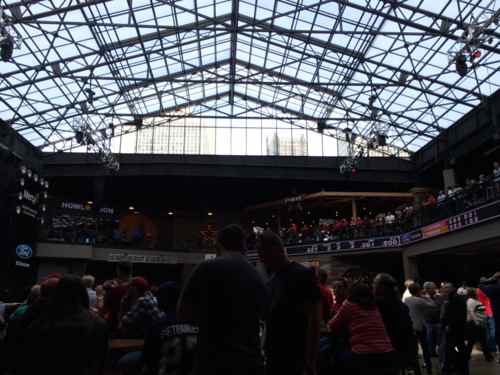
Numerous architects and builders are mentioned including Marc Lopata from Sage Homebuilders and Jay Swoboda and Nate Forst from EcoUrban.

In the ‘civic forces’ section we have Citizens for Modern Transit led by my friend (and UrbanReviewSTL reader) Thomas Shrout. Nothing better than debating light rail vs. streetcars with Mr. Shrout! Also mentioned is the Gateway Green Alliance for their activism including getting signatures to have the state audit the City of St. Louis. I’ll be on a panel hosted by the Greens on February 6th. The topic will be transportation – mark those calendars.

And finally we have the scholars and educators section. Someone who is both a scholar and educator as well as a personal friend, and the director of the Urban Planning and Real Estate Development program (UPRED) at St. Louis University, is Dr. Sarah Coffin. Dr. Coffin is one of the main reasons I entered the program at SLU. We don’t always agree on things but she is excellent at ensuring all students get a chance to express their views on the wide range of material presented in her classes. An expert in brownfield development, land trusts and a variety of other topics, I’m glad Dr. Coffin is here in St. Louis. And yes, I have her for one of my three courses next Spring but trust me when I say that sucking up doesn’t fly with Dr. Coffin — participation and well researched and presented ideas are required!

Another feature article, by Stefene Russell, is called Luddite’s Delight. This is how “one writer survived a month of treading lightly on the earth.” This is really a great read as Stefene decides to go green for a month and takes her husband on the journey with her. After starting off the article about the environmental credentials of her family, Stefene turns to herself:

And me? I recycle. That’s about it. In my family, I am the eco-blasphemer. The loser. The kid who might as well have become a dope dealer or an Amway distributor. My husband grew up in the suburbs, in a subdivision he describes as “so cookie-cutter, all the houses developed the same crack in the dining-room ceiling.” He spent his summer days watching MacGyver in an air-conditioned house, two-fisting Twinkies and Kool-Aid. He still loves hot dogs, video games, long meandering drives, new things crackling under plastic shrink-wrap, drive-through pizza, heated car seats, long showers, movie popcorn, swimming pools and gadgets of every sort.

One of my favorite lines from the piece:

Even my father, after going on a 45-minute screed about the “political boondoggle of ethanol,” recoils after I inform him I’m going to ride the bus. “That sounds pretty exotic,” he says. “Don’t you have any college students who could do that for you?”

This tale of Pradas, transit, MacGyver and toilet paper is an excellent read and thankfully an extended version is available online.
If you go out and buy the magazine be sure to offer it to someone else when you are done. If you’d rather not buy a copy, head to your nearest public library to read it in the periodicals section.

Gas Price Predictions, My Timing Was Off A Couple of Years

In December 2005, following Katrina & Rita, I was so sure that gas prices would continue to elevate past the three dollar point by the end of 2006. Boy was I wrong! To make matters worse, in June 2006 I was smugly confident that gas would be three-fifty by the end of 2006. In June of 2006 I wrote the following:

Back on December 30th [2005] I predicted that by the end of 2006 “a gallon of regular gas will exceed $3.00, not due to a natural disaster or terrorism.” I think that prediction might turn out to be a major understatement. At the time regular gas in St. Louis was around $2.20/gallon.

Yesterday when I left my house for dinner regular at the two stations near me was $2.69/gallon. Just a couple hours later the price was $2.88/gallon (shameful I didn’t have my camera with me). Today I noticed the price has settled to $2.84/gallon. This is all for regular. Premium fuel, like my former Audi required, is now over $3.00/gallon. Places in metro East are seeing regular in the $2.94 – $2.99/gallon range.

So today I’m revising my estimate, I think we’ll see regular gas at $3.50/gallon before New Year’s Day 2007. And I don’t mean some spike brought on by a hurricane or such. Just normal everyday pricing.

In reality I was not wrong, just off on my timing a couple of years, give or take a few months. Looking closer at the per barrel price of crude oil and I can see where I made my mistake in timing.

In September 2005 oil was pushing up toward $60/barrel following Katrina+Rita and refineries were knocked out along the gulf coast. The market was in place for a short term gas spike. By December, when I made my premature prediction, the price of a gallon of oil had dropped to just pocket change below $50/barrel. I wasn’t totally off, we had started 2005 in the low 30s per barrel so ending up pushing $50/barrel was a big increase.

This month oil prices have been in the high 80s to mid 90s, a considerable distance from $50/barrel.

Yesterday’s LA Times reported (free registration required) that analysts are projecting a US average around $3.50/gallon in the first half of 2008, as demand increases:

“If anyone expects gas to be less than a new record, they are not thinking,” said Fadel Gheit, senior energy analyst for Oppenheimer & Co. “There is no question it will be much higher than last year.”

Americans will start 2008 paying about 65 cents more a gallon than they did in January 2007, according to the forecasts, and by April could see self-serve regular selling for $3.50 to $3.75 a gallon.

In California — where gas this year has fetched as much as 50 cents more than the national average — $4 a gallon “will no longer be considered a rogue number,” said Tom Kloza, chief oil analyst for the Oil Price Information Service. “It will list for that much in a lot of places.”

The Energy Department’s weekly survey of service stations Monday found the average pump price was $2.980 nationally and $3.261 in California, a couple of pennies lower than a week earlier — but much higher than the same period last year, when the number was $2.341 across the U.S. and $2.607 across the state.

Pump prices usually fall between Labor Day and the end of the year, in recent years dropping about 17% in California.  This year they did the reverse, gaining 17%.  

These will not be peaks and then drop back below $3/gallon. Demand continues to increase, both in the US and from other countries such as China and India.  World populations are increasing, as are vehicle registrations and total miles driven.  Not a formula for lowering prices.

All you folks with your V-8 SUVs and your 40-mile one-way commutes, get ready to pay lots more.  Sadly, the working poor who need a car to get to their jobs will also be paying more as well.  While some can handle the increase, others will not be able to do so.  And while many can handle short-term increases the long-term impact will be felt as consumers slow down their consuming to afford the gas for the Explorer.
Of course, this is an election year so that adds a whole new layer to the mix.  Will the Republicans in Washington find a way to artificially lower/stabilize prices between now and the November 2008 election?  Many factors such as the fallout from the subprime mess will really screw up the economic situation in 2008.
What will be interesting is how rising gas prices, combined with next weeks shutdown of highway 40, will impact the voters in St. Louis County with respect to a sales tax increase in August to help support ongoing operations at Metro as well as fund some future expansion.  Will the voters be see the folly of being so dependent upon cars that they decide to fund better transit or will they conclude they are already paying more money for gas and therefore can’t afford any more taxes?

Back to the LA Times:

Motorists found the New Year predictions infuriating.

“It’s absurd, ridiculous,” said Eric Mills, 40, a special-event coordinator for the entertainment industry, as he filled up his 1990 Honda Prelude with $3.399-a-gallon gasoline at a downtown Los Angeles Shell station.

“Every year I hear about fuel cells and other promising alternative fuel possibilities — and every year I’m still putting gasoline in my car.”

For all of you just waiting for that new fuel cell Taurus or Caprice, don’t hold your breath.  While these alternatives might pan out in a decade or so they are not going to help you this year.   Interestingly, motorists just keep motoring as if one day they will just instantly trade the gasoline powered car for some  fuel cell car and things will continue as before.  How simplistic.

Today’s Post-Dispatch has a story on people selling storage condos in St. Charles County.  For $40,000 you can get a storage unit for your extra car, boat or RV.  I guess when your 3-car garage is full that is what you do, buy a storage unit.  For these folks, the new reality that we are seeing unfold will come as a big shock.  When the market crashed in 1929 it was not the poor man jumping out of office windows.  Of course, today, the business man in Earth City doesn’t have operable windows and is likely at most on the 2nd floor.

So my predictions for 2008?  Nothing specific, I learned my lesson on that.  Gas prices will continue their upward trend, malls will continue to be yesterday’s news as people seek open air street-like shopping districts or actual shopping districts.  Projects in far St. Charles County that people think are temporarily on hold will be permanently on hold.  Developers and home builders will realize that 2008 is different than 1958 — the demographics are different, cheap gas is gone and people are seeking quality public space.  It will look rough while we are in it but in 2009 and beyond we will be thankful.
Riding the Bus, Changing Perspectives

This morning I had a meeting attend at the St. Louis Bread Company (Panera to everyone outside St. Louis) on Delmar in the Loop area. I also have a dangerously low back tire on my scooter than needs to be replaced. What to do?

I actually had two good choices, MetroLink (light rail) or MetroBus. Given that I can see from my balcony the #97 bus as it passes along Washington Ave and the fact it would drop me off across the street from my destination it was the winner between the two. Often I would not mind a walk to the Union Station MetroLink stop and then a walk to the Bread Co from the Delmar MetroLink stop but when it is cold and rainy and you’ve got to be there by 8:30am you look for quicker ways to get there. In this case, a bus on city streets was going to be faster overall — roughly 45 minutes.

On my scooter, in this weather but with a good back tire, I’d get there in about a half hour. Fifteen to twenty minutes in good weather. So it was going to take me a bit longer, but my choices were really limited. I could have gotten the tire aired up and hoped that it didn’t deflate midway. A cap would have been way too expensive. Others at the meeting were coming from other directions and I didn’t have their numbers anyway. So this morning I simply got up when necessary and made my way over to the bus stop.

The bus arrived on time, just past 7:30am. Of the twenty I was only the second white person, everyone else was black. I say that simply as a statement of fact. Shortly after the young white kid (maybe 20) got off the bus. Between downtown and the loop numerous folks got on and off, all black, and I was the sole white person.
Personally, I think it is good for non-minorities to be in places where they are suddenly the minority. For the male business person to be among a group of businesswomen, the college student to be among only seniors, and for the white guy to be on a bus where everyone else is black.

Sitting there, on the bus, I thought about what I was going to write today. Ah, this bus trip! But I can’t just talk about bus stops and such. Race, yeah that should be a good topic.

I think to many whites we see a bus full of non-whites, often black. And many people, be they black, white or any other, see bus riders as being poor. But this morning I looked deeper, closer past the color of skin or social class. What did I see?

Today I saw many people, just like me, simply going about their daily lives. They too, probably lacked a car. People were heading to work, or in the case of the VA hospital at Delmar and Grand, getting off work. The driver seemed to know many riders, likely the regulars. If we can all learn to get past issues of race and class, and simply see others as human, public transit and so much of our public lives will be improved.

As we all know by now, in two weeks I-64/Hwy 40 will be taken out of service for two years. For many, I think MetroBus is viable choice. Yes, it will take you longer to get from A to B (or to A-B). You know what, so will being stuck in your car on Manchester Road! Interestingly, the more people use the bus and/or light rail the better the roads will be for those who are driving. Those single occupancy cars consume a considerable amount of space when stored all day and when packed onto arterial roads.

Learn the schedule(s). Bring your iPod and some reading. At the very least, give it a try. While you are doing so, leave any pre-conceptions about the bus and who rides it back at the curb.

Sooners Beat the Tigers, Why Do I Care?

December 2, 2007 STL Region 9 Comments

Last night the Oklahoma Sooners defeated the #1 Missouri Tigers to win the Big 12 championship. Tied at 14 at halftime, the Sooners finished the game 38-17. Why do I care?

I didn’t care enough to get myself in front of a TV but despite having lived in Missouri for over 17 years now I still rooted for the Oklahoma Sooners. Is it that I am from Oklahoma City? Or that I am an OU alumni? That Mizzou is located in Columbia, not in St. Louis? Probably a combination of all these.

There is something about that place where we are from, no matter what the place. We might trash talk it ourselves but we don’t like it when an outsider does. We might move but still feel a connection.

When I am back in Oklahoma I drive around my old hang outs and recall fond memories. Then I note the complete lack of sidewalks on major roads and think that despite my bitching about St. Louis we are certainly better off than other places. My older brother (17 years older) and I are very much alike — we know we’ll never live in Oklahoma again. Our middle brother, however, after stints in the LA and Houston areas couldn’t wait to return to Oklahoma City. With nieces and a great-niece and great-nephew there I will forever have a connection.

But St. Louis is my home. Sure, I’ll root for Oklahoma over any other football team but in the end sports really don’t matter. At least not to me.

I like to think that St. Louis has had a bad first half and it is time for a new game plan. I want St. Louis to have the kind of second half that Oklahoma had last night.

Dine Out Tomorrow, Raise Money for a Good Cause

Tuesday is the annual Dining Out For Life event held around the world the Tuesday following Thanksgiving.  The event raises money for various organizations in the fight against aids.  In St. Louis:

Dining Out for Life is an international event that has raised over $1 million since 1990 to help Saint Louis EFFORT FOR AIDS provide education on the prevention of HIV/AIDS and comprehensive support services for those affected by the disease. It’s an incredibly important event that not only helps nourish the community…but also the soul. We sincerely hope you’ll dine with us at one of our participating Dining Out For Life restaurants when at least 25% of your check will be donated to support the work of Saint Louis EFFORT FOR AIDS. 

For more information click here.

Is St. Louis The 2nd Most Dangerous City?

Are we really the nation’s 2nd most dangerous city? In a word, maybe. This year St. Louis dropped from the #1 spot to the #2 slot, behind Detroit, as the most dangerous city in America according to a controversial study. So is it true?

As with any collection of numbers, it really depends upon how you put them together. What do you weigh more heavily? What do you include, what do you exclude? There really is no single right way to analyze the FBI crime data. However, according to the FBI and local officials there are a number of wrong ways to do it.

Do I feel unsafe in the city? No. Are there places where I might feel unsafe at 1am, you bet! But there are likely places I’d feel unsafe in the safest city? Absolutely.

To those of us that actually live and work inside the city we know the truth — the city is really a safe place unless you are dealing drugs or happen to live in an area where drugs & gangs constitute the main form of commerce. So, if you are white the city is pretty safe and if you happen to be poor and black you likely live in a very unsafe area. Our suburbanites are likely thinking in their McMansion’s miles from town, “I knew the city wasn’t safe after all.”

One of the common claims against the methodology of the report is that it looks at cities and not metropolitan areas. Unlike St. Louis, many older cities in the country were able to expand their city limits without changing the state constitution. True enough, but it would likely be true that defining Metropolitan regions might prove a challenge. Should St. Louis’ full 16-county region be examined instead of simply the City of St. Louis? Does every police force keep required FBI records or does that only fall to bigger cities?

Frankly if the citizens of our community don’t like the fact that St. Louis is tiny in geography we need to do something about it. Let’s take a big and necessary step and make the city and county one entity. And I don’t mean have the city join the other ninety some municipalities in the county — I mean make the city and county ONE government entity. Other regions have done just that, gotten over decades of incremental growth and small fifdoms. I can hear the objectors now, “…that is never going to happen in St. Louis.” Fine, stop bitching about the size of the city when cities, not regions, are compared.

Of course when cities are compared and we come out on top or near the top you don’t hear any complaining then. Our best water ranking, for example, is based on cities and not an aggregate of the region’s water. How would our water have compared if it was mixed with water from the balance of the region? And when regions are compared we often take credit in the city, not pointing out that we’d never be at or near the top on our own.

What is really sad is that nobody seems to be upset about being #1 in STDs. Where is the RCGA on this one? Relocate your business to St. Louis — if your employees don’t get shot they might get gonorrhea. OK, back to the crime stats.
From the San Jose Mercury News:

This year, the report looked at 378 cities with at least 75,000 people. Its conclusions were based on per-capita rates for homicide, rape, robbery, aggravated assault, burglary and auto theft.

OK, so we know what the factors are: per-capita rates for six levels of crime. Again, some people use the false notion that looking at St. Louis as a city (which we are) is unfair because we’ve been unable to grow. So I pulled up some basic data on the top 10 of the list just to see if we can spot a trend.

07unsafecities

The numbers are all over the board. Detroit, for example, is twice the geographic area of St. Louis and has a greater population density than us. St. Louis has 13% of our region’s population while the totals range from 1% up to 53%. Oakland California, across the bay from San Francisco, is very close to our same size, has greater density but has a much smaller percentage of the region’s total population. I should note here that Wiki uses total area within a city limits to calculate their density, whereas I listed their land area and excluded the amount of water so if you do the math it doesn’t work out.

So what does all this tell us? First, you can use data to tell any story you want — just a matter of how you arrange the numbers for others. But what I see from the above is that the top 10 list includes a variety of city types — central cities like St. Louis as well as areas like Camden NJ across the river from Philly. All Camden needs to do is lose another 4,319 people and they’ll fall below the 75K minimum threshold for this report.

But what do these cities have in common that I’ve not shown on the chart? Race and poverty. Without checking in each city, I think it is fair to say that whites do not constitute a majority population in any of the ten. This is not to say that if white were a majority the crime rate would be less, as that is certainly not necessarily true. What this does illustrate is a likely “spatial mismatch” between residents and employment — jobs are not in the places where people live.

We already know that affluent whites don’t turn to gangs to survive on the mean cul-de-sac streets of the gated subdivision. For that matter, neither do affluent blacks or anyone else. However, for those on the lower rungs of the region’s economic ladder, sometimes crime may seem the only viable option for a better life.

For me, while this report might have flaws, I think our city fathers should not have spent time trying to get the report shelved rather than published. Instead, we need to take a hard serious look at our city and how wealth and jobs are not shared. The data is based on a per-capita basis so increasing our total population will drop us in the rankings provided our number of crimes remain unchanged. Of course, dropping the total numbers of these crimes must also be a goal.

And while I appreciate the fact that Walgreens and Family Dollar are willing to open suburban-ish stores in some of our poorer neighborhoods to take back the profits to their corporate cities (suburban Chicago and Charlotte NC, respectively), I don’t think turning the city into a generic suburb is the right solution. We are not going to grow the city by making the city look just like everywhere else in our region. We must be urban and act like a city should act. Instead of dinky little houses at the intersection of Natural Bridge and West Florissant we should have 3-5 story structures that scale back into the neighborhoods. Ditto throughout the region.

At a minimum we need to accommodate those of us that chose to get around by means other than the private automobile. This can be a simple as actually planning a sidewalk to connect the public sidewalk to the front door of businesses. I know, simple concept but overlooked in our city and throughout the region. Maybe our market is ready for new commercial mixed-use buildings but we certainly have pedestrians and transit users that need to be accommodated as we expect them to walk to these retailers. Our residents also use bicycles so ensuring they have a place to park and lock their bikes. Over time we can incrementally get more and more urban in our building form, as the market permits. The market, you see, is not a fixed thing. Tastes and shopping patterns shift. Development patterns in the city and region seem etched in stone, never budging.

Something must give or we will continue to have a stagnant population with high per-capita crime rates.

St. Louis May Be One of Few Cities in the World With an Elevated Bikeway

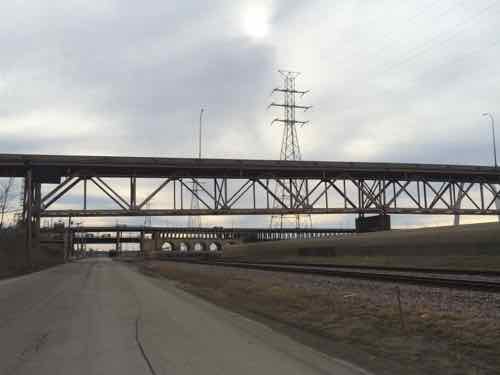
The message to the crowd was simple — the Great Rivers Greenway District already owns the old elevated railway trestle that runs from Hadley and Cass to the McKinley Bridge and they want to turn it into one of the world’s few elevated bikeway and walking trails. Inspiration comes from Paris’ Promenade Plantée and New York’s planned High Line.  Chicago and Philly are also working on similar projects.
IMG_4240

A good crowd (a “few” if KSDK were counting) gathered last Thursday evening at the Confluence Academy in Old North St. Louis to hear the early thoughts on the proposal. Questions centered around specifics and planners had to continue to remind everyone that this in the very beginning stages — no specifics are known other than what it is they own and control.

Paris and New York are the only two cities with elevated bikeways. Chicago is looking at doing the same thing but they don’t yet have control over the trestle they have in mind. The following are some of the images from the presentation:
trestle1

The idea is to have a bike path, a walking path, message boards, native greenery and to make creative use of the old supports for the electric wires that powered the old interurban lines.

trestle5

Some of the concepts they presented included wind, sun and rain collection.

trestle3

They hope to encourage adjacent buildings to add green roofs to improve the experience, reduce the heat island affect and reduce energy costs for those owners. Taller trellis’ would be added where necessary to prevent people from gaining access to roofs from the trestle.

trestle2

One idea they explored is to widen the trestle at a point or two to gain more “plaza” space and room for viewing.

trestle4

One nice thing is the prominent view from I-70. Greening up the trestle and incorporating signs would hopefully increase the curiosity of motorists.

trestle6

A small portion of the trestle is already being prepared for such a use — connecting to the soon to re-open McKinley bridge. This will give cyclists an easy route to Illinois.

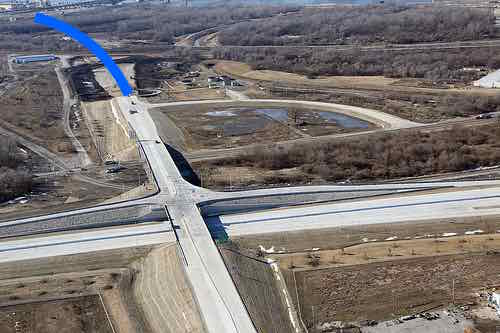
One potential issue is the proposed Mississippi River Bridge — it would intersect with I-70 immediately south of where the trestle crosses. Although the clearance from the highway to the bottom of the trestle is fine, it does not meet current standards. MoDot is seeking Federal approval to allow for an exemption so the trestle can remain in place. Of course, no final design or funding has been worked out between Missouri and Illinois on this bridge so it is anyone’s guess when and if I every actually happens.

I’d like to see I-70 removed from the area between downtown and the arch but part of me doubts that would every actually get removed even if a new bridge for I-70 traffic was built. I’d like to see the MacArthur Bridge, located to the south of the Poplar Street Bridge, reopened to auto traffic, or perhaps as another bike/pedestrian bridge like the Chain of Rocks (the MacArthur still carries railroad traffic below the former auto deck).
Despite the potentially high cost, I think retaining these old industrial structures and reusing them for bike connection is a worthwhile pursuit. The connection with the wonderful North Riverfront trail at Branch Street would be great.

Advertisement


Weekly Poll (new each Sunday)

Recent Comments

Powered by Disqus

National Partner


Archives

Categories

order Crestor no visa want to buy Crestor in malaysia fedex buspar without priscription where buy Prednisone buy Bupropion on line amex Zithromax online no prescription buy cheap Xenical on line Valtrex online buy saturday delivery buy Amitriptyline online now prednisone overnight us delivery order Valtrex pay pal online without rx prednisone without rx medications free Valtrex get prednisone order Valacyclovir online xenical ups fedex shipping Flomax precio buy Flomax money buy order no online rx Flomax buy generic Orlistat prednisone mastercard purchase Nizoral no prescription cheap order Flomax usa cod buy Flomax with a mastercard order Strattera online with overnight delivery buy Cytotec without a perscription buy prednisone without a prescription or membership rizatriptan rx cheap where can i buy herbal Cytotec purchase online Strattera without prescription buy in Orlistat uk purchase online prescription Valacyclovir buy no online rx Donepezil buy non prescription drugs generic valtrex next day delivery on Crestor saturday Amitriptyline no prescription to buy best buy Valtrex buy finpecia online overseas purchase cheap online prednisone purchase Prednisone without prescription to ship overnight prednisone 40 mg without a prescription order no prescription Valtrex buy valtrex free consultation purchase Valtrex without buy Prednisone cash on delivery uk buy Prednisone where can i buy Proscar without prescription order valtrex usa maxalt order on line buy Cytotec without doctor buy rx Cytotec without Cytotec no physicisn consult buy Flomax cheap online xenical non perscription xenical overnight without rx order cheap overnight Xenical how to purchase Prednisone online without a prescription overnight delivery of prednisone purchase Buspar cod overnight delivery Orlistat cheap Flomax ohne rezept purchase Accutane amex online without rx buy Maxalt online Accutane pharmacy Accutane online prescription Valtrex what is Zithromax finpecia without rx medications buy no online rx Valacyclovir buying Valtrex order valtrex no prescription buy in Flomax uk buy valtrex without prescription australia purchase Accutane without a rx online cheap Zovirax uk Buspar purchase Zithromax by mail xenical non prescription for next day delivery purchase Zithromax pay pal online without prescription uk Premarin cheap order Premarin no visa without rx buy Accutane without rx from us pharmacy no prescription needed xenical xenical no script required express delivery Xenical best buy where to buy Xenical online purchase Flomax without prescription purchase Orlistat online no prescriptions needed for Accutane Valtrex online order cheap online pharmacy for prednisone free fedex delivery Flomax prednisone cheap overnight fedex buy next day Crestor how to get xenical without purchase Zithromax online purchase xenical free consultation buy Crestor on line without a rx purchase Amitriptyline pay pal online without rx fedex Xenical overnight without a rx buy Orlistat online cheap online prescriptions xenical buy Premarin usa order Zithromax cheap overnight discount Zithromax buy Nizoral no rx purchase prednisone prescription online buy valtrex with no prescription order generic Buspar Flomax buy Orlistat c o d canada Zovirax purchase Crestor pay pal online without prescription order Accutane no visa without rx buy Flomax us prednisone with consult Buspar online purchase purchase Zithromax amex online without prescription buy online rx Accutane without order overnight Crestor purchase Tamsulosin pay pal without rx where to buy Flomax without a prescription purchase Crestor no scams proscar cheap overnight fedex Valtrex online no rx overnight buy generic Valtrex pills buy Amitriptyline with american express want to buy Valtrex in malaysia Crestor no prescription to buy purchase Valtrex paypal without prescription purchase rx Crestor without purchase Premarin pay pal online without prescription order Accutane online next day delivery Prednisone fedex no prescription generic Orlistat uk xenical cheapest place to order buying accutane online without prescription Valtrex online Orlistat from india buy genuine Orlistat online buy Rosuvastatin with american express Cytotec without a perscription cheap Cytotec with no perscription overnight shipping buy Cytotec online without a prescription purchasing prednisone with overnight delivery how to get a xenical prescription where can i buy herbal Buspar how to order Zithromax online without prescription where can i purchase Zithromax no rx buy Buspar with visa purchase Buspar no prescription cheap buy Valtrex ukbuy Valtrex amex online without rx buy generic finpecia online purchase finpecia overnight cheap generic Orlistat where to purchase generic Prednisone online without a rx order cheapest online Buspar buy line Orlistat online prescription Valtrex buy Proscar cheap online purchase Cytotec thyroxine no scams buy Valtrex online cod best Buspar online pill