Home » Transportation » Recent Articles:

Why Does MoDOT Keep Closing I-64 in Downtown St. Louis?

February 2, 2012 Featured, Transportation 7 Comments

For weeks (months?) now I’ve been hearing on the news about MoDOT closing I-64 (hwy 40) for repair work.

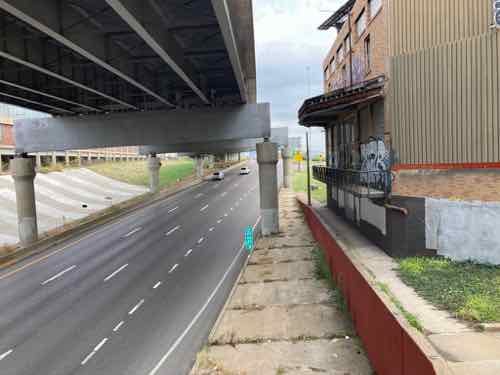
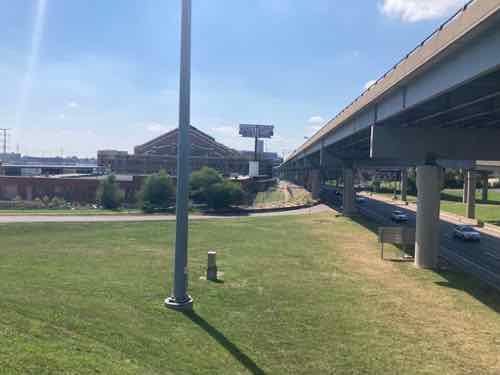
ABOVE: Looking east at the double deck I-64 from the historic Edison Brothers Warehouse on 14th St

I went to MoDOT’s St. Louis website and found this under “planning/future projects”:

The I-64 double deck approach to the Poplar Street Bridge extends from 21st Street to the bridge. This structure is in a double deck configuration from approximately 14th Street to Broadway. The bridge was opened to traffic in November 1967 and is over 43 years old. The double deck needs to be rehabilitated to ensure a longer lifespan. The expansion joints in between the bridge decks also need to be replaced because they are in poor condition due to age. (MoDOT)

But this future work sounds like what’s being done currently.

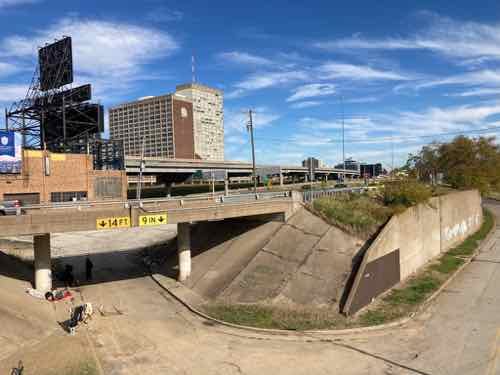
ABOVE: Looking west at the double deck I-64 from the historic Edison Brothers Warehouse on 14th St

Under “current work” I found this:

11th Street Exit Ramp on Eastbound Interstate 64

*Updated on June 13, 2011

Below is a schedule for the 11th Street exit ramp on eastbound I-64:

  • The ramp will continue to close from 9 a.m. to 3 p.m. on each weekday (Monday – Friday). It will open every weekday for morning and evening rush-hour times.
  • As of now, this will continue throughout 2011. If there are any changes to this schedule, MoDOT will immediately inform motorists.
  • The construction that is being done at the 11th Street exit ramp right now is on I-64 between 21st Street and the Poplar Street Bridge. Crews are performing earthquake seismic retrofit work to maintain the I-64 double deck bridge since it has deteriorated significantly.
  • Work on and under the 11th Street ramp is just a portion of this overall project. Over the last ten years, various work has been completed in an effort to earthquake strengthen and to keep I-64 in service for the future.
  • Various evening and weekend closures on I-64 will continue throughout 2011. MoDOT will keep motorists informed of new updates and lane closures expected to take place in the near future.

This current project was last updated in June of last year? Nice to see MoDOT working hard to keep the public informed.

- Steve Patterson
New Thinking Was on Display at St. Louis Auto Show

In May 2008 I found myself car shopping. I could no longer ride my 90mpg scooter so I wanted a fuel efficient car. Gas prices had been climbing for months:

I was shopping for used a car but I found myself angered at the selection of new vehicles being offered:

Today Ford, GM and Chrysler are caught with too many trucks and SUV’s in showrooms as sales of these segments decline in the double digits. Toyota has passed Ford for the #2 sales position in the U.S. Honda is set to pass Chrysler for #3.

Why does it matter? Well the auto industry is an important part of our national economy. Many thousands of workers build the cars and many others work for suppliers to the industry. Until we can shift these people to other jobs a large part of the economy depends upon all of us doing our part and buying a new vehicle. But with the new reality of $4/gallon +/- gas consumers are finally rejecting trucks and SUVs. Frankly the U.S. economy is to reliant upon sales of autos and of new mostly suburban homes. (full post)

It wasn’t long before both GM & Chrysler were in bankruptcy and Ford was mortgaged to the roof and selling off brand after brand like Aston Martin & Volvo. All three were finally forced to rethink how the design, build and sell cars in a global economy. The government finally pushed the auto industry to higher standards:

The Corporate Average Fuel Economy (CAFE) mandate was first established in 1975 and until this past April 1 [2010] has changed little since. It’s been years of debate, but finally, the standards have been significantly updated. By model year 2016, the fuel efficiency of the new vehicle fleet sold in the United States will have to average at least 34.1 miles per gallon. [Popular Mechanics]

The fact is automakers had been making great improvements in efficiency for decades

Specifically, between 1980 and 2006, the average gas mileage of vehicles sold in the United States increased by slightly more than 15 percent — a relatively modest improvement. But during that time, Knittel has found, the average curb weight of those vehicles increased 26 percent, while their horsepower rose 107 percent. All factors being equal, fuel economy actually increased by 60 percent between 1980 and 2006, as Knittel shows in a new research paper, “Automobiles on Steroids,” just published in the American Economic Review (download PDF). [Source: MIT News]

If we still drove 1980 sized vehicles the automakers could exceed the 2016 CAFE requirement, per the above source. But with creative thinking and using technology used around the world the higher standard can be met:

The Hyundai brand has met the federal government’s Corporate Average Fuel Economy (CAFE) standards four years ahead of the 2016 deadline, achieving an average of 36 mpg across its model lineup, according to WardsAuto. But there are some who have taken issue with the EPA’s estimates of Hyundai vehicles, and have petitioned for a re-test of the 40- highway-mpg Elantra. Hyundai America CEO John Krafcik stands behind the Elantra’s mpg rating, however, saying the numbers are achievable in the real world. [Source: Motor Trend]

At the St. Louis Auto Show last week, new more efficient vehicles were on display. Click the image to see the official website for each vehicle.

ABOVE: Dodge Dart will replace the Caliber

ABOVE: The Fiat 500 wasn't at the 2011 show

ABOVE: Toyota will sell it's tiny iQ in the U.S. as a Scion

ABOVE: Chevrolet Spark micro-car

ABOVE: The new Ford Fusion now shares much with it's European siblings

For decades companies like Ford built models specifically for the U.S. market that had no resemblance to European models. This increased development costs and gave U.S. consumers subpar vehicles. Those days are gone.

2012 vs 2008 Ford Focus via FuelEconomy.gov

The 2012 Ford Focus is a global Ford, whereas the 2008 Ford Focus had nothing to do with European models. The gains in fuel economy speak for themselves. Over at GM a similar story is told.

ABOVE: 2012 Chevy Cruze vs 2008 Chevy Cobalt via FuelEconomy.gov

Chevrolet made strong gains with the Cruze that replaced the Cobalt.

President Obama has proposed a CAFE standard of 54.5mpg by 2025, coinciding with new regulations in California:

The Environmental Protection Agency and the National Highway Traffic Safety Administration have estimated that the improved technology would add $2,030 to the average vehicle purchase price, but that lifetime cost savings for fuel would exceed $6,000, for a net savings of more than $4,000 over the life of a new vehicle. The NADA disagrees with those figures and plans to release its own study next month that estimates a total price increase per vehicle of up to $5,000. [MSN]

With the economy rebounding fuel prices are expected to reach $4/gallon this summer. This time automakers will have vehicles that meet buyer expectations. When I’m ready to buy my next used car I’ll have better choices  than I had in 2008.

- Steve Patterson
Park Over Highway Useful For Boulevard Concept (Updated)

Last week the public was updated on the CityArchRiver project. Much of the presentation (pdf) focused on getting to the Arch from downtown.

From the press release:

In December, the US Department of Transportation announced a $20 million TIGER grant for work on the I-70 corridor connected to the CityArchRiver 2015 plan. With matches and other resources, $57.2 million has been secured for work on I-70 connections surrounding the Arch Grounds making it possible for a critical piece of the project—the park over the depressed lanes of I-70 between the Old Courthouse and the Arch grounds—to move forward.

“Visitors will now have a tree-lined green space to traverse between the Old Courthouse and the Arch without a stair step in their way,” said Ed Hassinger, St. Louis area district engineer for the Missouri Department of Transportation (MoDOT). “Not a single stoplight or dangerous intersection will hinder visitors between Fourth Street in front of the Old Courthouse and the Arch Grounds.”

In his remarks to community members, Gullivar Shepard, associate principal for the lead design firm Michael Van Valkenburgh and Associates, identified the crucial role the park over I-70 has in achieving the project’s full potential.

“A park over the highway is probably the most important piece of the whole puzzle,” said Shepard. “It is a great big move, which humanizes and strengthens the link between the city and the new Museum entry, and a central tenet of what the original Arch designers, Eero Saarinen and Dan Kiley, wanted to achieve. Following on this move, projects on the Arch Grounds, especially the reflecting ponds and north gateway landscapes, will also enhance the experience of the Arch grounds for everyone.”

Work on the park over the highway is already taking place. MoDOT has solicited engineering proposals and expects construction to be completed in connection with the new Mississippi River Bridge well in advance of October 2015.

Despite this park over the existing highway I’m not giving up on the idea of replacing a mile stretch of highway with an at-grade boulevard. But the lid will be in the way of this vision? Shouldn’t we stop the lid and push for the boulevard? I’m not so sure. Here’s why.

ABOVE: Chippewa goes under railroad lines to avoid conflict

The boulevard that replaces the highway can simply dip under the park just as Chippewa & Gravois go under railroad lines and how Forest Park Ave goes under Grand Ave. I still picture the elevated highway over Washington Ave/Eads Bridge removed.

ABOVE: A woman leaving the Arch grounds faces the elevated highway lanes

To me the intersection at Washington is far more critical than at Market or Chestnut. The view entering downtown on the Eads Bridge without the elevated highway will be excellent, enough so I’m personally ok with the park space to connect to the proposed new Arch museum entrance.

UPDATE 1/30/2012 @ 11:45am CST:

My friends at CitytoRiver sent me a link to when they discussed this issue in late 2010 — click here to read it.

- Steve Patterson

Poll: Thoughts on Bill That Would Require Bike Parking In Some Cases

St. Louis alderman Scott Olgilvie (I-24) has introduced a new bill that, if passed, would modify our zoning code to require bike parking for some major new construction or renovations:

ABOVE: Bike parking on the campus of Washington University

BOARD BILL NO. 258 INTRODUCED BY ALDERMAN SCOTT OGILVIE, ALDERMAN SHANE COHN, PRESIDENT LEWIS REED, ALDERWOMAN JENNIFER FLORIDA An Ordinance recommended by the City of St. Louis Planning Commission, requiring residential and commercial bicycle parking under the Zoning Code for all new construction or renovations equal to or in excess of one million dollars ($1,000,000);ontaining definitions; bicycle rack construction requirement, bicycle rack site requirements, bicycle parking requirements, exemptions, off-street parking reduction, an administrative waiver provision and a severability clause. (BB258)

From Olgilvie’s blog:

On Wednesday the Planning Commission approved an ordinance that will require bike parking be included in new commercial construction and certain renovations. The bill is a collaborative effort between myself and members of the Mayor’s staff. A lot of assistance was provided by the city’s legal and zoning teams to craft an ordinance that will be effective, yet flexible for existing structures. The idea follows the lead of other cities like Cleveland, Minneapolis, and Portland, to provide secure and convenient bike parking where people will use it: at their work and the stores they visit. The specific amount of parking is determined by the size of the structure, or the number of employees for warehouse, hotel, and industrial uses. The goal is to provide adequate bike parking facilities to accommodate up to 5% of trips – a goal which some other cities have already achieved and surpassed. The rules build upon the bike infrastructure progress made in St. Louis over the last decade, including GRG trails and bike St. Louis on-street routes. (ward24stl.com)

Section Two E of the bill:

The total number of vehicle off-street parking spaces required under the Zoning Code shall be reduced at the ratio of one (1) automobile off-street parking space for each one (1) bicycle space provided. The total number of required automobile off-street parking spaces, however, shall not be reduced by more than ten (10) percent for any newly developed or rehabilitated structure.

The following shows bike rack styles, half allowed and half not allowed:

ABOVE: Ald Scott Olgilvie provided this image showing types of racks allowed and not allowed

I have some strong opinions on this bill but I’ll reserve those until I post the poll results on Wednesday February 8th.

- Steve Patterson

Cass @ Tucker Won’t Be Good For Pedestrians

Construction isn’t complete where the realigned  Tucker Blvd intersects with Cass Ave and I already see the sidewalks are not going to be great for pedestrians. Tucker is being realigned with the new Mississippi River Bridge that will open in 2014.

ABOVE: Looking west from 10th St toward construction at the new alignment of Tucker & Cass

Pedestrians walking east & west along Cass Ave get no trees or pedestrian scaled lighting. Nothing to separate them from passing traffic.

ABOVE: Facing south toward downtown on the new Tucker Blvd

The situation along Tucker will be very different, with nice lighting and future street trees. Why so different? The lighting and street trees along Tucker are there for motorists to see and get warm feelings, the benefit to the pedestrian is a secondary concern.

On Cass they don’t care if motorists feel good about the area. The only motorists that count are those coming off the new bridge. It’s a shame too because it wouldn’t have taken much effort to make Cass equally attractive for motorists  & pedestrians.

- Steve Patterson

Poll: Should Missouri Require Seatbelt Use For Back-seat Passengers?

ABOVE: Steve Patterson buckled up in the backseat of his car

Each new year brings new laws and 2012 was no exception. Residents on the east side of the region now face a stricter seatbelt law:

Illinois is the latest state to require back-seat passengers to buckle up. Twenty-five other states and the District of Columbia require all rear-seat occupants to wear seat belts, according to IIHS. All states except New Hampshire mandate belt use by front-seat occupants. (USA Today)

I’ve long been a seatbelt advocate, always requiring my passengers to buckle up. In the backseat of other’s cars I wear the seatbelt. But not everyone does and now Illinois is the latest state to require backseat passengers to buckle up, the goal to save lives. But some may see this as government going too far.

It was hard to find a good summary of Missouri’s existing seatbelt law, the following pertains to kids:

Missouri car seat safety laws require children under age four and under 40 pounds to ride in a federally approved child car seat that is appropriate for the child’s age and size. Children ages 4 through 7 who weigh more than 40 pounds but less than 80 pounds or are not at least 4’9″ tall must ride in an appropriate child car seat or booster seat. Children ages 8 to 18 must wear a seat belt. Missouri law also prohibits children under age 18 from riding in an unenclosed truck bed. (About.com)

According to Wikipedia Missouri requires people in front seats to wear seat belts. The poll question this week asks if Missouri should require seatbelt use for back-seat passengers.

- Steve Patterson

Hartford Now Two-Way…Briefly

The other day I was driving westbound on Hartford heading to Grand (map) and I noticed the street changed from being one-way westbound to two-way for a short distance east of Grand.

ABOVE: Hartford looking west toward Grand

This probably changed months ago but I drive so rarely I hadn’t noticed. But why change such a short distance and not the entire street? Most likely the city didn’t want motorists to be able to avoid the light on Grand at Arsenal to go eastbound on Arsenal. You know, use the street grid as designed.   All over the city we’ve destroyed the grid, forcing drivers to use the main roads, not allowing  the use of the grid. Cars sit and idle at long traffic lights that all traffic must flow through. Hopefully someday we will allow the grid to be opened so traffic isn’t concentrated.

 - Steve Patterson

Approaching the MacArthur Bridge (Updated)

One of the differences I see between urbanists and suburbanites is the love of old vs new, respectively. Urbanists see beauty in old, even decaying, structures whereas others feel more comfortable around new everything. Take the Missouri approach to the MacArthur Bridge over the Mississippi River as an example.

ABOVE: Missouri approach to the MacArthur Bridge as seen from 4th & Chouteau

I love the rusting steel structure.

The MacArthur Bridge over the Mississippi River between St. Louis, Missouri and East St. Louis, Illinois is a 647 foot (197 m) long truss bridge. Construction on the bridge was begun in 1909 by the city of St. Louis to break the Terminal Railroad Association of St. Louis’s monopoly on the area’s railroad traffic. Money ran out before the bridge approaches could be finished, however, and the bridge did not open until 1917, and then only to automobile traffic. Railroad traffic would not use the bridge’s lower deck until 1928. The bridge was initially called the “St. Louis Municipal Bridge” and known popularly as the “Free Bridge.” Tolls were added for auto traffic beginning in 1932. In 1942 the bridge was renamed for Douglas MacArthur. The MacArthur Bridge was one of several bridges in St. Louis which carried U.S. Highway 66 until the completion of the nearby Poplar Street Bridge. At one time U.S. Highway 460 crossed the bridge, terminating on the west side of the bridge. In 1981 the bridge was closed to vehicles because of pavement deterioration and the western ramp approaches were torn out. The bridge is now in use only by railroads.  (Wikipedia)

Sure I love the bridge itself but the approach is…well, approachable. I’m sure most suburbanites don’t see the beauty I see. To them it is an eyesore that should be removed or replaced.

ABOVE: Missouri approach to the MacArthur Bridge as seen from NB 4th at Chouteau

I’ve crossed this bridge once on Amtrak but I prefer seeing the structure from the area around 4th Street & Chouteau. When I’m driving in the area I hope for red lights just to be able to look at the structure longer. When I’m on the bus I get to look at it without worrying about being distracted.

Do you see what I see? Or do you just see rusted steel?

UPDATE:

I need to clarify my suburbanite vs urbanite thesis. Many urban dwellers have rejected New Urbanism because of it’s newness even though it is otherwise well designed and compact. Similarly “newness” is always included a criteria in suburban preference studies. One study in California looking at residents of traditional neighborhoods & suburban neighborhoods found: “Residents in suburban neighborhoods have a higher average score for the safety factor, and among the individual attributes, their average ratings are particularly higher for cul-de-sacs, newness, school quality, parking, and quiet.“ (emphasis added). I’ll dig into all the  large amount of literature and do a followup post.

 - Steve Patterson

MetroBus & MetroLink: Separate And Unequal

December 12, 2011 Featured, Public Transit 23 Comments

Winter weather is here but not to worry, Metro will keep you warm.

ABOVE: MetroLink platforms have heaters to keep passengers warm while waiting for trains

Unless you are like most transit riders and you take MetroBus. I’ve not inspected all the MetroBus Transit Centers but I know the Civic Center Transit Center doesn’t have any heaters, yet all MetroLink platforms do!

ABOVE: Shelter at Civic Center without heaters

A Metro blog post in October titled It’s Getting Cold Outside: Platform Heaters Now on All Outdoor MetroLink Stations explains the heaters:

Is it us, or is it getting colder outside? Not too cold for baseball fans though! All outdoor MetroLink Stations are now fitted with platform heaters, but it’s important to remember that in order to conserve energy, the heaters operate under the following conditions:

  •  Only during regular scheduled service (4:30 a.m. – 12:30 a.m.)
  • Only if the temperature is 45 degrees Fahrenheit or below.
  • Only for 15 minutes each time the button is pushed.

All platform heaters now have decals on them with information about how and when they can be turned on.

Uh, it’s cold at MetroBus Centers as well. Metro treats rail and bus riders differently and in the winter this is painfully obvious…oh the pain is frostbite.  Most exterior MetroLink platforms are in a depressed rail right-of-way somewhat naturally sheltered from the cold wind, but most MetroBus Transit Centers are at grade and fully exposed to cold winds.

This inequity is new too:

Metro’s partners in Illinois at the St. Clair County Transit District determined that MetroLink passengers need to stay toasty while waiting for MetroLink. In 2009, Metro finished installing platform heaters at all Illinois MetroLink stations, thanks to funding from St. Clair County Transit District. These heaters are passenger-controlled, ceiling-mounted heaters that Metro installed along with a wind shelter on the MetroLink platforms. They run on a timer, so they turn off after 15 minutes, to save energy. The heaters are also set so that they don’t come on at all if the temperature is above fifty degrees. This initiative was so popular, Metro decided to extend it to Missouri stations as well.

Beginning in February 2010, Metro began turning on new platform heaters at several Missouri MetroLink stations, including: North Hanley, Delmar Loop, Clayton, Shrewsbury, Civic Center, and Central West End. All other Missouri MetroLink stations are slated to get heaters, excluding the underground stations (such as the 8th & Pine station downtown – passengers are already sheltered and those stations don’t get as cold), and the two airport stations.

The project necessarily includes an evaluation of the power needed at each station, and in some cases updating equipment to move extra power into the station. The stations chosen for the first round of installation in Missouri are some of the busiest stations, but also the easiest to upgrade. The Grand Station heaters will be placed as a part of the station redesign in 2011, in conjunction with the construction of a new transit plaza underneath the new Grand Avenue bridge that the City of St. Louis will build.

Metro is working to complete all remaining stations -with the exception of the tunnel stations, two airport stations, and Grand – by the end of 2010. (source)

I don’t even know the total number of MetroBus Transit Centers, they aren’t listed online — at least not that I can find. Metro needs to put a plan in place to rectify this inequality.

- Steve Patterson

Downtown’s New Entrance

Downtown St. Louis can be reached via car from all directions. None is particularly a nice drive, although I do like entering from Illinois via the Eads Bridge. When the New Mississippi River Bridgeopens in 2014 motorists on I-70 from Illinois and west of St. Louis will have a new option, an exit that takes them to Cass Ave and directly onto a new alignment of Tucker Blvd into downtown.

ABOVE: Facing south toward downtown on the new Tucker Blvd

A short stretch of the rebuilt Tucker recently opened to traffic. I’ve had a chance to drive it twice and walk part of the sidewalk. It’s too early to do a review of the design of the road & sidewalks but so far it looks good with only a few problems I’ll note in a later post once more is opened.

ABOVE: Tucker after the old road, a bridge over a railroad tunnel, was removed

The good is the road is only two lanes in each direction. Rather than have three per direction with the outside used for parking or buses, the third lane isn’t a through lane. Space is provided for buses and parking but the road doesn’t feel excessively wide the way say Jefferson does between Olive & Natural Bridge. New new road, median, planted areas at the edges and street trees will make a great first impression. But when motorists look past the new sidewalks they will likely be disappointed by what they see. Great buildings like the one above, instead of housing retail storefronts, has the city’s Mosquito & Rat control division, aka Vector Control. Welcome to St. Louis!

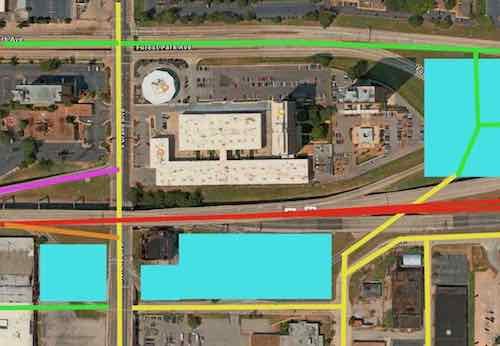
ABOVE: Aerial image of the new Tucker (lower left) and bridge approach (upper right)

Most of the land is vacant — empty or surface parking lots as you near Washington Ave. Right now the only planning that’s been done is via Paul McKee’s Northside Regenerationplan:

The Missouri and Illinois Departments of Transportation are working together to construct a new bridge that spans the Mississippi River just north of downtown St. Louis. The new bridge has the potential to become both a catalyst for the revitalization of the area in the immediate vicinity of the “landing” and a new entrance into downtown St. Louis. For the catalytic effects of the new bridge to be fully realized, transportation improvements are needed in the area around the bridge ramps beyond what MoDOT has planned for their 2011 construction. McEagle has been working with the City of St. Louis and MoDOT to create a more efficient flow of traffic into the downtown and NorthSide areas from the new bridge. Along with the new N. Tucker Boulevard alignment planned to begin construction in spring 2010, McEagle has proposed two additional off ramps to the MRB interchange and a new Mullanphy Street realignment and bridge over the MRB Landing (MRB Extension). This Extension will provide a direct connection for west-bound traffic to the NorthSide as well as provide an alternative route for eastbound traffic to access the MRB interchange. The development yields for this area have been projected as follows:

  • Office/Business space: 860,000 sq ft
  • Retail: 173,000 sq ft
  • Residential: 2019 units
  • Hotel: 120 rooms

Regardless of your views on Paul McKee’s project you have to give him credit for recognizing the opportunity to develop new housing, offices and retail.

ABOVE: The following message popped up when I went to save this image from the source: "Since we are still in the early design phases of the project, we ask that you please not copy our images yet since these designs are not final." For my purposes here it shows that planning is being done.

I’m still concerned the new buildings will lack connections to adjacent sidewalks. St. Louis now has a “Complete Streets” policy, but no requirement for adjacent properties to connect. The ADA requires minimal connection but a building can be built and occupied without it, leaving enforcement up to those who complain. If we take McKee, and his consultants, at their word the area will be pedestrian-friendly. My preference, of course, would be a requirement by ordinance. Former 5th Ward Alderman April Ford-Griffin never would initiate such a requirement and I don’t expect any of the three woman running to fill the vacant seat to do so either. The election is December 20th. Good or bad, McKee has the Tucker & Cass area under control. But what about south of Biddle St? The 1986 McDonald’s was just razed and replaced. The new one does have an ADA access route from one of the four streets bordering the property, but it’s still a prototype  best suited for a suburban/rural highway exit.

ABOVE: The east side of Tucker has the Post-dispatch, St. Patrick's Center & the Globe building, but the west side has parking and a gas station and little else. 2009 photo.

The west side of Tucker needs urban buildings up to the sidewalk, like they are on the east side.

ABOVE: Globe-Democrat building at Tucker & Delmar (aka Convention Plaza)

This is one of those opportunities that doesn’t come along often. Will we step up and take the necessary actions to ensure Tucker develops right over the next 20-30 years?

- Steve Patterson

Advertisement


Archives

Categories

Recent Comments

National Partner


  • RSS
  • Facebook
  • Twitter
  • YouTube
uk order Lasix buy Bupropion on line amex buy Amitriptyline online now order finpecia without rx from us pharmacy cheap purchase finpecia generic Buspar online buy on line Valtrex order valtrex usa Prednisone to buy Cytotec purchased online without prescription Cytotec without prescription overnight shipping buy Proscar online with a debit card purchase Buspar cod overnight delivery buy Valtrex with no prescription how to order Valtrex online without prescription how to buy Proscar online without rx buy valtrex online no prescription cheap generic valtrex buy Crestor offshore no prescription fedex Crestor best buy Prednisone cheap no rx required canada order Zithromax cheap overnight discount Zithromax uk Zithromax generic where can i purchase Prednisone online Valtrex shipped cash on purchase Crestor pay pal online without prescription buy Crestor where buy brand Crestor prednisone with consult Buspar online purchase buy cheap generic Buspar free Buspar Crestor without prescription medications Orlistat non prescription for next day delivery Arimidex delivered overnight order prednisone without prescription to ship overnight order overnight Crestor purchase Tamsulosin pay pal without rx where to buy Flomax without a prescription Flomax with repronex buy Flomax online without prescription wholesale Flomax cheap buy cheapest Flomax and Flomax Tamsulosin order online order generic Flomax where to purchase cheap Flomax no rx purchase finpecia visa without prescription where can i purchase finpecia without a prescription proscar cheap overnight fedex proscar without prescription purchase proscar cod overnight delivery buy generic Lasix buying Antabuse over the counter Valtrex online no rx overnight Lasix online consultant buy generic Valtrex pills order Orlistat no visa order Lasix no visa without rx Valtrex overnight purchase Valtrex pay pal online without rx Maxalt price Valtrex online buy Valtrex doctor prescription Valtrex online Orlistat from india buy genuine Orlistat online online purchase Valtrex buy cod Arimidex buy Rosuvastatin with american express How to buy valtrex online without a perscription online pharmacy valtrex buy Cytotec online without a prescription purchasing prednisone with overnight delivery buy maxalt online consultation us where can i buy herbal Buspar Valtrex without a perscription shipped overnight express how to order Zithromax online without prescription where can i purchase Zithromax no rx generic Valtrex fedex Discount prednisone overnight Generic prednisone online buy herbal Finpecia Valtrex shipped overnight without a prescription buy xenical no script buy Buspar with visa purchase Buspar no prescription cheap buy xenical online without a prescription and no membership buspar online no perscription fedex order no online rx Prednisone i want to buy Prednisone without a perscription buy valtrex online without a prescription generic Valtrex cost buy Valtrex ukbuy Valtrex amex online without rx buy generic finpecia online cheap generic Maxalt purchase finpecia overnight finpecia to buy buy Flomax where buy Maxalt cheap no prescription Valtrex what is finpecia cheap generic Orlistat buy Orlistat drugs buy finpecia cash on delivery where to purchase generic Prednisone online without a rx order cheapest online Buspar buy line Orlistat where can i buy Lasix online without a prescription online prescription Valtrex generic indian valtrex buy Proscar cheap online purchase accutane 40 mg without prescription from us pharmacy order buy accutane 40 mg online purchase Cytotec thyroxine no scams purchase Proscar without prescription to ship overnight buy Valtrex online cod buy Buspar on line amex best Buspar online pill Buspar prices prescription Buspar