A Freshly Painted Crosswalk
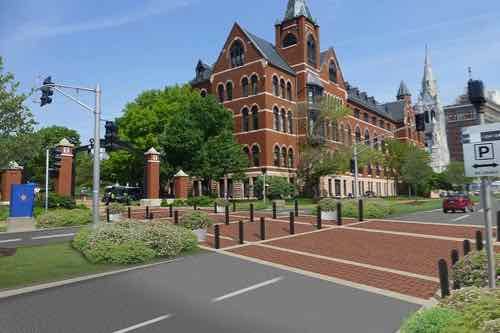
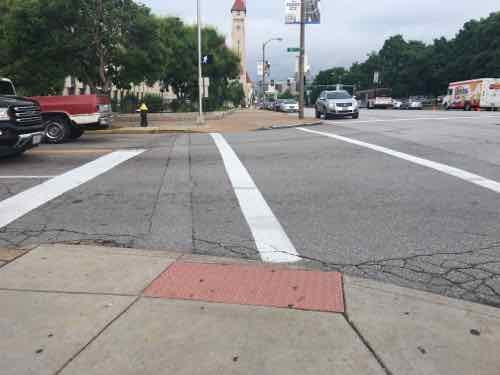
The bold & highly visible “continental” crosswalk at 17th & Olive is such a beautiful sight to my eyes. Â Wish all crosswalks were marked in this way.
- Steve Patterson
The bold & highly visible “continental” crosswalk at 17th & Olive is such a beautiful sight to my eyes. Â Wish all crosswalks were marked in this way.
- Steve Patterson
Recently the humble speed bump was elevated to a political issue, from MayorSlay.com:
“Today, I vetoed an odd little bill that would have paid for the installation of speed bumps in one of the city’s 105 parks. The bill’s sponsor ignored the testimony of the Streets Department that there were better and more effective ways to slow traffic and the opinion of the city counselor that such constructions are legally questionable under state and Federal law.
At my direction, the city’s operations director will work with the directors of the Parks and Streets Departments, the city’s chief engineer, the park’s users, and the bill’s sponsor to find appropriate, effective, and legal measures to calm traffic along that stretch of park road. If the issue is safety, not aldermanic courtesy, that will solve the problem.”
The sponsor was 21st ward alderman, Antonio French, a personal friend of many years. The bill was BB43.
I visited O’Fallon Park to check out the places where French wanted speed bumps, namely two points where the newish jogging trail crossing the main internal road in the park. I can certainly see why he wanted something to slow traffic, neither crossing point is marked other than two faint crosswalk lines.
The phrase “speed bump” doesn’t really apply in the case of O’Fallon Park, speed hump is better:
Speed humps are rounded raised areas placed across the roadway. They are generally 10 to 14 feet long (in the direction of travel), making them distinct from the shorter “speed bumps†found in many parking lots, and are 3 to 4 inches high. The profile of a speed hump can be circular, parabolic, or sinusoidal. They are often tapered as they reach the curb on each end to allow unimpeded drainage.
They are both inexpensive and effective. Â But the mayor questioned the legality in his blog post on the veto:
The mayor is referring to the recommendation he received from the city counselor’s office, which told him in a statement, “since speed bumps are not explicitly permitted in [Missouri Statutes section] 304.120, they logically fall under the category of prohibited obstructions in [section] 229.030.” The counselor’s office goes on to state that the speed bumps would create additional legal liability for the City. (RFT)
At the request of the Post-Dispatch, the local [MoDOT]Â office researched state law on the issue, and found no reference whatsoever to speed “bumps,” which are in parking lots, or “humps,” which are in streets, said Traffic Operations Engineer Brian Umfleet.
And the law, Umfleet said today, typically spells out what is illegal. Roundabouts, for instance, aren’t in state law either. Nor are some of the newer, fancier traffic-control methods, such as the “Diverging Diamond,” at Dorsett Road and Interstate 270 – yet MoDOT builds those, too. (STLtoday.com)

ABOVE: The 2nd point the jogging path crosses road is diagonally from the sign on the left to in front of the dark SUV on the right.
How could these crossings have only two narrow crosswalk lines and no signs at all? I wondered if this was the norm so at first I visited O’Fallon’s south side counterpart, Carondelet Park.
The crosswalks in Carondelet Park are significantly more visible than the standard crosswalk markings in O’Fallon Park.
I personally prefer the Zebra or Ladder styles of crosswalk markings.

ABOVE: Another point where the jogging path crosses the road in Carondelet Park. The "continental" crosswalk markings become visible a bit closer and the sign is visible from a great distance.
It would appear the city skimped on pedestrian safety when the jogging path was completed in O’Fallon Park, relative to Carondelet Park at least. Â Forest Park uses textured pavement near such crossings to slow traffic, in addition to warning signs. It amazes me French had to introduce a bill and have the mayor veto the bill over something that should have been included with the original installation of the jogging path.
- Steve Patterson
Yesterday I posted about the challenges crossing 4th Street at Locust (Crosswalks & Curb Ramps Needed at 4th & Locust) to get to the Federal Reserve. Â Today I want to share problems with crossing Broadway (5th) at Locust and St. Charles at Broadway to reach the Federal Reserve.
The situation, above, differs from 4th in that here a crosswalk exists on the pavement. Â However, there is no curb ramp on the far side. Like 4th, this was done when the Federal Reserve took over this block of Locust for their pedestrian plaza.
From the Post-Dispatch on December 11, 2003:
A $13 MILLION PLAN to restore the Security Building took an important step forward — and so it seems did a proposed $90 million investment by the 500-pound gorilla next door, the Federal Reserve. … The designs for the Security Building, by the way, revealed another interesting transformation: a Fed plan to replace Locust Street between Fourth and Broadway with a pedestrian plaza.
So the Federal Reserve spent $90 million but they couldn’t include a couple of curb ramps in newly poured concrete?  Unacceptable!  But in November 2005 the Downtown St. Louis Partnership (now Partnership for Downtown St. Louis) gave the Federal Reserve an award for the plaza.
There is one spot where both ends of the crosswalk have curb ramps, shown above. Â Recently the Federal Reserve completed their expansion, which included a new sidewalk along St. Charles St.
On the right you will see a curb ramp at the corner of the new work by the Federal Reserve. Â Not sure where someone is supposed to go from there. Â The detectable warnings direct the blind into the middle of the intersection. Â I suppose someone could cross Broadway since an exit from a parking garage could serve as a dangerous curb ramp on this side of Broadway.
When trying to cross St. Charles there is a curb ramp on this side of the street, between the building corner and the traffic signal. Â However, the ramp for the other side is way out at the corner, hidden from view by the blue & yellow boxes. Â Brilliant! Â I guess for only $90 million you can’t expect much?
Keep in mind that others, such as parents with strollers, use curb ramps. Â These issues are personally frustrating to me but they make St. Louis less than ideal for all pedestrians.
- Steve Patterson
Pedestrians trying to cross 4th Street at Locust face an interesting combination of ramps and signals. Â Neither side has a marked crosswalk. Â On the north side of Locust there is an older ramp on the east side of 4th but when the St. Louis Federal Reserve didn’t bother to include a ramp on the west side.
The south side of Locust has the opposite problem, a ramp on the west side but not one on the east.  This side, however, does include a pedestrian signal.  However, a crosswalk is badly  needed here because motorists on the one-way street don’t know where to stop when they get a red light.  This is a dangerous intersection for the able-bodied pedestrian and impossible for the disabled pedestrian.
St. Louis vacated Locust between 4th & Broadway (5th) but nobody ensured that pedestrians could get to/from this one-block pedestrianized street.
- Steve Patterson
This weekend I noticed a couple of planters decorated with reflectors in the center of N. Grand Blvd in front of the Fox Theater.
It appears the intent is to create a pedestrian refuge for those crossing the busy street to get to the Fox.
From the above we can see Grand Blvd before the planters were added in the center. So I ask again, is this intended as a refuge for pedestrians crossing the street? If so much more work needs to be done to make it a proper crossing – curb ramps and stripes.
- Steve Patterson
Everywhere I turn I encounter crosswalk issues. On Monday I brought you the finally corrected crosswalk on Delmar. From the 2nd floor terrace of the Pultizer Foundation I noticed a bad crosswalk on Washington Ave in Midtown:
Neither side has curb cuts and a car is parked blocking the crosswalk!
From the street level we can see the car parked so it fully blocks the crosswalk. The sign indicates parking is permitted in both directions.
What needs to happen is to bulb out the curb both the width of the parking lane and crosswalk. A channel can be left to allow rainwater in the gutter to drain. The bulb out would do a few things: 1) the ramp could be within the bulb rather than cut back into the existing sidewalk, 2) the bulb would prevent motorists from accidentally blocking the crosswalk and 3) the bulbs would shorten the distance to cross the street. The current situation cannot continue.
- Steve Patterson
Last July I posted about a crosswalk on Delmar that lacked ADA ramps (Delmar Crosswalk Missing ADA Ramps)
This past Monday I was pleasantly surprised to see ramps were finally installed.
- Steve Patterson
I started this month talking about how Lisi Bansen was struck by a car as she traveled on Delmar using her manual wheelchair (post). There she had no sidewalk available. The city finally came through with sidewalks connecting accessible apartments and a store two blocks away – four years after she died.
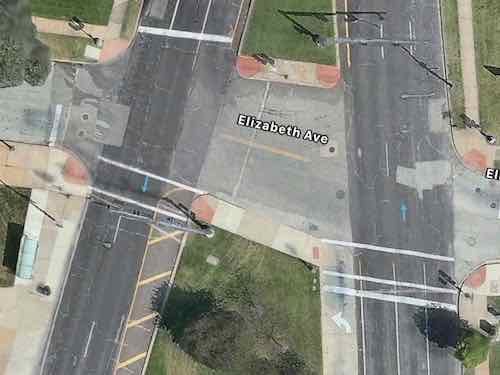
At the intersection of Truman Parkway & Chouteau (map) the situation is both different and the same.
Most of us understand that as pedestrians you cross a street parallel with vehicular traffic. But the problem is, at this intersection, is the crosswalk in placed within the parallel travel lane. Who as the right-of-way? The motorist driving in the lane or the pedestrian within the crosswalk? Both can’t have the right to the same space. I know who would lose in a conflict!
After seeing the situation from my car and grabbing images from Google’s Street View I knew I had to see if the situation was different than it appeared. It is different than it first appears. Not any better, just different.
Driving Southbound on Truman Parkway I pulled over out of the way just before Chouteau to observe the signals. Traffic on Truman Parkway got the green but the pedestrian signal never got the okay to cross signal. Then I spotted a button for pedestrians to activate the crosswalk signal. So a person activates the signal when needed. Problem solved, right? Not quite!
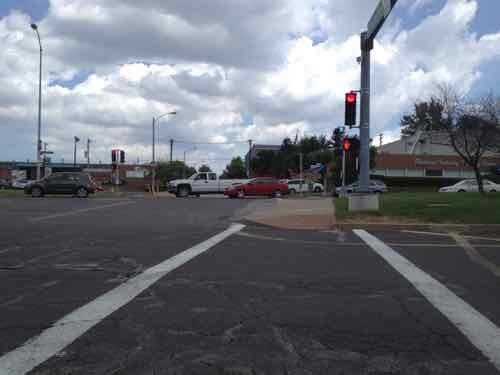
I parked a block away and walked to the SW corner of the intersection to see how the signals functioned. Approaching the corner I see the button on the signal post.
This is an old type button that a blind person wouldn’t know if it was working. New buttons give you an audible feedback to to let you know they have been pressed. Using the button you are facing away from the intersection. But guess what? The button doesn’t do anything!
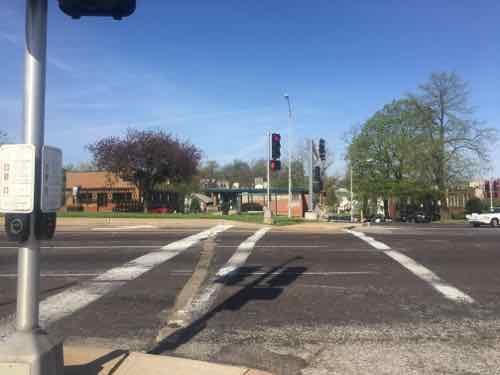
In the above image is another button at the same corner. The first is in the shadow line of this poll. If you look you can see the don’t walk on the pedestrian signal across Chouteau. This button does actually work, sorta.
Above I’m standing at the ramp — the place where you’d stand if you wanted to cross. The walk signal is activated in the above. Don’t see it? Look behind the light poll and it is on for a few seconds. Yes, the signal to walk is blocked by a pole. The don’t walk begins to flash almost immediately.
I’d say 98% of the intersections in the city do not require a pedestrian to press a button to get the okay to walk signal. The other crossings at the intersection to not require the pedestrian to activate the signal. Why is this so different from others?
It goes back to that curb ramp. After the passage of the Americans with Disabilities Act of 1990 the City of St. Louis was faced with thousands of intersections that needed curb ramps. When designing from scratch each intersection would ideally get 8 ramps – two per corner to handle each direction of travel. To save money and get more intersections in compliance the city opted for only four curb ramps per intersection.  This This meant that crossing either street you’d use the same ramp. In your typical residential intersection this was a reasonable compromise. Often it was the only physical way because of sewer drains or other infrastructure in the way.
The problem is that since those early days even when new intersections are created (such as the above), when curbs are replaced, the engineers seem to incorrectly think the compromise of a single curb cut per corner is adequate. Because they only used a single curb ramp on the SW corner of this intersection they had to do the pedestrian activated signal. But the button is to far away from the point where you’d cross and as mentioned when you are at the crossing point you can’t see the signal!
On this corner there is nothing to prevent a curb ramp in a better location. Rather than have the pedestrian activated signal that you can’t see it would have been cheaper and better to have a second ramp to pull the crosswalk out of the Southbound travel lane.
Engineers do a great job of planning for motorists but they do a lousy job for pedestrians. Projects involving pedestrian routes should be reviewed while on paper.
– Steve Patterson
The new Culinaria grocery store on 9th between Olive and Locust has helped to dramatically increase the number of pedestrians in the area near the store. A friend of mine pointed out something that I and many others hadn’t noticed at 9th & Locust (map).
When crossing Locust on the West side of 9th Street signs indicate that pedestrians should not continue straight ahead — they should use the crosswalk on the East side of 9th. The pedestrian above is crossing Locust while the light is green. The “use crosswalk” sign is seen on the right. No pedestrian signal exists, but many intersections downtown are missing such signals.
Note that the crosswalk stripes on the pavement have been covered over. So while the other side of the street is close enough to toss a quarter across the street the city doesn’t want you to cross here. Instead they want you to cross 9th twice as well as Locust. But why?
During the construction of the Roberts Tower has 8th Street closed between St. Charles St & Locust. Before then 9th Street was a one-way street Northbound. But with Southbound 8th closed part of 9th was changed to 2-way traffic. Before Culinaria opened 9th was 2-way up to Olive with traffic directed left on Olive (one-way Eastbound). But the two-way traffic was pushed back one block from Olive back to Locust. That meant Southbound traffic on 9th had to turn right at Locust, as the above signs indicate. The city took the lazy way out — giving drivers a right arrow and telling pedestrians that is not a valid crosswalk.
But person after person crosses at this non-crosswalk.
Most, but not all, wait for a green light:
The person above, crossing Locust walking Northbound, is going against the light. When the light turned green the couple with the stroller crossed as well. In fact, all that I observed crossed at this non-crosswalk. It is natural to cross at this point.
The city, I guess, put up the signs and covered the crosswalk stripes to reduce their liability in the event a right turning car from 9th onto Locust injures or kills a pedestrian. A cover your ass action. Except that a person with visual impairments is not going to see the signs. Their white cane or guide dog will read this as a conventional intersection. The solution in this case, to meet the ADA is to place a physical barrier that would be detected by cane. A guide dog would know not to cross to the other side.
But the real solution is to give pedestrians the right of way. Remove the right arrow from the traffic signal and use right arrows on the pavement so that motorists know they must turn right to avoid oncoming traffic. Signs cautioning drivers to yield to pedestrians in the crosswalk would be good although my observation was that motorists were doing this anyway.
For the record using the East side of 9th coming from or going to Washington Ave is not an option.
Just a short block from Locust you can see that the above corner lacks a curb cut. The city needs to be more concerned about the flow of pedestrians.
– Steve Patterson
Twice now in the last few weeks I’ve crossed Delmar at the crossing shown below:
Both times I drove to the Loop area in my car and parked in the disabled parking next to the Pageant. Note to Secretary Salazar, I have a state permit to allow me to park there.
Both times crossing Delmar I had to deal with the curbs on each side of the street. A person that requires a wheelchair would be completely out of luck. Many people use wheelchairs. I use mine downtown all the time. I’ve taken MetroLink to the Loop in my chair too. Some folks, say just after surgery, use a chair temporarily. But while walking I still find the ramps very helpful. Parents pushing baby strollers also find ramps helpful.
When the roadbed was narrowed and sidewalks widened a few years ago the idea of crossing the street was overlooked.
The distance between Rosedale Ave on the East and Skinker on the West is nearly 1,000 feet – roughly the distance of three blocks downtown – with no place to cross in between. This distance needs two, not one, crosswalk with curb cuts.
- Steve Patterson