Home » Gateway Mall » Recent Articles:

Time To Rethink Aloe Plaza

May 11, 2023 Downtown, Featured, MLS Stadium, Parks, Plazas Comments Off on Time To Rethink Aloe Plaza

Eighty-three years ago today a new urban plaza was opened across Market Street from Union Station. The decennial census taken the previous month would later show the city’s population had declined slightly.
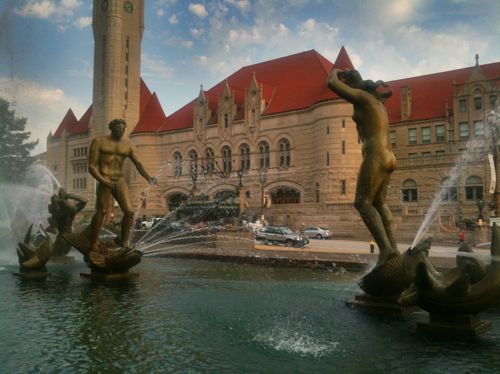
Carl Milles’ ‘Meeting of the Waters’ is the focal point of Aloe Plaza. 2011

St. Louisans of the 1930s removed the buildings, businesses, and activity from across Union Station. It was what people first saw upon arrival, they wanted beauty instead of what they viewed as clutter and illicit activity. Passive over bustling. They were successful…too successful.
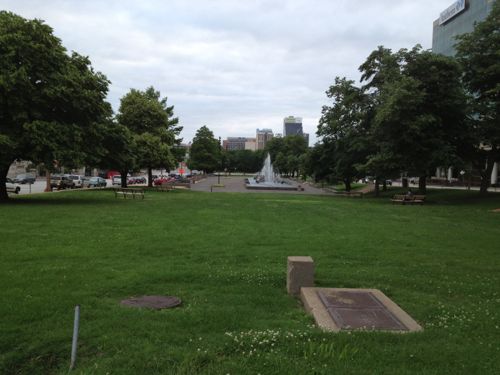
Looking west across Aloe Plaza, from 18th Street in 2013

For a good 70 years the west end of Aloe Plaza is what motorists saw as they exited the highway, ending up at 20th & Chestnut. Now with CITYPARK, our new MLS stadium replacing the on/off ramps, the situation west of Aloe Plaza is entirely different.
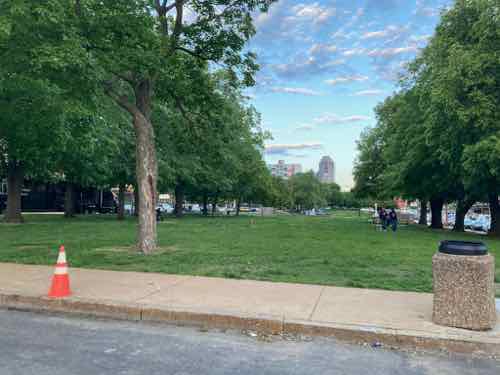
Looking east from 20th Street atAloe Plaza, just as STL CITY SC began hosting the Portland Timbers on April 29 2023.

20th Street is closed for a block party before matches, porta-potties are lined up nearby. To the west is the start of the Brickline Greenway, a 2-way cycle track plus a wide pedestrian path. This needs to continue east and the two blocks of Aloe Plaza are next.

The space has some very large old trees. I’m not an arborist so I can’t say they’re worth keeping, or not. The ’Meeting of the Waters’ fountain by Carl Milles is certainly sacred, though in desperate need of a new basin.
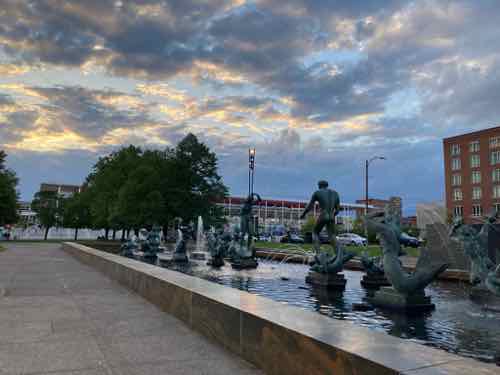
Meeting of the Waters with CITYPARK stadium in the background, just as STL CITY SC began hosting the Portland Timbers on April 29 2023.

I’d love to see something happen (charrette, competition, etc) to gather ideas on how to turn this passive two-block long public park into an exciting new public space that includes the fountain in the same or different place. Does the fountain need to be centered on Union Station? Must it be parallel to Market Street? Among many questions we should ask ourselves.

One thing I see as a must-have amenity is a public restroom. The entire region needs these where we expect tourists, people cycling/walking, and such. Not inside a nearby business — a highly visible kiosk structure that opens directly to the sidewalk. These can be self-cleaning, the ones I used in San Francisco last fall were wonderful.

I can also imagine a structure(s) for food, beverage, events, and such.

I’m not sure about the name Aloe Plaza. It made sense in 1940 as the former president of the board of aldermen, Louis B. Aloe, had died just over a decade before. Aloe was instrumental in a 1923 bond issue — a century ago. Aloe, the bond issue, the businesses displaced, etc should all be represented in the new space. I’m just not sure the name for the last 83 years should carry forward.

The entire two block park bounded by Market, 18th, Chestnut, and 20th needs to be rethought, reimagined for the 21st century.

— Steve
————————————————————————
St. Louis urban planning, policy, and politics @ UrbanReviewSTL since October 31, 2004. For additional content please consider following on Facebook, Instagram, Mastodon, Threads, Bluesky, and/or X (Twitter).
 

Aloe Plaza Nudes Unveiled Eight Decades Ago, MLS Coming

May 11, 2020 Downtown, Featured, Parks, Planning & Design Comments Off on Aloe Plaza Nudes Unveiled Eight Decades Ago, MLS Coming

Eighty years ago today the nude sculptures in the Aloe Plaza fountain across Market Street from St. Louis Union Station were formally unveiled. The other figures in the fountain were unveiled the previous night.

Carl Milles’ ‘Meeting of the Waters’ is the focal point of Aloe Plaza

Artist Carl Milles attended,  Edith Aloe (1875-1956) did the unveiling.

Edith Aloe, 64, was the widow of the man who two decades earlier pushed to raze buildings across from St. Louis Union Station — former president of the Board of Aldermen Louis P. Aloe (1867-1929). Mrs. Aloe was instrumental in Milles being selected to create the fountain.

Since then the plaza has largely remained unchanged. A wheelchair ramp was added years age to access the plaza from Market Street and a decade ago awful spot lights were installed. Why awful? The resulting light from overhead is so bright it overpowers the lighting within the fountain — prison yards likely have similar lighting schemes. Incredibly uninviting.

Aloe Plaza across from Union Station cleared away “undesirable” buildings, followed by decades more demolition creating the largely failed Gateway Mall

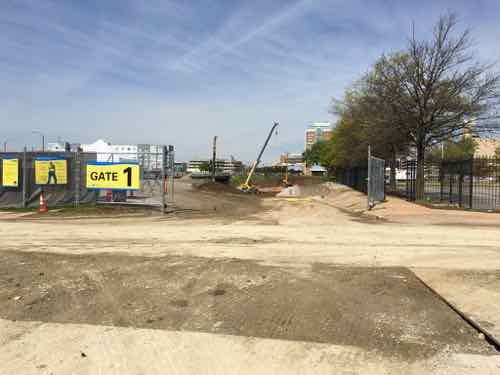
The view above is looking West from 18th Street in June 2013. Right now the new Major League Soccer (MLS) stadium is being built on the West side of 20th Street.

Looking West from Aloe Plaza as crews remove the old highway interchange and begin work on the stadium. April 24, 2020

The stadium will give the Gateway Mall a proper terminus, but will Aloe Plaza remain unused, unchanged?

We should begin thinking & talking about a major renovation of the 2-block long plaza. The fountain & sculpture are sacred, in my view. Everything else is negotiable.

Why?

Union Station has made major investments in replacing the failed train shed mall, uh, festival marketplace with an indoor aquarium & outdoor Farris wheel. The MLS stadium is an even bigger investment. Both will draw huge crowds. Aloe Plaza is located between them.

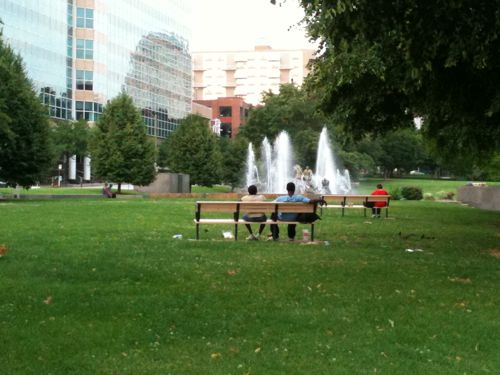
Aloe Plaza was designed as a tranquil passive space in a growing city of 800k plus. 2011 photo

The first question is if the space should remain passive or if it needs activity areas?

Obviously I think it needs a redesign with opportunities for programmed activity.  But what activities? Would programming & activities compliment or distract from the fountain?

Too bad the Gateway Mall Advisory Board was disbanded.

— Steve Patterson

SOURCE: May 11, 1940 (page 3 of 16). (1940, May 11). St.Louis Post-Dispatch (1923-2003) Retrieved from link.

PS: The 1940 census shows 64-year old widow Edith Aloe living in the Park Royal Apartments, 4605 Lindell Blvd. — apartment 414. Her rent was $125/month. Her 24-year old single maid Evelyn Iffrig also lived there. Evelyn married in 1946, so Edith would’ve needed a new maid. Evelyn died in 1995, her husband lived until 2006.


Remembering Peter Fischer, Improving Citygarden

August 1, 2016 Downtown, Featured, Parks Comments Off on Remembering Peter Fischer, Improving Citygarden

Peter Fischer, the reserved head of the Gateway Foundation, died a year ago Saturday 7/23. His best known work is Citygarden, which opened June 30, 2009:

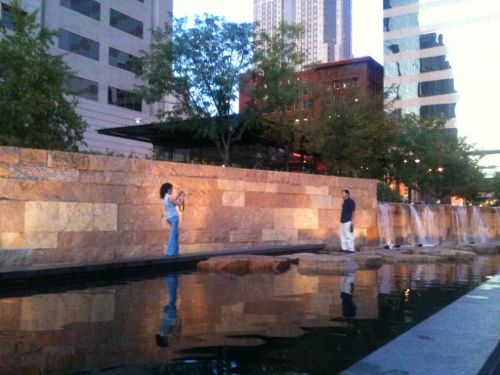
Citygarden started with his Gateway Foundation, a group dedicated to promoting art and urban design. His affinity for unpretentious art is reflected throughout the park. Park patrons can climb on the sculptures, dart around the water plumes and swim in the fountains.

A frequent visitor to the park, Mr. Fischer especially loved watching kids splash in the water features. When safety concerns arose, he proposed to continue to allow swimming but hired lifeguards to keep watch.

The world soon took note of the park. A New York Times piece praised the park, and numerous awards were given. In 2011, Citygarden won its biggest award, the ULI Amanda Burden Urban Open Space award. (Post-Dispatch)

Lighting is part of what makes Citygarden so special, September 2011

I was there for the ribbon cutting , I think he was too. But he wasn’t on the stage giving a speech, he always proffered to remain in the background.

One of the few times he and I talked was shortly after Citygarden opened, I saw him sitting and observing people. I rolled over and chatted briefly. I got an email from him once — just before a public Gateway Mall Advisory Board meeting — he didn’t want me taking/posting pictures of the model we’d be shown for Kiener Plaza.

I love Citygarden, visiting often. However, it’s not perfect.

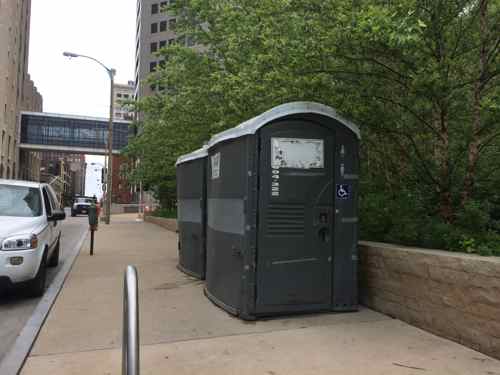
The only restroom is inside the restaurant, so these are on the 10th Street (West) side.

As I’ve stated before, I’d like to see the block to the West joined via the Hallway walkway with a public restroom.

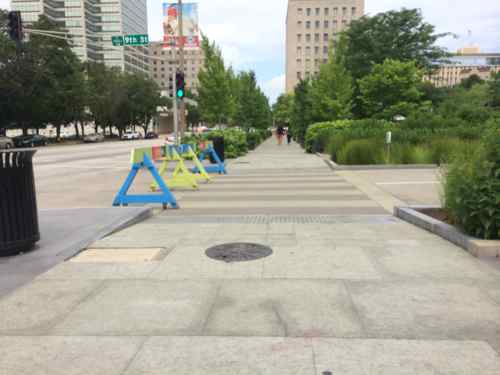
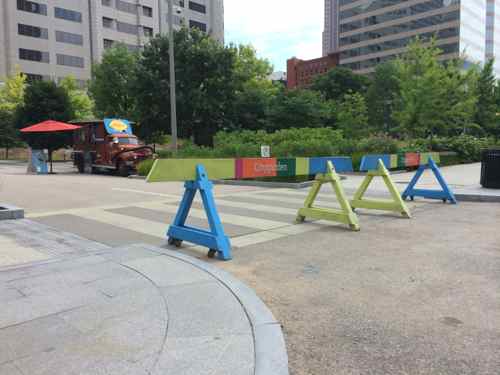
There was no thought about communicating to pedestrians on the hallway about traffic on 9th Street, so Fischer had it closed to vehicles.

Colorful barricades close off 9th Street to vehicles

I chose not too pursue the opening of 9th Street while Peter Fischer was still alive — I knew better. But now, more than a year after his death, I think the subject deserves attention. But it’s not as simple as just moving the barricades out of the way. There’s no way to communicate to pedestrians that Northbound vehicles on 9th Street have a green light.

One way streets function only in pairs — one each direction. Eighth and 10th streets are both one-way Southbound.

— Steve Patterson


Gateway One/Peabody Plaza Is Here To Stay

In the 1970s/80s the City of St. Louis sought to keep the Gateway Mall marching Eastward toward the the Old Courthouse and Arch. However, there was no money to pay for it. There were also historic buildings in the blocks — the owner(s) proposed renovating the historic buildings. Another plan was selected:

Downtown business executives and union leaders created Pride Redevelopment Corp. and successfully pushed for a plan to clear the land between Kiener and Serra. Then, they would develop office towers on the north side, facing Chestnut. The revenue from the towers would underwrite costs for a “half mall” on the south side.

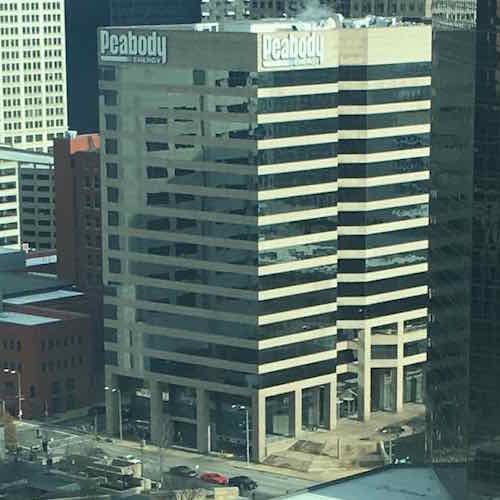
Over the protests of preservationists, the three notable buildings were demolished. But because the economy remained in a trough, only one tower was built: Gateway One, the 15-story sore thumb that has irked scores over the years. (Now it’s Peabody Plaza, home to Peabody Energy.) (Spotlight: Building interrupting the Gateway Mall is a mayor’s regret)

The Buder & International were imploded in August 1984, the Title Guaranty was also gone by the end of 1984. The half-mall plan called for four identical buildings — one on each of the four blocks from 6th to 10th.  More detail here.

Gateway One is now Peabody Plaza

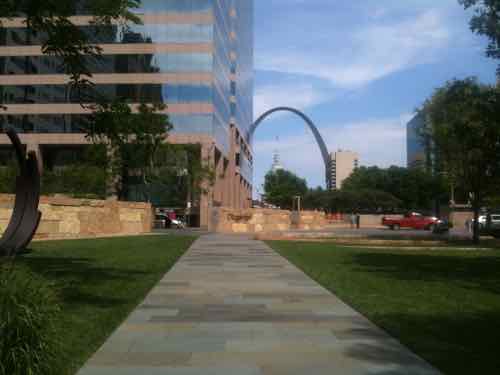
Looking East from Citygarden

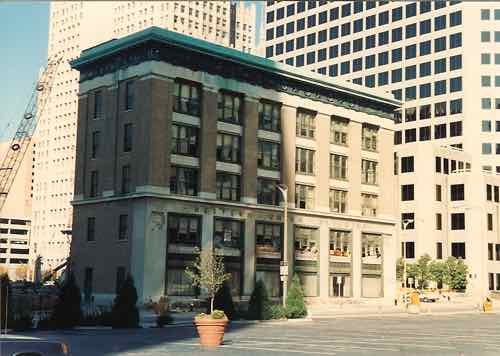
The historic Western Union building facing 9th between Chestnut & Market was razed in 1993 for a 2-block passive green space as part of the Gateway Mall, later remade into Citygarden.

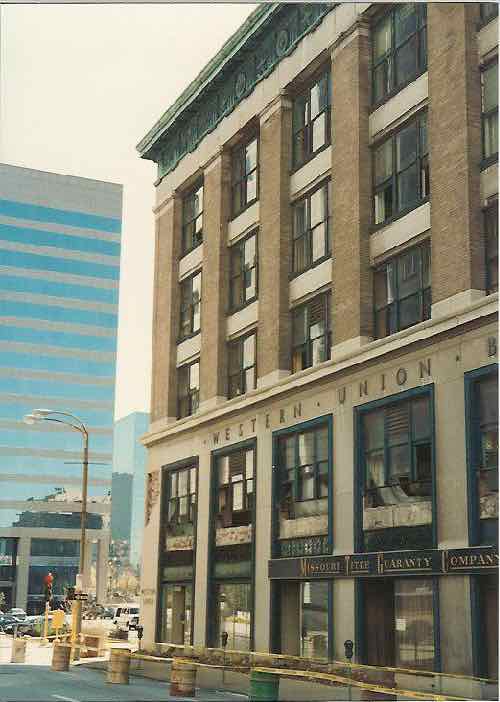
Another 1993 photo of the Western Union building at 900 Chestnut, with the Gateway One in background
Another 1993 photo of the Western Union building at 900 Chestnut, with the Gateway One in background, left

In hindsight, most acknowledge the half-mall plan was a mistake. It was already dead by 1993, but demolition continued. Had the buildings on the two blocks West of Gateway One not been razed the one half building wouldn’t have stood out so much. I moved to St. Louis in August 1990 — Gateway One was already complete by then, But in 1992/93 I personally argued with architect Donald Royce, telling him razing the two blocks between the Gateway One and the Serra “Twain” block was another mistake. Fifteen years later Citygarden almost makes up fir the bad decision.

Back to Gateway One.

Over the years many have said it should be torn down. I’m no fan on the building, but that’s not going to happen. Ever.

The building sold in 2006 for $65 million. For many decades the building will be too costly to raze for more park space — we can’t afford to redo the excessive park space of the Gateway Mall — we don’t need more.   Peabody has another decade remaining on their lease and the building will remain viable for decades.

Face the facts — it’s not going anywhere. Just be thankful St. Louis abandons plans before they’re finished, otherwise we’d have a total of four.

— Steve Patterson


Proposed Alterations To Soldiers’ Memorial Should Take These Issues Into Consideration

Soon the Missouri History Museum is expected to show final designs for two blocks of the Gateway Mall bounded by 14th, Pine, 13th, and Market — Soldiers’ Memorial & Court 0f Honor. A big unknown is Chestnut Street which runs one-way Eastbound between the two blocks.

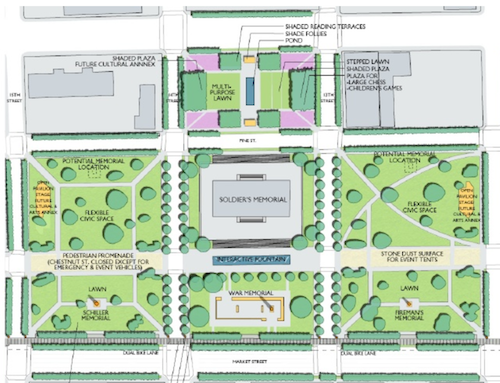
The Gateway Mall Master Plan calls the area around Soldiers' Memorial the "Civic Room"
The Gateway Mall Master Plan calls the area around Soldiers’ Memorial the “Civic Room”

St. Louis' Court of Honor, June 2010
St. Louis’ Court of Honor, June 2010

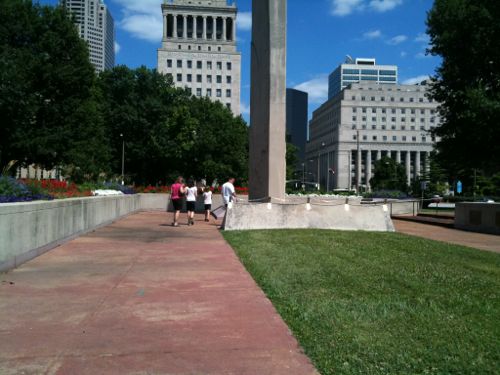
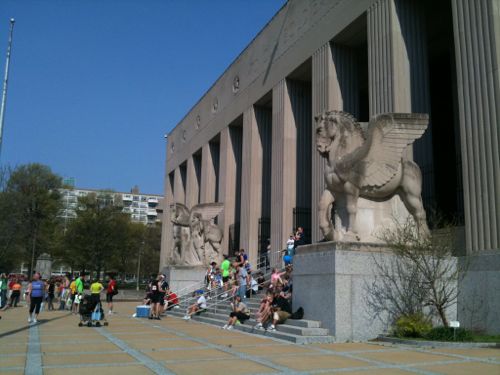
Soldiers' Memorial, 2011
Soldiers’ Memorial, 2011

Since the Slay administration chose to abandon the Gateway Mall Advisory Board, I don’t know what to expect in the way of review for compliance with the master plan, public input, stakeholder input, etc.

Here are my primary areas of concern:

  • Festivals
  • Street grid, traffic flow
  • Linear hallway along Gateway Mall

Let’s examine each:

FESTIVALS

This might be moot, since the Slay administration ran off great events like the Taste of St. Louis in favor a concert series that never happened:

After a year without major summer festivals in downtown St. Louis, the city may have finally had enough. On Black Friday the mayor’s office announced that it had ended its agreement with Los Angeles-based International Creative Management (ICM) to produce a promised but never held “Summer Rocks” series on the Gateway Mall.

That controversial deal, spearheaded in part by developer Steve Stogel (president of Clayton-based DFC Group) and approved by the city via Festival Reservation Bill 328, blocked out a downtown area from Union Station to City Hall from May to September 2015, and would have continued to do so for another nine years (and possibly more). The non-compete clause had already forced out local festivals like Taste of St. Louis, Ribfest and Bluesweek. (RFT)

The Gateway Mall Master Plan calls for this area to be the city’s main space for festivals. It calls the blocks including, and around, Soldiers’ Memorial the Civic Room:

The Civic Room will create a large uni?ed space well-suited for civic events, markets, festivals and concerts. In order to achieve this, it is anticipated that Chestnut Street would be closed incrementally over time, beginning with temporary closures for festivals, and ultimately consideredfor permanent or seasonal closure, though still allowing emergency and service vehicle access.Chestnut Street should still be hard surfaced with a paving different than surrounding areas, to accommodate tents and other services necessaryfor festivals. Locations for performance stages and cultural or art annexes should be provided to further de?ne the civic character of the space and create attractions to activate the Mall.

Before Citygarden was built a few blocks to the East, that area was used for large events as well — the Taste of St. Louis started where Citygarden is now. With this new agreement, the Missouri Historical Society (MHS) will have discretion for the use of the middle of the Civic Room festival area:

Although MHS will not host concerts or festivals that do not meet with the mission of Soldiers Memorial, it is willing to collaborate with festivals held in its neighboring parks for something that is mission driven. For example, MHS might have a wreath laying ceremony during Pride on the Soldiers Memorial grounds for LGBTQ members of the military. (FAQ)

Personally, I’d like to see large festivals held elsewhere, perhaps in & around the new Kiener Plaza?  Kiener is closing next month for a 12-14 month makeover, the median will be removed from Market Street.

STREET GRID, TRAFFIC FLOW

I never liked the master plan’s suggestion to eventually close Chestnut St. When you close one block of a street that kills activity on the rest of the open blocks before & after the closure. I’d like to see Chestnut & Pine return to two-way traffic West of Tucker. Then they’d feel like neighborhood streets again rather than very long highway on/off ramps.

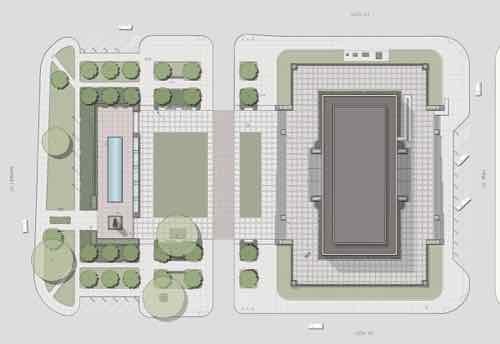
Missouri History Museum drawing from Fall 2015 shows what appears to be a single lane. Final design may be different.

The problem with this draft is it doesn’t show the surrounding context. What about the blocks to the East West, & North?  What is the whole concept for all of these blocks? It doesn’t need to be built by the history museum but all needs to be part of the design process — so it’ll all work eventually. Looks like they’re designing this in isolation — an island. Chestnut is two lanes with diagonal parking to the East & West — lanes, crosswalks, curb ramps need to align. Without showing surrounding existing conditions it is hard to determine if these have been considered. Most likely they haven’t.

The new parking-protected bike lane on Chestnut is an issue, but it should’ve been on Olive. That would’ve required building accessible bus stops in the parking lane — Chestnut was picked for the bike lane because it was easier than Olive.

HALLWAY

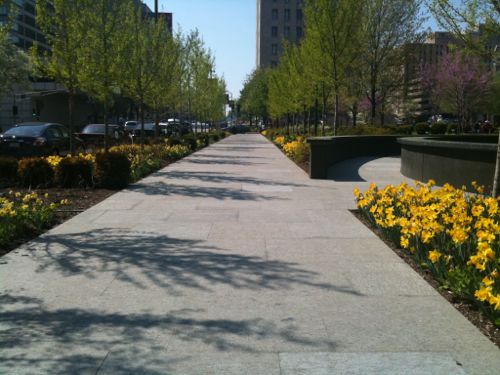
One of the best parts of the Gateway Mall Master Plan is the hallway concept — a wide tree-lined sidewalk along the North side of Market St.

The Gateway Mall master plan calls for this "hallway" to run from Broadway to 20th
The Gateway Mall master plan calls for this “hallway” to run from Broadway to 20th

Their preliminary design doesn’t show the hallway. So far we only have the two blocks along Citygarden.

— Steve Patterson


Advertisement


[custom-facebook-feed]

Archives

Categories

Advertisement


Subscribe