August 6, 2020Accessibility, Featured, North City, WalkabilityComments Off on Checking Out New Pedestrian Bridge Over I-70 Connecting Old North St. Louis and Near North Riverfront Neighborhoods
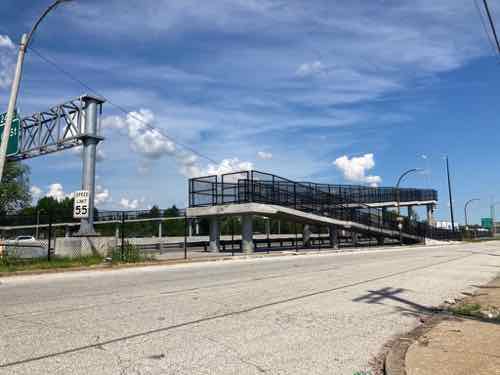
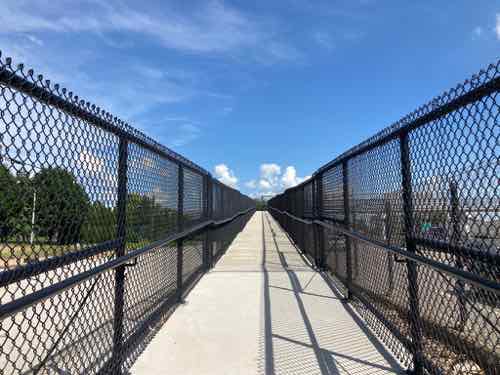
In December 2018 MoDOT temporarily closed I-70 to remove an old pedestrian bridge at North Market Street. A similar pedestrian bridge was removed from over I-44 at Marconi Ave, and at other locations. Yesterday I checked out the new ADA-compliant replacement over I-70.
The East side of the new pedestrian bridge, along Northbound 10th Street, has a switchback ramp.
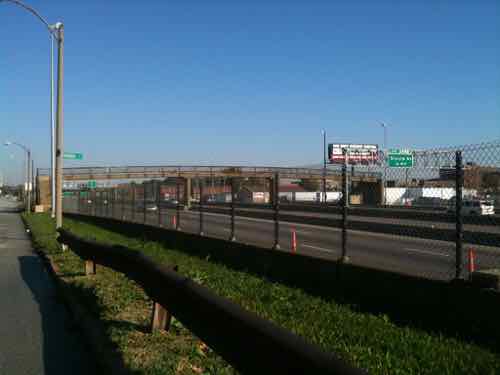
Before getting into the new bridge we should look at what it replaced. Interstate 70 was built decades before the Americans with Disabilities Act of 1990, so the old pedestrian bridge had stairs on each side.
This 2010 photo is from the West side along 11th Street. The stairs on each end went down in opposite directions.
Stairs make such a bridge impossible for those of us who use wheelchairs, but also difficult for people who walk using a cane or walker. They’re also a challenge to a parent pushing a stroller, cyclists, etc.
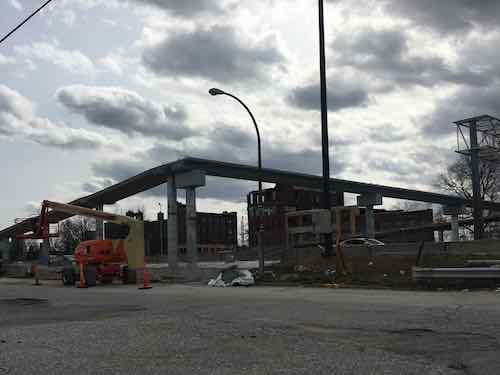
In April 2019 I snapped this image of construction on the new bridge as I was driving by. Yes, I drive too!
Yesterday’s weather was so nice I decided to check out the completed bridge. It was 1.2 miles just getting there from our apartment near 7th & Cass Ave. I did encounter missing curb ramps in a few places — often missing sidewalks. But I made it.
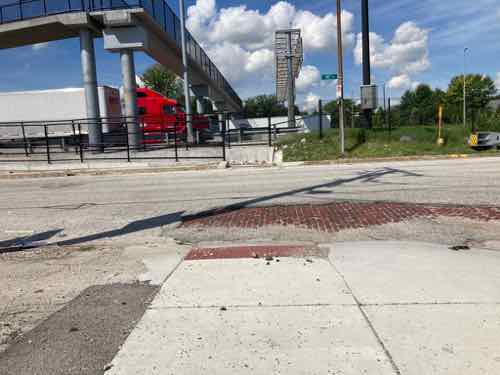
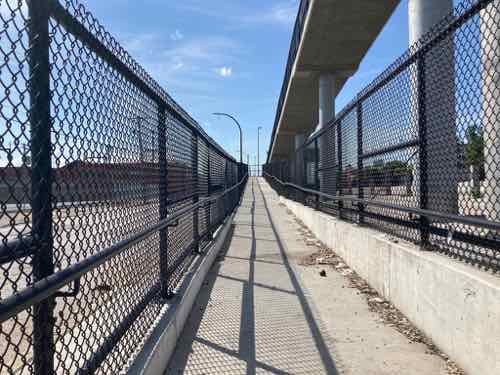
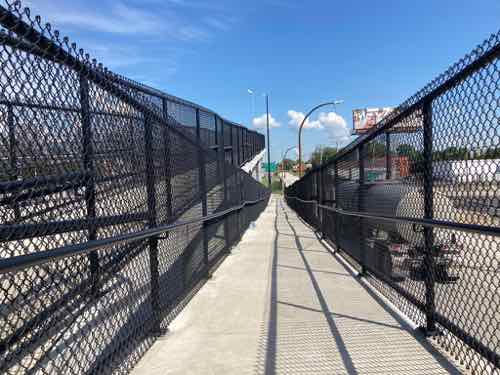
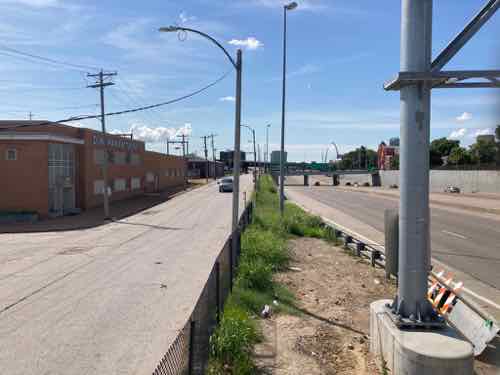
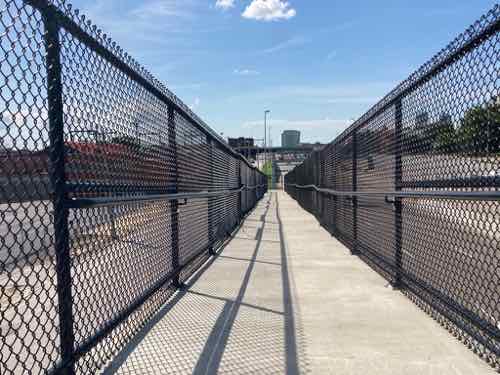
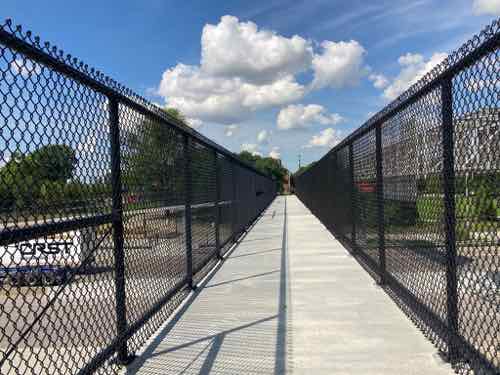
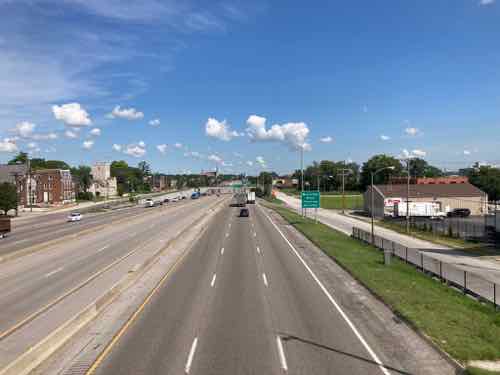
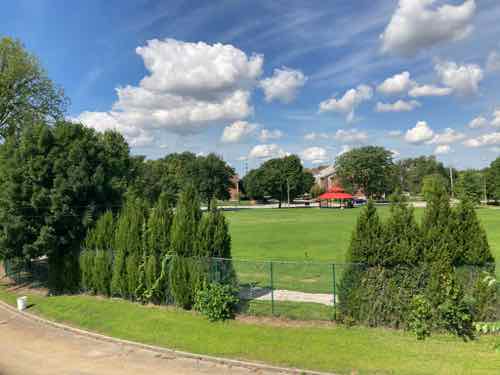
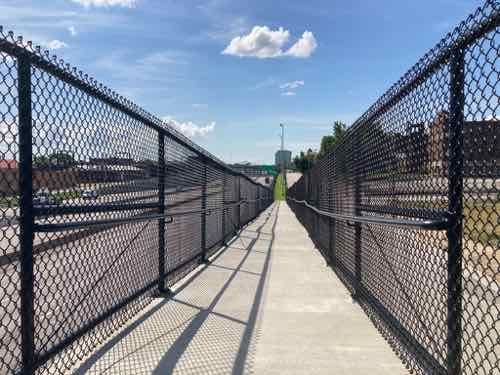
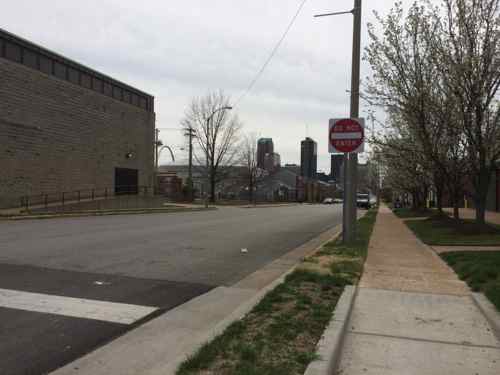
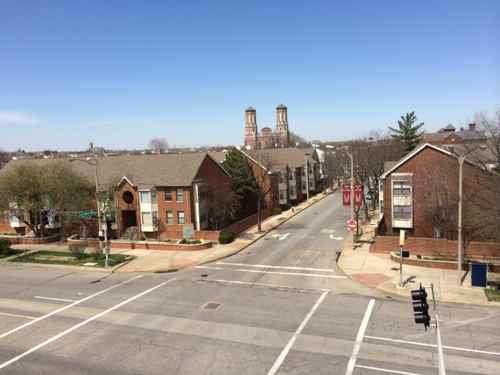
The access point on the East side of I-70 is at North Market Street. There is no painted crosswalk, no signs warning drivers to yield to pedestrians. No curb bulbs to narrow the crossing distance. Nothing. 10th Street traffic is one-way northbound — and it is fast.Once safely across 10th Street you see trash has accumulated. The city has equipment to clean streets but tight spots like this don’t get cleaned.From the base looking up the ramp to the landing. I use a power chair which had no problem with the incline. Being ADA-compliant means the maximum level should be acceptable to person using a manual wheelchair. Every so often there are level spots to give someone s rest.From the landing, looking back down.Looking South from the landingFrom the very top looking back at the landingLooking East at North Market Street from the top.Looking West across the level top of the bridge.Looking North at Northbound I-70.Looking South at Northbound I-70. The switchback ramp can be seen on the left.Looking South at Southbound I-70. The straight ramp on the West side (11th Street) can be seen on the right.From the West end of the bridge you get an excellent view of Jackson Place Park. This was the center of three circles in the original plan of the separate Village of North St. Louis.Looking South down the straight ramp on the West side (11th Street).Looking back up from the bottom.At the bottom you look across 11th Street at Monroe Street. A new curb ramp was built across the street. Like the other side, 11th is one-way and there is no crosswalk markings, signs, etc.Back up toward Jackson Place Park you can get an overview of the West side.
It is nothing fancy, but it gets the job done. Highways divided many neighborhoods, many previously connected streets permanently severed. I have no idea how much this cost, but it was worth every penny. The highway is still an at-grade divider at this point, but the bridge makes it possible for everyone to safely to cross over it.
Once the current pandemic is over I’ll take the bus to other new pedestrian highway bridges so I can compare. Yesterday I explored in Old North, got takeout from Crown Candy, and returned home 3.5 hours after leaving. Roundtrip was about 3 miles.
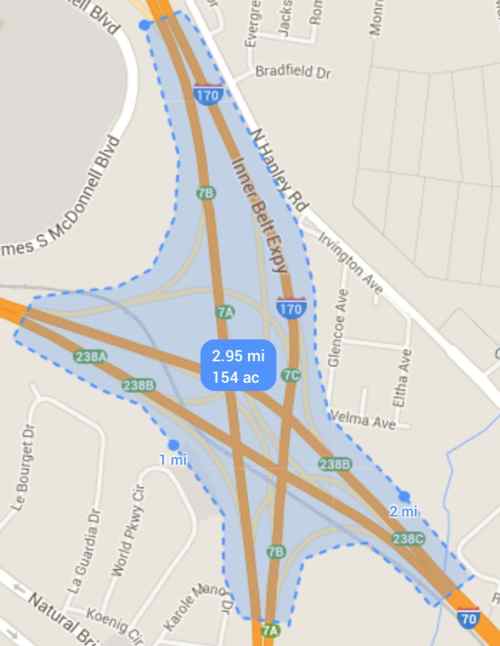
Urban interstate highways, especially their interchanges, a major land hogs. The other day on MetroLink heading to Lambert Airport the extent became very visible.
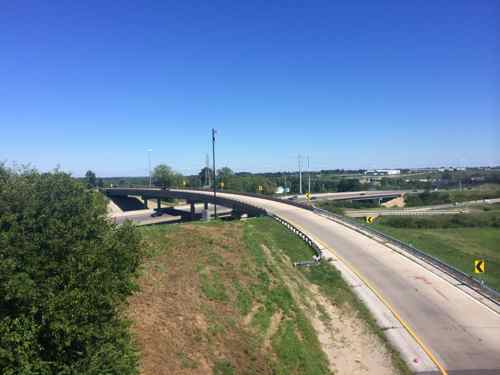
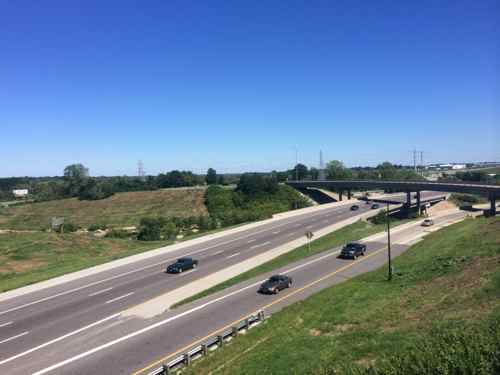
The EB I-70 ramp onto NB I-170Traffic from I-170 merging with WB I-70Using Google Maps I calculate this interchange consumes 154 acres, about 1/4 of a square mile
One quarter of a square mile isn’t much, is it? At current density levels this would be enough to house:
475 people (St. Louis County)
1,200 (St. Louis City)
2,845 (Chicago)
17,000 (Manhattan, NYC)
Urban highways reduce overall density, place barriers that further separate us. I’m not saying we change this particular interchange, just recognize what highways do to urbanized areas (vs rural).
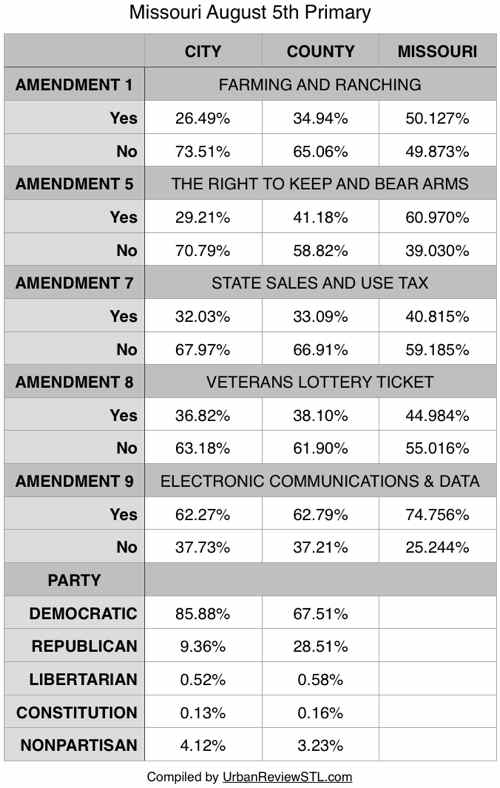
A decade ago Missouri voters amended our state constitution to ban same-sex marriage, but the majority of voters in the City of St. Louis voted no. As is often the case, city voters differed from state voters. I’ve not looked at previous elections, but this year voters in St. Louis County voted against the same four amendments. Two amendments city & county voters rejected, Amendments 1 & 5, were approved by statewide voters.
caption
I couldn’t locate statewide information on the number of ballots cast from each party, most likely greater than half were Republican.
The amendment that received the most votes was #7, a 3/4-cent sales tax for roads.
Transportation officials have been working for more than a decade to find more money. In 2002, voters defeated a proposed $483 million sales and fuel tax increase.
“There is no perfect solution,” said Kehoe, the sponsor. He said Amendment 7 was crafted around polling that showed a sales tax was most likely to pass at the polls. He said the fuel tax would have to be raised 20 to 25 cents per gallon to generate the money needed. (stltoday)
As you’ll see, Missouri has long resisted increases in the fuel tax. Here is the text from MoDOT’s funding history page:
Funding History
2008
In July, the start of fiscal year 2009, Amendment 3 is fully phased-in, providing MoDOT with all of the motor vehicle sales tax revenues previously going to General Revenue.
MoDOT sold bonds for a portion of the new Interstate 64, a design-build project in the St. Louis region. For the first time, MoDOT secured bonds primarily with federal funds, rather than state funds. These bonds are called Grant Anticipation Revenue Vehicle (GARVEE) bonds.
2004 In November, Missouri voters approved Constitutional Amendment 3, which requires all revenues collected from the sale of motor vehicles come to MoDOT. Previously, half of the sales tax went to MoDOT and half to the state’s general revenue fund. It requires the Missouri Highways and Transportation Commission to issue bonds for building highway and bridge projects and uses these additional revenues to pay back the bonds over a period of time. The additional Amendment 3 revenues are to be phased-in over a 4 year period in 25 percent increments.
2002 Legislation is passed extending the 6-cents-per-gallon motor-fuel tax, which was due to expire in 2008. Proposition B, an omnibus transportation bill that would have increased the motor-fuel tax by 4 cents per gallon and the general sales tax by 1/2 percent, is defeated by voters by a 3-to-1 margin.
2000 Legislation was passed, effective May 30, 2000, allowing MoDOT to issue $2.25 billion in bond financing to accelerate highway improvements. Up to $250 million in bonds can be issued in 2000 and up to $2 billion from 2001 through 2006. Projects funded by the first $250 million were required to come from MoDOT’s 5-Year Statewide Transportation Improvement Program. MoDOT can issue up to $500 million per year in bond financing through the year 2006. MoDOT submits a bond financing project list to the Legislature each January for approval.
1992 A 6-cent per gallon increase in the motor fuel tax is passed by the Legislature. The 6 cents is to be phased in over a 5-year period; 2 cents in 1992, 2 cents in 1994 and 2 cents in 1996.
1987 Proposition A, a constitutional amendment to increase the motor fuel tax by 4 cents per gallon, is approved by the people. It becomes effective June 1.
1984 Fees for motor vehicles and truck classes not raised in 1983 are increased.
1983 Fees for some classes of trucks are increased.
1982 Proposition B, a constitutional amendment to raise the motor fuel tax by 4 cents per gallon, is defeated by the people.
1979 Voters approve a constitutional amendment changing the CART distribution formula. Counties receive 10 instead of 5 percent, cities receive the same 15 percent and the state receives 75 instead of 80 percent. The law is effective Jan. 1, 1980. The amendment also merges the Highway Department with the Transportation Department. Also included in this legislation is a provision that one-half of the motor vehicle sales tax go to finance road and bridge construction. Of this half, 74 percent would go to the state, 15 percent to the cities and 10 percent to the counties. The remaining 1 percent goes for planning of other transportation modes.
1978 An initiative petition to increase the fuel tax 3 cents per gallon is defeated.
1972 The Legislature passes a bill increasing the gas tax from 5 cents to 7 cents per gallon.
1961 The Legislature passes a bill temporarily raising the fuel tax from 3 cents to 5 cents per gallon. The bill provides that a constitutional amendment be put before the people which would allow cities and counties to share in state motor fuel tax revenues. If the amendment is not submitted within six months, or if it is rejected, the tax would revert to 3 cents. Voters approve the amendment on March 6, 1962, and the 5-cent per gallon tax becomes permanent. This act establishes the County Aid Road Trust program.
1952 On March 24, an act is approved increasing the motor vehicle tax from 2 cents to 3 cents per gallon. The law becomes effective July 29.
1950 On April 4, Missourians again reject a referendum proposal to increase the motor vehicle tax. The proposal would have increased the tax from 2 cents to 4 cents per gallon.
1938 On Nov. 8, the people defeat by referendum election an attempt of the Legislature to raise the fuel tax from 2 cents to 3 cents per gallon. At the same time, an initiative petition proposal to amend the Constitution to fix the fuel tax at 3 cents for 10 years is also defeated.
1924 A 2-cent tax rate for motor vehicle fuel is adopted by a vote of the people under initiative petition. It is the state’s first motor fuel tax.
From the above I made this list of the fuel tax rate since 1924:
1924 2-cents
1952 3-cents (28 years, 100% increase)
1961: 5-cents (9 years, 66% increase)
1972: 7-cents (11 years, 40% increase)
1987: 11-cents (15 years, 57% increase)
1992: 13-cents (5 years, 18.18% increase)
1994: 15-cents (2 years, 15.38% increase)
1996: 17-cents (2 years, 13.33% increase)
It has now been 18+ years since the fuel tax was increased, the only period longer was the first increase after the initial tax! Had the 1990s 2-cent increase every two years continued we’d be at 34-cents — double the current rate. We’d still be lower than Illinois and many other states. Amendment 7 proponents say voters rejected a 2002 attempt to raise the fuel tax rate. From above: “Proposition B, an omnibus transportation bill that would have increased the motor-fuel tax by 4 cents per gallon and the general sales tax by 1/2 percent, is defeated by voters by a 3-to-1 margin.” They’d proposed a measly 4-cent fuel tax increase combined with a 1/2-cent general sales tax. I don’t recall how I voted a dozen years ago, but I likely voted no based on the general sales tax increase.
Here’s what should happen:
The Missouri legislature should pass legislation to double the fuel tax from 17-cents to 34-cents over the next 5-10 years.
The Missouri legislature should pass legislation make I-70 a toll road between Kanas City and St. Louis. This revenue, not the fuel tax, would be used to widen I-70.
We do need to maintain our infrastructure, we should be cautious about adding to the system if we aren’t willing to raise the fuel tax. Why build more miles of highway if we can’t maintain what we have now?
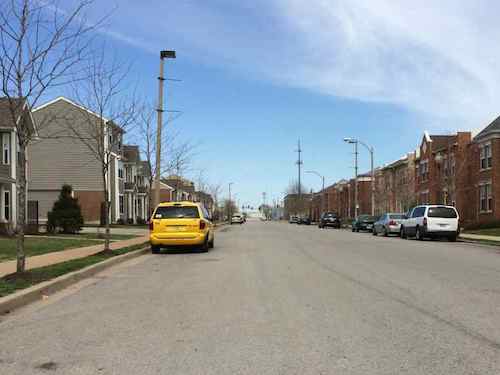
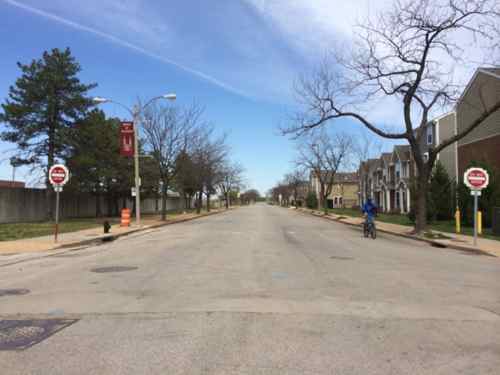
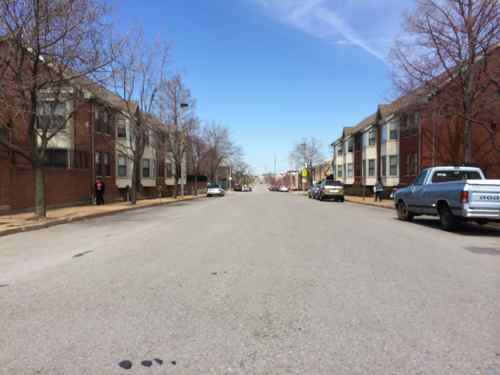
Decades ago traffic engineers converted many downtown St. Louis streets from two-way traffic to one-way traffic, 9th & 10th going north & south, respectively. The 9th/10th couplet extended north to I-70, basically serving as very long on/off ramps, cutting through the Columbus Square neighborhood. Today the former Cochran Gardens high-rise public housing project is gone, replaced with mixed income apartments. The 1980s Columbus Square condos and townhouses are still nice, the neighborhood is generally pleasant and safe. Despite the fact that 9th & 10th are no longer connected to I-70, they remain very wide one-way streets, undermining the positive investment in the area.
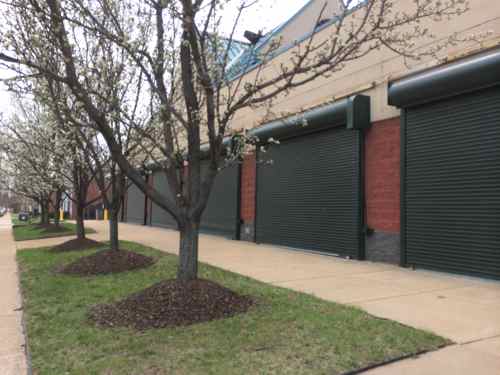
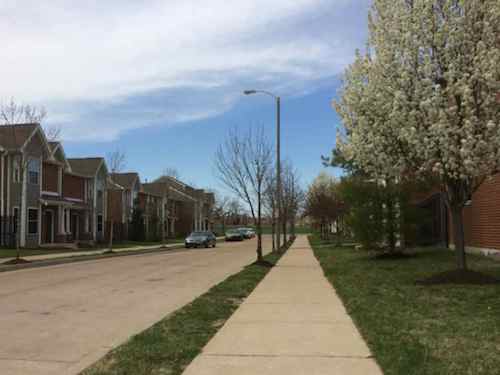
Looking south at 9th from CassThe St. Louis Housing Authority owns this retail building on 9th at Cass, one-way streets as a freeway on ramp aren’t good for neighborhood retail businesses.Most streets perpendicular to 9th/10th have a nice neighborhood scale. This is New Haven Ct.Looking north on 9th from O’Fallon St, lanes aren’t marked but wide enough for at least 3Looking north on 10th St from O’Fallon St, just as wide and useless as 9thLooking north on 9th from Cole
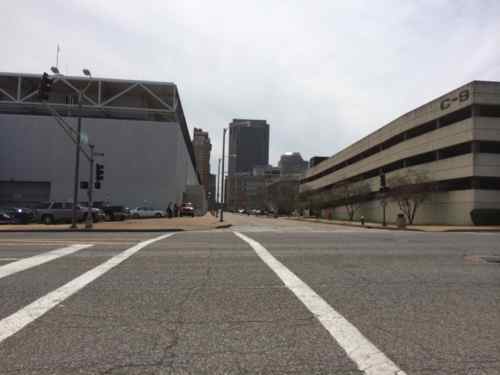
Looking south at 9th from Cole St., the dividing line between downtown and the Columbus Square neighborhoodLooking north at Cole St & 10th St
I’d like to see 9th & 10th be two-way all the way through downtown, but that’s more complicated with garage entrances/exits. signals, etc. But from Cole St. to Cass Ave it would be very simple, just some changes to the signals at Cole & Cass, the rest is signs and paint.
We ran these long on/off ramps through this neighborhood for decades, now we need to do the right thing and make 9th & 10th neighborhood streets again!
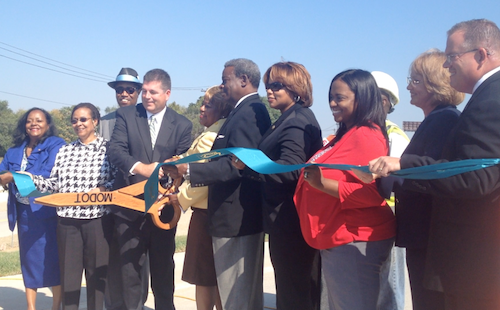
Yesterday MoDOT and city officials cut a ribbon to open traffic from I-70 onto the new Tucker.
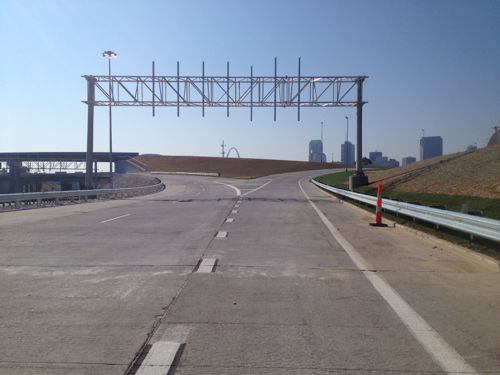
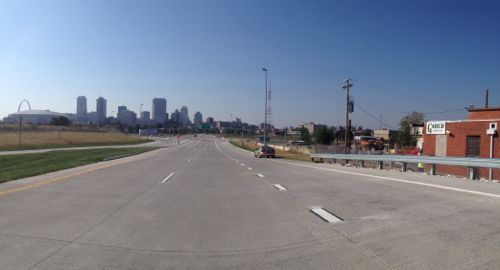
An hour before the off ramp from I-70 to Tucker signs still weren’t placed. Only the right was opened, the left will be for I-70 traffic when the new bridge opens next yearThe view of downtown motorists will now seeOfficials cut the ribbon opening the off ramp from I-70 onto the new Tucker on September 26, 2013.The land surrounding thus on/off ramp is now more valuable.
With the new offramp, and the opening of the Stan Musial Veterans Memorial Bridge in 2014, the adjacent land is suddenly prime real estate. Will it be developed like most highway offramp areas or will it be more urban/dense/walkable? I don’t have any illusions the city will make any such demands so my only hope is Paul McKee comes through with a plan the surprises his many critics.
AARP Livibility Index
The Livability Index scores neighborhoods and communities across the U.S. for the services and amenities that impact your life the most
Built St. Louis
historic architecture of St. Louis, Missouri – mourning the losses, celebrating the survivors.
Geo St. Louis
a guide to geospatial data about the City of St. Louis