Home » Midtown » Recent Articles:

Rethinking Interstate 64 (aka U.S. 40) In Midtown St. Louis, Between Compton & Grand

August 15, 2022 Accessibility, Featured, Midtown, Planning & Design, Transportation, Walkability Comments Off on Rethinking Interstate 64 (aka U.S. 40) In Midtown St. Louis, Between Compton & Grand

Regular readers know I have a strong dislike of the interstate highways that were forced through existing dense urban neighborhoods, destroying social networks and dividing neighborhoods. So it’s no surprise I’ve thought about I-64 in Midtown St. Louis for decades.
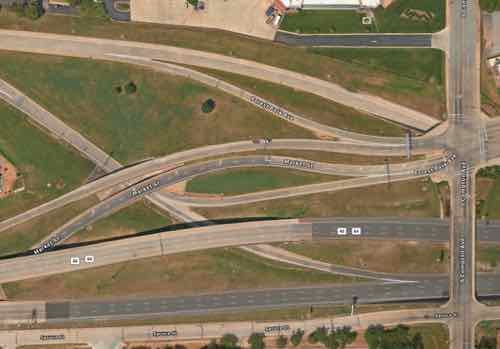
Aerial of the vast area immediately west of Compton. Source: Apple Maps. Click image to view area in Google Maps.

It was August 2021 when I learned MoDOT would be undertaking the huge task of rethinking the stretch of I-64 between Jefferson and Kingshighway.  Nine months later, in May 2022, the Future 64 planning project finally went public:

The I-64 Corridor between Kingshighway and Jefferson is an essential route for homes, schools, and businesses. The Missouri Department of Transportation (MoDOT) is working with the community to determine the future of the corridor in terms of needs and desired outcomes. Before MoDOT makes any improvements to the corridor corridor, it will evaluate the existing conditions of roadways, interchanges, surface streets, and bicycle/pedestrian access.   

The method the department is using is formally known as a Planning and Environmental Linkages study or PEL. This PEL study will look at the potential impact future projects will have on the environment, the community, and connectivity in the area. MoDOT is conducting the PEL now so when funding is identified for corridor projects, construction can begin sooner.

The PEL study for the I-64 central corridor is called: Future64: Community. Transportation. Together. The title reflects the importance of public engagement and community involvement in this process. As a result, this study will incorporate ongoing engagement that is equitable and inclusive to help ensure that a wide range and extensive number of voices are heard, and that equity is the focus of proposed solutions. (MoDOT/Future64)

Typically MoDOT doesn’t take the time to rethink, they just replace what was there. Example: the South Broadway bridge over I-44 downtown being replaced without any pedestrian sidewalk (see This Is Our Chance To Reconnect Two Neighborhoods Long Separated By Highways).

So this planning effort is an important milestone.

After the project went public some immediately began posting their ideas, but I’m a little slower in both my analysis and presentation.  Now, a year after I began thinking about specifics, I’m ready to share what I’ve come up with — and why.

First we need to look back at what the area looked like pre-interstate. In February 1909 if you were heading west on Market and reached Jefferson the main road bent to the left but became Laclede. Market west of Jefferson was a minor residential street. Between Beaumont & Leffingwell the road split again, with Laclede continuing ahead and Manchester off to the left. To repeat: Market briefly became Laclede, which split off to Manchester at a diagonal. Yes, Manchester used to run at a diagonal heading through what later became known as Mill Creek Valley toward downtown.
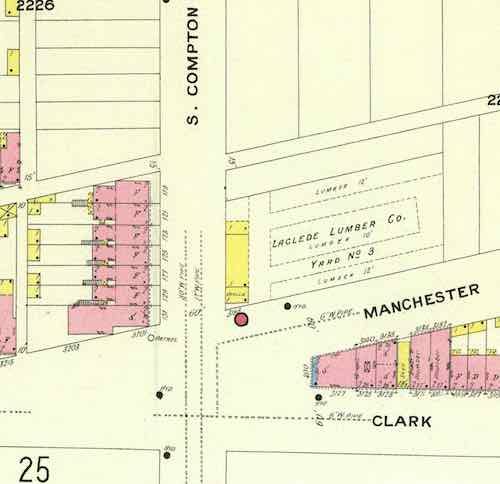
From the February 1909 Sanborn map we see Manchester, not Market, intersecting with Compton. Click image to see the full page view on the University of Missouri digital library website.

Go ahead, look at a map and visually draw a line between Manchester & Vandeventer and Compton & Market. Because of the many rail lines Manchester wouldn’t have been a straight line, it would have bent to the north of them. My point is a century ago streets continued uninterrupted, but highways/interstates (and industrialization) radically altered the landscape to make life easier for those behind the wheel of those noisy new horseless carriages (shaking cane). It’s possible the Manchester  connection was severed prior to the highway but I didn’t want to further delay this post while searching the Post-Dispatch archives for the answer.

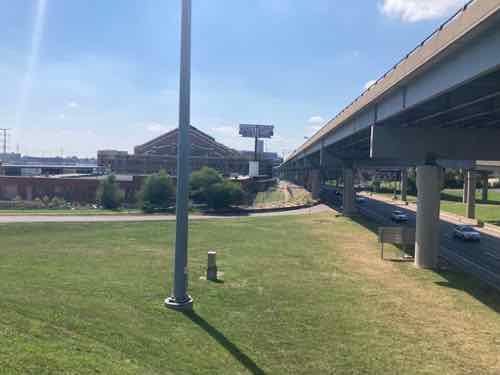
It’s a given that I-64/U.S. 40 will not be removed, or buried in a big dig. What is happening now will determine how it looks and functions for the next 50-70 years. Next we need to list and look at what I see as the problems to solve by changing how the highway and interchanges are currently configured.

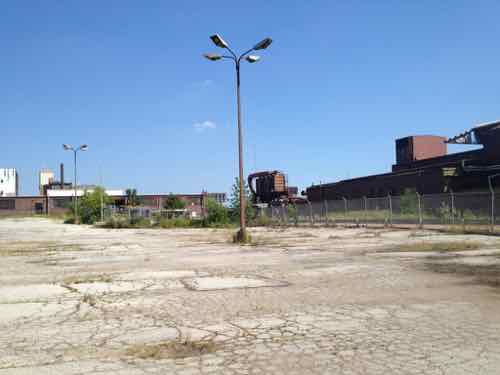
  • Large amount of land used, wasted
  • Pedestrian & bicycle navigation of area is challenging, nearly impossible, the local street network decimated
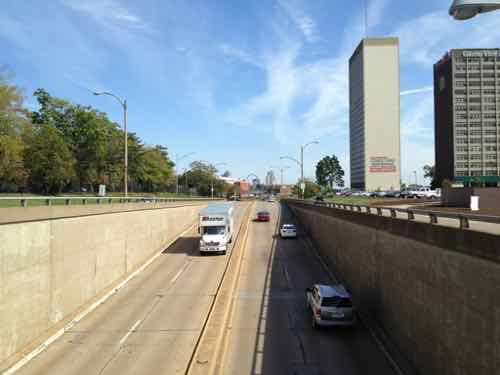
  • Driving the area is also challenging, with awkward & confusing on/off ramps
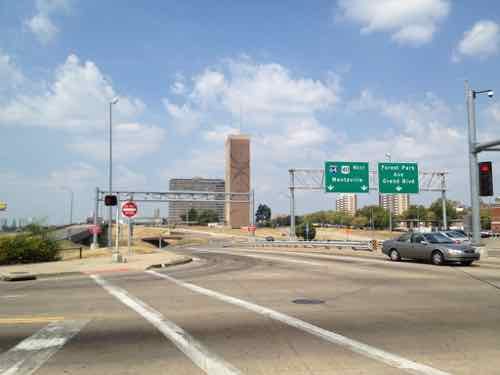
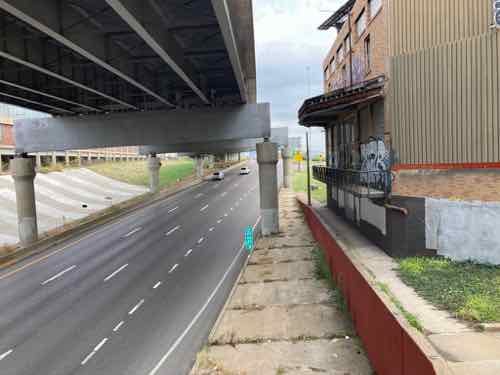
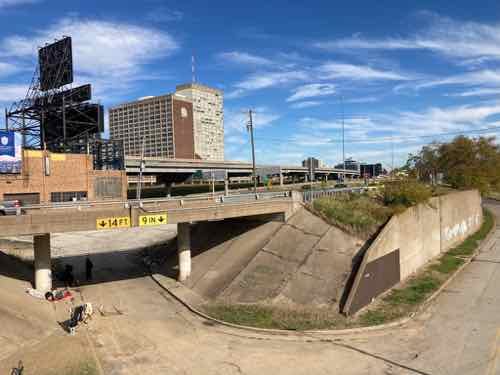
Looking west northwest from Compton & Spruce…if only I had a drone to get video/aerial photos
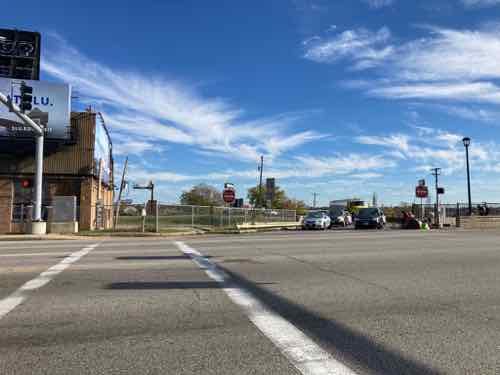
The Grand exit from eastbound I-64 may have made since in the 1950s/60s but not today
After a right right turn back drivers that exited eastbound I-64 are facing west at Grand

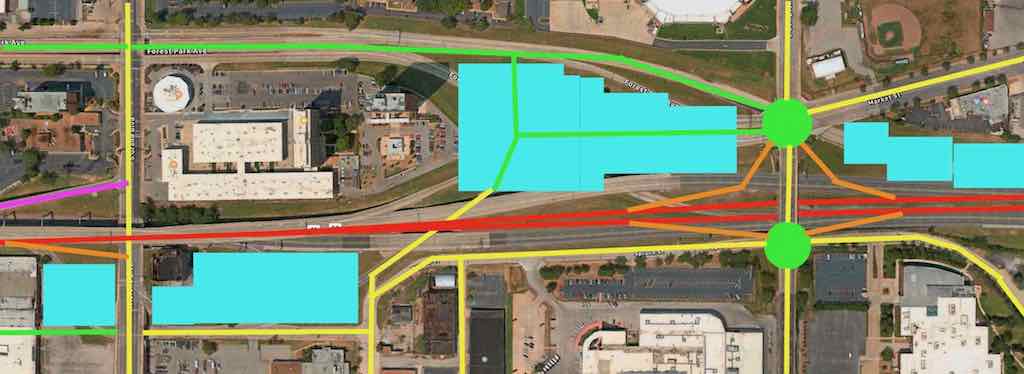
Okay, here’s my proposed solution.

Below I’ll look at this in two sections. Click image to view larger version.

Key:

  • Yellow: existing streets
  • Green: new or revised streets
  • Red: interstate
  • Purple: existing ramp
  • Orange: new on/off ramps
  • Light blue:

Let’s start on the left/west side.
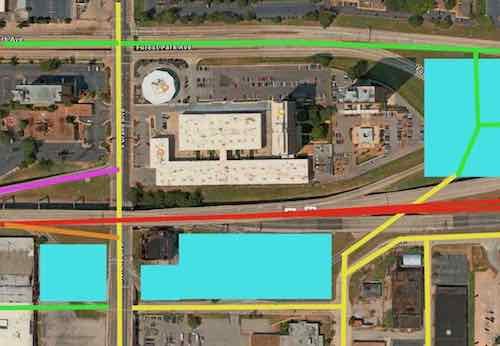
The biggest change from the left is the awkward existing Grand exit from eastbound I-64 has been replaced by a more conventional ramp. Drivers would be going up as they exited, but that would help them slow down. With the current ramp gone the building right at Grand & I-64 could be incorporated into a new development on reclaimed land. I’d also bring Forest Park Ave up to grade at Grand for a more conventional intersection.
The new exit would come up to Grand, the light could be moved. If the elevated section is completely replaced it would make this easier. The new eastbound exit would be similar to the one at 14th — just up instead of down.
Removing the current exit would free up a lot of land that can be used for new construction near the Grand MetroLink station and the heavily used #70 Grand MetroBus.
With Forest Park ducking under Grand the intersection on top is awkward for drivers, bicyclists, and pedestrians. As with Forest Park & Kingshighway, this intersection needs to be at grade and conventional.

Ok, lets move down to the big area to the east.
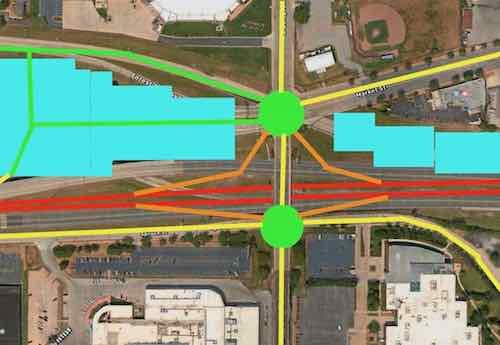
It makes sense to continue to allow interstate drivers in both directions an exit in this area. but it can be accomplished in a far more compact manner.  Specifics below.

The two green circles are roundabouts. Market Street could continue into the center of the newly developed area. Ideally 5+ story building would be built as a terminus to the view when heading west on Market. A new north-south connection through the new development would allow access to Spruce Street and the other parts south of I-64. The eastbound lanes of I-64 would need to be shifted north to give room for the on/off ramps at roundabout at Compton & Spruce. The westbound lanes of I-64 can shift south to free up land for development.

I’m not a traffic/civil engineer so I might not have sufficient room for say acceleration/deceleration on on/off ramps or some other detail, but I think this accomplishes the job of fixing the current problems. It gives more room for development, and increases connections for all modes of travel.

I’d love to see the new development include a variety of residential price points from low income to top market rates, parking available at a rate of less than one space per dwelling unit. It shouldn’t all be expensive housing geared toward college students. Other uses include office, retail, small manufacturing, perhaps business incubator space, etc.

I don’t know that I’ll live long enough to see any changes, but hopefully these ideas will be helpful to the process.

— Steve Patterson
 

A Look at City Foundry St. Louis…in August 2013

November 22, 2021 Featured, Midtown, Planning & Design Comments Off on A Look at City Foundry St. Louis…in August 2013

In August 2013 the vacant brake foundry in Midtown St. Louis, Vandeventer Ave. & Forest Park Ave., was an “eye sore” just south the main campus of Saint Louis University.  IKEA’s announcement to build on the opposite side of Vandeventer was still a few months away. I visited the foundry site as best I could in my power wheelchair, taking 9 photos in a 20 minute period.

Before posting about the new City Foundry STL (with food hall, offices, retail space, and recently opened grocery store) I want to take you back to the afternoon of Saturday August 24, 2013:

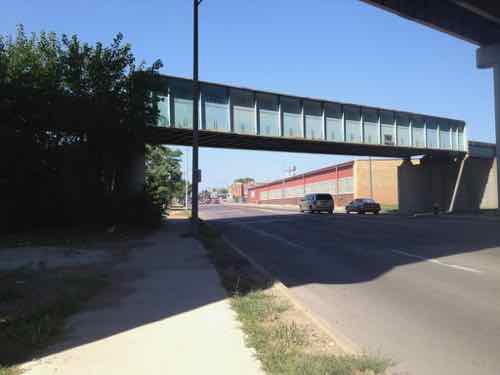
Looking NE from the west side of Vandeventer, under I-64.
A little further north, looking toward Forest Park Ave.
Turning east, the rail spur (right) hadn’t been used in decades.
Further north, looking east.
Now east of Vandevener, looking east along the north side of the foundry site, Forest Park Ave
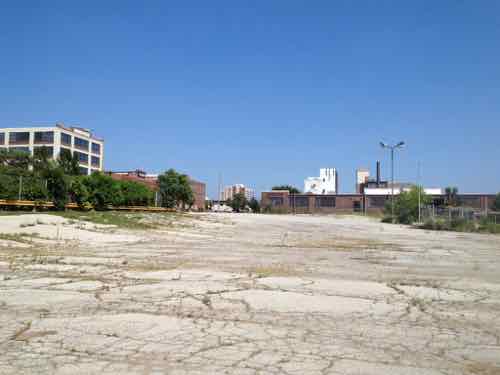
From the gently-sloping parking lot within the site, looking east.
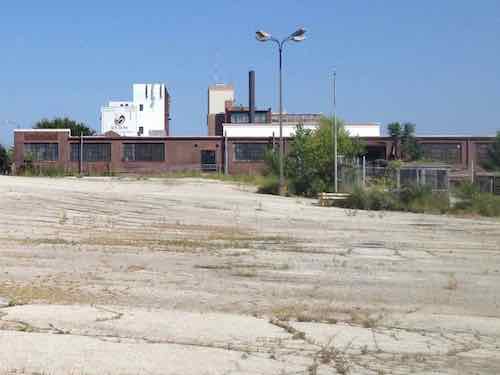
This is a cropped view from the previous image.
Into the site a little more, looking SE
Looking south along Spring Ave, the east boundary of the foundry site.
Down the hill, looking back north along Spring Ave. The eastern most foundry building is now on the left.
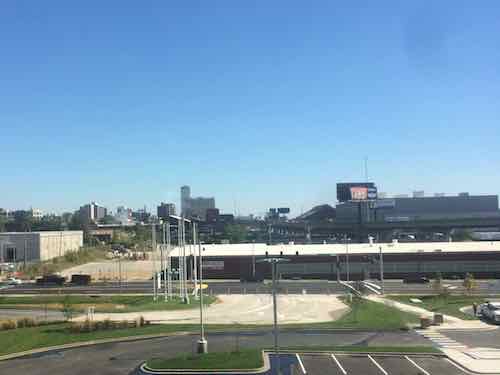
Looking east from IKEA’s 3rd floor restaurant on September 23, 2015 — the day the media was allowed to preview the new store. IKEA’s Opening Day was a week later, September 30, 2015. The foundry site to the east was unchanged more than 2 years after my visit above.

Soon I’ll use these images to compare the foundry to the completely reimagined present. The single-story building along Vandeventer was razed, all other buildings remain today. See amazing before interior photos here.

— Steve Patterson


Readers Prefer A Downtown Soccer Stadium Near Union Station

November 2, 2016 Downtown, Featured, Planning & Design Comments Off on Readers Prefer A Downtown Soccer Stadium Near Union Station
7 In February I proposed putting a dedicated stadium in between Pine & Market, West of 20th

In the non-scientific Sunday Poll less than 10% of readers didn’t favor a dedicated soccer stadium, almost as many were undecided.  Just over half picked near Union Station first with Grand & Chouteau 2nd.

Q: Which of the following represents your priorities with respect to a dedicated soccer stadium:

  • 1) no dedicated soccer stadium 2) Grand/Chouteau 3) Near Union Station 3 [4.92%]
  • 1) no dedicated soccer stadium 2) Near Union Station 3) Grand/Chouteau 3 [4.92%]
  • 1) Grand/Chouteau 2) Near Union Station 3) no dedicated soccer stadium 16 [26.23%]
  • 1) Grand/Chouteau 2) no dedicated soccer stadium 3) Near Union Station 0 [0%]
  • 1) Near Union Station 2) Grand/Chouteau 3) no dedicated soccer stadium 31 [50.82%]
  • 1) Near Union Station 2) no dedicated soccer stadium 3) Grand/Chouteau 4 [6.56%]
  • Unsure/No Answer 4 [6.56%]

Back in February 2016 I proposed a site near Union Station, see A Great Site For A Major League Soccer (MLS) Stadium In Downtown St. Louis. Regardless, I don’t think either ownership team or city leaders have the slightest clue about how to crete a quality pedestrian-friendly neighborhood. The Grand & Chouteau site should become a dense mixed-use neighborhood, but SLU is opposed to quality urbanism.

We’ll see what happens.

— Steve Patterson


Sunday Poll: Which Location Would You Pick For A Soccer Stadium?

October 30, 2016 Downtown, Featured, Midtown, Popular Culture, Sunday Poll Comments Off on Sunday Poll: Which Location Would You Pick For A Soccer Stadium?
Please vote below
Please vote below

The NFL has left, but major league soccer (MLS) is interested in St. Louis.

There are at least two potential MLS ownership groups in St. Louis.

They include Foundry St. Louis, which has already identified property at the northwest corner of Chouteau Avenue and Grand Boulevard for stadium development, and MLS2STL, whose representatives are adamant the stadium site should be downtown. (Post-Dispatch)

The downtown site would technically be in Downtown West — just West of Union Station.

So today’s non-scientific poll seeks to figure out where the readership thinks a dedicated soccer stadium is best placed, if at all. There are many pros & cons to both possible locations.

The poll will close at 8pm.

— Steve Patterson


1960s Grand Bridge Closed For Replacement 5 Years Ago Today

It was five years ago today when St. Louis closed the 1960s Grand Ave bridge over the railroad tracks so it could be replaced:

The Grand Bridge is scheduled to close from Chouteau Avenue to the I-64 off-ramp on Monday, March 14, 2011. The bridge will close before the morning rush around 5:00 am. The bridge will be closed to traffic for about 14 months; the entire project is expected to be completed in 18-24 months. During that time, the current bridge will be completely removed and replaced. When finished, the project will provide a dramatic facelift to Midtown. (St. Louis)

The old bridge had 3 vehicles lanes in each direction and vary narrow sidewalks.

Looking north from the old transit stop, June 2010

The new bridge, with 2 lanes per direction & wider sidewalks, opened in July 2012. See: New Grand Viaduct Huge Improvement, Development Opportunities Remain.

The Grand bridge over I-44 will soon be replaced, though traffic won’t be completely cut off:

The driving surface of the bridge will be completely replaced and the bridge will be raised to meet interstate standards. Although the project will be completed in stages, drivers can expect fewer lanes across the bridge and will not be able to make left turns during construction, MoDOT said.

At least one lane will be open in each direction on Grand during each stage of construction.

Construction is expected to start in June, with all driving lanes expected to be open by the end of the year. (Post-Dispatch)

Work continues on a new kingshighway bridge over the railroad tracks South of I-44, the old bridge closed last July.

— Steve Patterson


Advertisement


[custom-facebook-feed]

Archives

Categories

Advertisement


Subscribe