Home » Politics » Recent Articles:

April 2023 Election Results Sets New 14-Member Board of Aldermen

April 5, 2023 Board of Aldermen, Featured, Politics/Policy Comments Off on April 2023 Election Results Sets New 14-Member Board of Aldermen

St. Louis voters have selected their candidates for our new 14 wards, cut in half from the 28 wards for more than a century.

St. Louis City Hall

Of the 28 the following aldermen didn’t run this year:

  • Dwinderlin Evans (4th ward)
  • Christine Ingrassia (6th ward)
  • Jack Coatar (7th ward)
  • Annie Rice (8th ward)
  • Dan Guenter (9th ward)
  • James Lappe (11th ward)
  • Bill Stephens (12th ward)
  • Carol Howard (14th ward)
  • Jesse Todd (18th ward)
  • Marlene Davis (19th ward)

The following aldermen ran, but were defeated in the March primary:

  • Michael J. Gras was the 28th ward alderman, coming in a very close 3rd in a 3-way primary in the new 9th ward.
  • Lisa Middlebrook was the 2nd ward alderman, but was defeated in a 3-way race against two other existing aldermen in the new 13th ward.
  • Brandon Bosley (3rd ward) and James Page (5th ward) were defeated in a 4-way primary race in the new 14th ward.

The following aldermen were defeated in Tuesday’s general election:

  • Joe Vaccaro, longtime conservative alderman in the 23rd ward, was defeated by 24th ward alderman Bret Narayan in the new 4th ward.
  • Tina Pihl was 17th ward alderman, losing to Michael Browning in the new 9th ward.
  • In the new 13th ward Norma Walker, recently elected to fill the 22nd ward seat, was defeated by 27th ward alderman Pamela Boyd.

Two former aldermen lost in their attempts to return to the board: Ken Ortmann & Jennifer Florida.

State Rep Rasheen Aldridge thankfully defeated Hubbard dynasty candidate Ebony Washington. Aldridge will resign as state rep to be sworn in as 14th ward alderman. A special election will be held to fill the state rep seat — hopefully a Hubbard won’t be elected.

The new 14-member board of aldermen will be:

  • 1) Anne Schweitzer* (13th)
  • 2) Thomas Oldenburg* (16th)
  • 3) Shane Cohn* (25th)
  • 4) Bret Narayan* (24th)
  • 5) Joseph Vollmer* (10th)
  • 6) Daniela Velazquez
  • 7) Alisha Sonnier
  • 8) Cara Spencer* (20th)
  • 9) Michael Browning
  • 10) Shameem Hubbard* (26th)
  • 11) Laura Keys* (21st)
  • 12) Sharon Tyus* (1st)
  • 13) Pamela Boyd* (27th)
  • 14) Rasheen Aldridge

So ten of the fourteen aldermen were reelected (marked with *, followed by their pre-2023 ward number), with only four being entirely new to the board. With Aldridge, the board will now have two openly LGBTQ members, joining Cohn.

Fifty percent are people of color (PoC), and one more than half are women. When you include the board president, comptroller, and mayor this is the first time in the 259-year history of the city that women and people of color will be in charge — long overdue!

I believe it is the new aldermen representing the even-numbered wards that will start with 4-year terms — those representing odd-numbered wards will initially have only a 2-year term. In 2025 the odd-numbered wards will hold elections for 4-year terms.

Voters also approved Proposition C establishing a Charter Commission to propose charter amendments to voters. I strongly recommend language changes to eliminate the March primary — with instant runoff/ranked-choice voting in every April in races with 3+ candidates. We shouldn’t have to go the polls just 4 weeks apart!

A 3% tax on recreational/adult-use cannabis was approved in the city, and in St. Louis County. Though I’m a supporter of legal cannabis, I’m among those who voted yes because these jurisdictions will need to provide city services.

Sadie Weiss and Tracy Hykes were elected to the board of education, Nicole Robinson defeated incumbent Pam Ross for a trustee seat on the community college board. Voters approved the DeBaliviere special business tax district.

— Steve
————————————————————————
St. Louis urban planning, policy, and politics @ UrbanReviewSTL since October 31, 2004. For additional content please consider following on Facebook, Instagram, Mastodon, and/or Twitter.

 

Glad the Illinois Primary is Tuesday, June 28th

June 23, 2022 Featured, Metro East, Politics/Policy Comments Off on Glad the Illinois Primary is Tuesday, June 28th

The old Illinois capital building in downtown Springfield IL

I’ve lived in two states my entire life, Illinois isn’t one of them. But as a St. Louis Missouri resident for nearly 32 years I’ve seen plenty of Illinois campaign television advertisements. Of course, Illinois residents in the St. Louis metro area have seen more than their share of Missouri political ads.

The Illinois primary is Tuesday, June 28, 2022.

While there are many races on ballots in Illinois it is ads for two that are the ones we’ve all been seeing. A lot. Governor & 15th congressional district.

Let’s begin with the race for congress, both GOP candidates are incumbents!

U.S. Reps. Rodney Davis and Mary Miller are running in the Republican primary for Illinois’ 15th Congressional District on June 28, 2022. This race is one of six U.S. House incumbent-vs.-incumbent primaries occurring in 2022 as a result of congressional redistricting after the 2020 census. (Ballotpedia)

Illinois lost one seat in congress as a result of population loss in the 2020 census, so two Republican colleagues are now in a bitter campaign against each other. Each is trying to paint themselves as the most pro-Trump and the other as being less conservative than themselves.

The head-to-head contest is an offshoot of new congressional boundaries drawn by state lawmakers in Springfield following the federal census and Illinois’ loss of one of its current 18 U.S. House seats. Miller’s home was narrowly drawn into a district with another Republican, U.S. Rep. Mike Bost of Murphysboro, but she opted instead to challenge Davis. Members of Congress do not have to live in the district they represent. (Chicago Tribune)

The 15th is the most conservative district in Illinois, which means the democratic nominee won’t stand a chance. Either Davis or Miller will be out of office in January 2023, a week from now we should know who will be sworn in again and who will pack up their D.C. apartment.

In the Illinois race for governor the situation is very different. Democrat J. B. Pritzker is seeking a second term, he’ll easily win his primary. Half a dozen Republicans are running to become the GOP nominee to challenge Prizker in November.

Six candidates are running in the Republican primary for governor of Illinois on June 28, 2022. Darren Bailey and Richard Irvin have led the field in fundraising and media coverage.

Bailey is a farmer who serves in the Illinois State Senate. He was first elected to office in 2020. In his campaign ads, Bailey has highlighted his support for reducing taxes and government spending while serving in the state senate, his support for law enforcement, his support for Donald Trump (R), and his opposition to Governor J.B. Pritzker (D). A campaign ad said, “In Springfield, Darren stood up for working families and fought against every single tax increase. When Governor Pritzker tried to close Illinois, Darren sued him and won to keep our state open. Now, Darren is running for governor with a plan to cut our taxes, fund our police, and impose term limits on politicians.”[4]

Irvin is an attorney who has served as mayor of Aurora, Illinois since he was elected in 2017. Irvin’s campaign ads have highlighted his work as a prosecutor and his support for increasing police department budgets, his experience as a veteran, his opposition to J.B. Pritzker, and his economic record as mayor of Aurora. A campaign ad said, “Running our second-largest city, crime’s come down because the police budget has gone up. I hired more cops each year. We’ve recruited new companies […] and we’ve controlled spending, balanced budgets, so residents got property tax relief. My city is now stronger, safer, and full of opportunity. I want that for Illinois.” (Ballotpedia)

I’ve seen ads for only [two] three of the six. Like the 15th congressional district ads, the spots from the top two challengers have been vicious. I’ve also seen a few ads for Paul Schimpf. Nothing from the other three candidates. If Bailey loses either the primary or general he’ll no longer be in public office because his term as state senator ends. However, Irvin was just re-elected to a second term as Aurora’s mayor last year. If he doesn’t become governor he’ll still be mayor.

Past Illinois Democratic governors have been vulnerable at election time, but Prizker appears to be in a better position than his predecessors.

Illinois U.S. Senator Tammy Duckworth is seeking another 6-year term. I’ve not seen a single ad for the seven (7) Republicans on Tuesday’s primary ballot who want to go against her in November.

It’ll just be nice having a break from divisive political ads for a bit, though I know Missouri’s primary is only 5 weeks later, on August 2, 2022.

— Steve Patterson


b


Vote For The Moderate Candidate: Bernie Sanders

March 9, 2020 Featured, Politics/Policy Comments Off on Vote For The Moderate Candidate: Bernie Sanders

Wait, isn’t Bernie Sanders the left-wing extremist? No, not really.

In the 1940s, Senators Robert Wagner and James Murray and Congressman John Dingell Sr. introduced legislation that would have established a national program for hospital and medical insurance. It was stymied by a coalition of Southern Democrats and conservative Republicans, as was also the case with Truman’s efforts after 1949 to achieve the same result. But it was central to the party’s core ambition for many years after.

Only in the 1960s did Democrats abandon the concept of universal, single-payer health care and champion a narrower program of guaranteed hospital insurance and voluntary medical insurance for the elderly—the program that we now know as Medicare. They didn’t abandon universal coverage because they viewed it as too radical. Rather, they believed it was no longer necessary. After World War II, major employers began extending unprecedented benefits to workers, including annual cost-of-living adjustments to wages, defined benefits pensions and private health insurance. Given this reality, they turned their focus to a narrower subset of the population that, by definition, would not benefit from employer-based health programs: senior citizens. (Politico)

Since 1980 Democrats have been moving to the right, FDR wouldn’t recognize today’s Democratic Party.

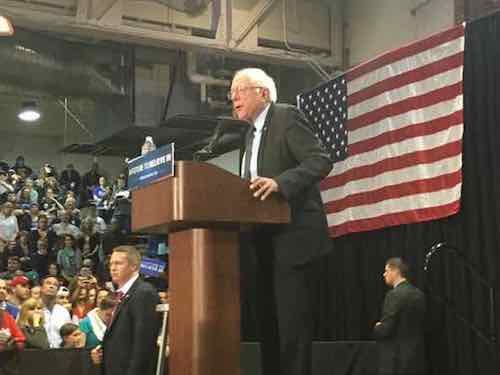
Bernie Sanders in Affton four years ago.

The policies Bernie Sanders has advocated for decades are very moderate:

  • Healthcare for everyone. Millions would live longer, others wouldn’t go bankrupt, people wouldn’t need to resort to online fundraising. Our peer countries have universal healthcare, but somehow we think this is extreme.  Now with Coronavirus it’s especially important people not to fear the cost of going to the doctor.  Speaking of cost, we could save money with Medicare for All.  Doing nothing will continue to cost us more and more. Better coverage for less money isn’t radical, it’s common sense.
  • Taxing the 1%. Decades ago the wealthiest paid their share of taxes, but now we’ve got the 99% objecting to them paying more. Some billionaires paid a lower rate than their workers. It’s not radical to think they should pay a higher rate.
  • Act on climate change. Time is running out, today’s kids count on us to make wise decisions. Not doing anything is the radical position.

Elected Democrats that call themselves “moderates” are only slightly less conservative than Republicans. No wonder the other candidate would consider a republican as a running mate.

Missouri votes tomorrow, Illinois a week from tomorrow.

— Steve Patterson


Missouri Is A Solid Red State

December 11, 2019 Featured, Missouri, Politics/Policy Comments Off on Missouri Is A Solid Red State

When I moved to Missouri in 1990 it was a swing state, a bellwether:

The Missouri bellwether is a political phenomenon that notes that the state of Missouri voted for the winner in all but three U.S. Presidential elections from 1904 to 2016 (the exceptions are 1956, 2008 and 2012). While states like Ohio, Nevada, Florida and New Mexico have been arguably stronger indicators of political trends in recent years, Missouri was a consistent swing state throughout the 20th century. Prior to the 2008 elections, Lincoln County, Missouri was said to be the only bellwether county in a bellwether state. (Wikipedia)

Missouri would go red or blue throughout the 20th century. However, the last time Missouri went blue was in 1996. The country went blue in 2008 & 2012, but Missouri stayed red. The 2008 election was very close in Missouri, but widened in 2012 & 2016.

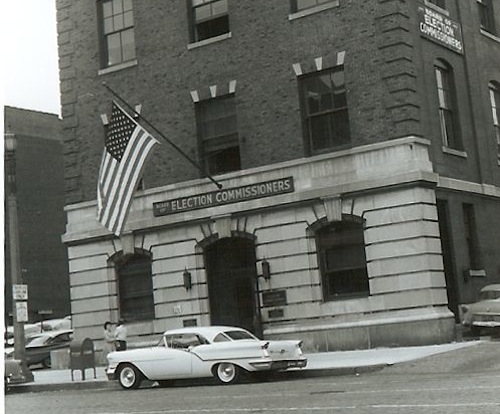
Vintage photo of the former offices of the St. Louis Board of Election Commissioners. From my collection

Twentieth century bellwether, 21st century red state.  Here’s the results from the recent non-scientific Sunday Poll:

Q: Agree or disagree: The right Democratic nominee could turn Missouri from Red to Blue in the 2020 General Election

  • Strongly agree: 4 [13.79%]
  • Agree: 2 [6.9%]
  • Somewhat agree: 2 [6.9%]
  • Neither agree or disagree: 2 [6.9%]
  • Somewhat disagree: 3 [10.34%]
  • Disagree: 6 [20.69%]
  • Strongly disagree: 9 [31.03%]
  • Unsure/No Answer: 1 [3.45%]

Most agree with me — regardless of the Democratic nominee a majority of Missouri voters vote for Trump. Illinois, meanwhile, remains a safe blue state.

— Steve Patterson


Opinion: Repeal 2nd Amendment To Return To ‘Collective Rights’ Over ‘Individual Rights’

August 21, 2019 Featured, Politics/Policy Comments Off on Opinion: Repeal 2nd Amendment To Return To ‘Collective Rights’ Over ‘Individual Rights’

Gun show billboard, 2011

There’s something about the United States that sets us apart from everywhere else in the world when it comes to gun violence. Some try to blame video games or mental health, but the those aren’t unique to the U.S.

Part of what is different is the constitutional right to bear arms, but that is read one of two ways: collective rights or individual rights.

The Second Amendment of the United States Constitution reads: “A well regulated Militia, being necessary to the security of a free State, the right of the people to keep and bear Arms, shall not be infringed.” Such language has created considerable debate regarding the Amendment’s intended scope. On the one hand, some believe that the Amendment’s phrase “the right of the people to keep and bear Arms” creates an individual constitutional right for citizens of the United States. Under this “individual right theory,” the United States Constitution restricts legislative bodies from prohibiting firearm possession, or at the very least, the Amendment renders prohibitory and restrictive regulation presumptively unconstitutional. On the other hand, some scholars point to the prefatory language “a well regulated Militia” to argue that the Framers intended only to restrict Congress from legislating away a state’s right to self-defense. Scholars have come to call this theory “the collective rights theory.” A collective rights theory of the Second Amendment asserts that citizens do not have an individual right to possess guns and that local, state, and federal legislative bodies therefore possess the authority to regulate firearms without implicating a constitutional right. (Wex Legal Dictionary)

Until 2008 the collective rights theory was accepted as the meaning of the militia reference in the Second Amendment. The late  John Paul Stevens, appointed to the Supreme Court by Republican Gerald Ford, wrote a couple of opinion pieces about gun violence and the constitution.

From 2012, two years after retiring:

The first 10 amendments to the Constitution placed limits on the powers of the new federal government. Concern that a national standing army might pose a threat to the security of the separate states led to the adoption of the Second Amendment, which provides that “a well regulated Militia, being necessary to the security of a free State, the right of the people to keep and bear Arms, shall not be infringed.”

For more than 200 years following the adoption of that amendment, federal judges uniformly understood that the right protected by that text was limited in two ways: First, it applied only to keeping and bearing arms for military purposes, and second, while it limited the power of the federal government, it did not impose any limit whatsoever on the power of states or local governments to regulate the ownership or use of firearms. Thus, in United States v. Miller, decided in 1939, the court unanimously held that Congress could prohibit the possession of a sawed-off shotgun because that sort of weapon had no reasonable relation to the preservation or efficiency of a “well regulated Militia.” (Washington Post)

The individual states that formed the Union were concerned about a national army that might infringe on their rights as a state. Remember, the Bill of Rights was ratified in December 1791 — not long after independence from England.

Justice Stevens again, from March 2018:

During the years when Warren Burger was our chief justice, from 1969 to 1986, no judge, federal or state, as far as I am aware, expressed any doubt as to the limited coverage of that amendment. When organizations like the National Rifle Association disagreed with that position and began their campaign claiming that federal regulation of firearms curtailed Second Amendment rights, Chief Justice Burger publicly characterized the N.R.A. as perpetrating “one of the greatest pieces of fraud, I repeat the word fraud, on the American public by special interest groups that I have ever seen in my lifetime.”

In 2008, the Supreme Court overturned Chief Justice Burger’s and others’ long-settled understanding of the Second Amendment’s limited reach by ruling, in District of Columbia v. Heller, that there was an individual right to bear arms. I was among the four dissenters.

That decision — which I remain convinced was wrong and certainly was debatable — has provided the N.R.A. with a propaganda weapon of immense power. Overturning that decision via a constitutional amendment to get rid of the Second Amendment would be simple and would do more to weaken the N.R.A.’s ability to stymie legislative debate and block constructive gun control legislation than any other available option. (New York Times)

In 2018 Stevens argued for repealing the 2nd Amendment. I agree. The individual rights fraud pushed by the N.R.A. is partly to blame for gun violence that sets the United States apart from every other nation. A pistol in the home for self-defense is fine, but buying dozens of assault rifles and ammunition in a short period of time is not.

The recent non-scientific Sunday Poll was hijacked — more than twice the number of usual responses. The highly skewed results are visible in the original post, so I’m not going to reprint them here.

— Steve Patterson


Advertisement


[custom-facebook-feed]

Archives

Categories

Advertisement


Subscribe