Readers: Saint Louis University Shouldn’t Be Allowed To Raze The Historic Pevely Dairy Complex
College campuses often reflect their location: rural, suburban or urban. Although Saint Louis University is in an urban location, it is doing a great job of destroying all aspects of urban life.
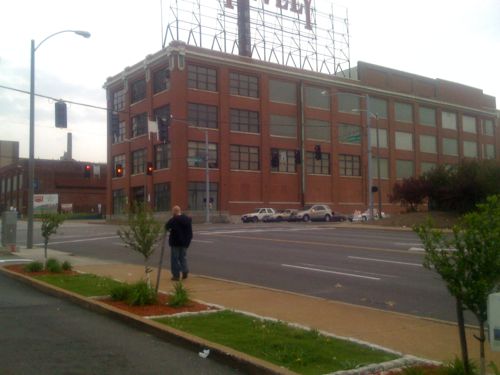
Last week the majority of readers that voted in the poll do not want this to continue:
Q: Should the St. Louis Preservation Board allow SLU to raze the former Pevely Dairy building at Grand & Chouteau?
- No 134 [66.34%]
- Yes 43 [21.29%]
- Maybe 14 [6.93%]
- Other: 9 [4.46%]
- Unsure/No Opinion 2 [0.99%]
The 43 “Yes” answers must be from those who think they have a rational look at life.
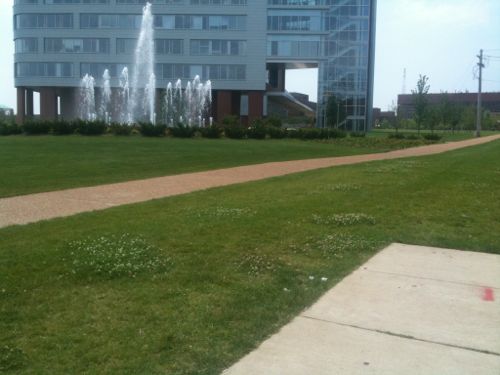
The reality is each and every time an urban building is replaced with an anti-urban building set behind a green lawn the environment is denigrated, making revitalization that much harder. Wealthy institutions know this will help them but more land, something they couldn’t do if areas thrived with private investment.
Here are the nine other answers provided by readers:
- Not the main structure.
- Hell no! Apparently SLU thinks its interests are parallel to ours. WRONG!
- only if they replace it with a huge fountain or better yet museum of fountains
- Yes, SLU doesn’t own enough vacant land for this project.
- No, there’s a shortage of university housing, build reasonably price apts
- Need to see post-demo land use plans before final determination
- SLU has a Center for Sustainability with no real estate–rehab Pevely for that
- No, they should renovate it and add on another building if needed
- If it can’t be rehabbed
From the nomination (PDF) to the National Register of Historic Places in 2009:
The Pevely Dairy Company Plant sits on an approximately eight-acre site in the Midtown Neighborhood of St. Louis on the west side of South Grand Boulevard between Chouteau and Hickory Avenues. Constructed between 1915 and 1945, the Pevely Dairy Company Plant was designed as the headquarters for the growing company; it remained in service as a dairy until November 2008. It is comprised of three buildings, a smokestack, and two parking lots. The 1915 four-story, red brick office building is located at 1001 South Grand Boulevard. It features a three-bay façade with large display windows in the first level, and retains the original wood door and pedimented entrance surround. A terra cotta cornice with colored tile designs ornaments the flat roofline. Many of the original wood industrial windows have also been retained on this building, as well as the glazed brick walls and floors and intricate woodwork. The 1916 milk plant sits behind the office building at 3626 Chouteau Avenue. This three-story brick and concrete industrial building had additions in 1943, 1945, 1975 and 1997. Featuring metal hopper windows, three loading docks, two metal coolers and two steam tanks, the milk plant’s architecture is primarily functional rather than artistic. The interior retains its glazed brick walls and floors, as well as large, open storage rooms that include concrete mushroom columns. A 1928 garage is located south of the milk plant at 1101 Motard Avenue. This brick, arch-roofed structure retains original glazed glass metal windows, with sliding metal doors and stepped parapet walls on the east and west elevations. The interior consists of an open parking area with a concrete floor. Originally connected to a boiler and powerhouse, the 1943 smokestack now sits across a parking lot from the office building. The brick structure includes a glazed brick design spelling out the Pevely name. The adjacent parking lot and a lot between the milk plant and garage have historically served as open parking and loading space, and are included in the boundary. Though three of the Pevely structures have burned since the period of significance, the factory as a whole retains the industrial structures primarily associated with the company. These buildings are in good condition and continue to reflect their industrial significance.
The issue is said to be on the November 28th Preservation Board agenda, which isn’t available yet. I’m glad to see Mary “One” Johnson is no longer on the board, she consistently voted in favor of demolitions.
Saint Louis University must show the structure(s) cannot be reused — not necessarily for their intended purpose  but for any reasonable use. We’ll see how they try to spin this at the meeting.
– Steve Patterson
I think you touched on one key point, but only in passing – the real issue here is sprawl. Since the industrial uses surrounding SLU’s campus are rapidly disappearing, there’s a large amount of land available for relatively low cost. Land values are the biggest drivers in creating urban densities and “urban buildings” – it simply makes little economic sense to use expensive land for surface parking or empty grassy areas. SLU is taking full advantage of depressed real estate values to significantly expand their physical footprint. And, with more land available, there’s little reason to build up when they can build out. UMSL isn’t much different; the only difference is they started with a golf course instead of a 19th century urban area.
SLU made an economic analysis before they decided to purchase this building, apparently fully intending to tear it down. This happened with few real constraints. SLU has to assume that the existing zoning was appropriate for what they want to do, or that it can be easily changed. SLU has to assume that there would be few obstacles to demolishing the structure. Both are tools that can be used to guide development, but only if they’re applied. If the “city” (Planning Dept, Mayor, Aldermen) isn’t willing to demand a master plan and to hold an institution to it, we’re going to continue to see development like this happening in a vacuum.
The real issue here is not so much SLU as the rest of us. Pevely moved out, leaving the complex vacant. The loft developer couldn’t make the numbers work. If someone, anyone had truly wanted to “save” the buildings, to put them to a new use(s), they could have offered more than SLU was willing to pay. Was SLU motivated? Absolutely. But they’re also not crazy, there’s some number that would’ve been too much, even for them.
And part of the challenge is that this is an industrial complex. History is relative. Taking the description and editing it, some of the absurdity becomes apparent: “the milk plant’s architecture is primarily functional rather than artistic. . . . The adjacent parking lot and a lot between the milk plant and garage have historically served as open parking and loading space, and are included in the boundary. Though three of the Pevely structures have burned since the period of significance, the factory as a whole retains the industrial structures primarily associated with the company.” The same could’ve been said of the Chrysler and Ford plants, both recently demolished, and of the Colgate plant, on the north side -were/are any of these considered to be “historic”?
Factory buildings are tools, designed to be modified as manufacturing processes evolve or to be removed when they’ve outlived their original purpose or useful life. The same can be said of fast food restaurants or big box stores or enclosed shopping malls. Yes, they all have a history, and yes, they all add to the context in which they’re placed. But to argue that something built in the 1920’s is somehow better / more sacred than something built in the 1940’s or 1960’s is both arbitrary and absurd. The real issue isn’t that this building is old, it’s the fear that whatever replaces it will be less to “our” liking. Using history to be the taste police misses the point and is a crude tool. What’s really needed are form-based zoning requirements and rigorous, citizen-based design review IF we as a city want to impose that level of government control over private land owners.
I think you touched on one key point, but only in passing – the real issue here is sprawl. Since the industrial uses surrounding SLU’s campus are rapidly disappearing, there’s a large amount of land available for relatively low cost. Land values are the biggest drivers in creating urban densities and “urban buildings” – it simply makes little economic sense to use expensive land for surface parking or empty grassy areas. SLU is taking full advantage of depressed real estate values to significantly expand their physical footprint. And, with more land available, there’s little reason to build up when they can build out. UMSL isn’t much different; the only difference is they started with a golf course instead of a 19th century urban area.
SLU made an economic analysis before they decided to purchase this building, apparently fully intending to tear it down. This happened with few real constraints. SLU has to assume that the existing zoning was appropriate for what they want to do, or that it can be easily changed. SLU has to assume that there would be few obstacles to demolishing the structure. Both are tools that can be used to guide development, but only if they’re applied. If the “city” (Planning Dept, Mayor, Aldermen) isn’t willing to demand a master plan and to hold an institution to it, we’re going to continue to see development like this happening in a vacuum.
The real issue here is not so much SLU as the rest of us. Pevely moved out, leaving the complex vacant. The loft developer couldn’t make the numbers work. If someone, anyone had truly wanted to “save” the buildings, to put them to a new use(s), they could have offered more than SLU was willing to pay. Was SLU motivated? Absolutely. But they’re also not crazy, there’s some number that would’ve been too much, even for them.
And part of the challenge is that this is an industrial complex. History is relative. Taking the description and editing it, some of the absurdity becomes apparent: “the milk plant’s architecture is primarily functional rather than artistic. . . . The adjacent parking lot and a lot between the milk plant and garage have historically served as open parking and loading space, and are included in the boundary. Though three of the Pevely structures have burned since the period of significance, the factory as a whole retains the industrial structures primarily associated with the company.” The same could’ve been said of the Chrysler and Ford plants, both recently demolished, and of the Colgate plant, on the north side -were/are any of these considered to be “historic”?
Factory buildings are tools, designed to be modified as manufacturing processes evolve or to be removed when they’ve outlived their original purpose or useful life. The same can be said of fast food restaurants or big box stores or enclosed shopping malls. Yes, they all have a history, and yes, they all add to the context in which they’re placed. But to argue that something built in the 1920’s is somehow better / more sacred than something built in the 1940’s or 1960’s is both arbitrary and absurd. The real issue isn’t that this building is old, it’s the fear that whatever replaces it will be less to “our” liking. Using history to be the taste police misses the point and is a crude tool. What’s really needed are form-based zoning requirements and rigorous, citizen-based design review IF we as a city want to impose that level of government control over private land owners.
If vacant land is so plentiful and cheap why buy land with a complex listed on the National Register of Historic Places and then pay more to raze the historic buildings? Just buy the cheap land instead.
Because it’s within the apparently ever-expanding boundaries of the SLU campus(es) / universe. And, as a former realtor, you know’s all about location, location, location – SLU is willing to pay a premium to control this corner. x
Obviously, SLU / Fr. Biondi has a grand vision / masterplan. Does the city know what it is? The neighbors? Those in the preservation community? I doubt that we all agree, but if we knew, we might be more at peace.
I said it before, big institutions have an edifice complex, they like to build things. One big reason is that it’s always easier to get a fat cat donor to write a big check for a new building than it is to get them to pay to maintain or renovate an older one.
If vacant land is so plentiful and cheap why buy land with a complex listed on the National Register of Historic Places and then pay more to raze the historic buildings? Just buy the cheap land instead.
Because it’s within the apparently ever-expanding boundaries of the SLU campus(es) / universe. And, as a former realtor, you know’s all about location, location, location.                                                                                                                               Â
Obviously, SLU / Fr. Biondi has a grand vision / masterplan. Does the city know what it is? The neighbors? Those in the preservation community? I doubt that we all agree, but if we knew, we might be more at peace.
I said it before, big institutions have an edifice complex, they like to build things. One big reason is that it’s always easier to get a fat cat donor to write a big check for a new building than it is to get them to pay to maintain or renovate an older one.
You can’t replicate the urban fabric of 100 years ago with 50% fewer people. Density requires lots of people and it’s pretty important that those people have jobs. Today’s job environment reflects office work over industrial processes. The Pevely building isn’t unsightly, but neither is it truly historic. Buildings like Pevely Dairy dot the South of Market (SOMA) landscape in San Francisco; many have been turned into office lofts and they currently house many of the Web 2.0 and social networking startup companies. Most of the startup activity in the Bay Area today is in SOMA, not down in the suburban office park sprawl of Silicon Valley. SLU’s vision for the area, even in the absence of a master plan, obviously reflects a significant medical complex. If greater St. Louis had invested all the funds blown on TIF for retail buildings into true venture capital, the demand for buildings like Pevely would be sufficient to fund the redployment of these assets into a 2nd useful life. Â
You can’t replicate the urban fabric of 100 years ago with 50% fewer people. Density requires lots of people and it’s pretty important that those people have jobs. Today’s job environment reflects office work over industrial processes. The Pevely building isn’t unsightly, but neither is it truly historic. Buildings like Pevely Dairy dot the South of Market (SOMA) landscape in San Francisco; many have been turned into office lofts and they currently house many of the Web 2.0 and social networking startup companies. Most of the startup activity in the Bay Area today is in SOMA, not down in the suburban office park sprawl of Silicon Valley. SLU’s vision for the area, even in the absence of a master plan, obviously reflects a significant medical complex. If greater St. Louis had invested all the funds blown on TIF for retail buildings into true venture capital, the demand for buildings like Pevely would be sufficient to fund the redployment of these assets into a 2nd useful life.
The number of buildings of Peveley’s type are remarkably limited in viable transit/urban-friendly corridors in Saint Louis and as such it is a truly historic building worthy of preservation. I think in your view the buildings along Washington Ave. would not be “truly historic” yet we know in truth that they are. But for their preservation, dowtown would continue to be a ghost town. And I agree we can’t replicate the urban fabric of 100 yrs. ago w/ 50% of the people but we can and must prioritize urban form in our strongest corridors. Grand Ave. is an anchor for the future of Saint Louis, and the highest standards need to be adopted.
Any reasonable uses is a pretty vague term. The entire south campus is dated and in need of major upgrades. How can one expect SLU to continue to lead in research and on-hands clinical as well as teaching with an out-dated plant? There were opporttunities to preserve the building and for whatever reasons, no one stepped up to the plate.
It’s easy to say adapt the uses to the building, but really…go inside the Deloge/Tenet hosptial/Med School/Glennon complex maze and you’ll see how unrealistic this is. Tunnels, steps, hallways zig zagging hither and tither. You can’t demand cutting edge science and health care with 100 year old layouts.
Just wait. Sooner rather than later, the Medical school will need to be rebuilt (I’m surprised it hasn’t been already)…that is a beautiful building on the outside but not so on the inside. Then there is the hospital itself. That also needs to be updated. There is only so much one can do before it is best to just start over from scratch.  Save the outrage for the buildings that will need it.
Any reasonable uses is a pretty vague term. The entire south campus is dated and in need of major upgrades. How can one expect SLU to continue to lead in research and on-hands clinical as well as teaching with an out-dated plant? There were opporttunities to preserve the building and for whatever reasons, no one stepped up to the plate.
It’s easy to say adapt the uses to the building, but really…go inside the Deloge/Tenet hosptial/Med School/Glennon complex maze and you’ll see how unrealistic this is. Tunnels, steps, hallways zig zagging hither and tither. You can’t demand cutting edge science and health care with 100 year old layouts.
Just wait. Sooner rather than later, the Medical school will need to be rebuilt (I’m surprised it hasn’t been already)…that is a beautiful building on the outside but not so on the inside. Then there is the hospital itself. That also needs to be updated. There is only so much one can do before it is best to just start over from scratch. Save the outrage for the buildings that will need it.
And another comment or two:
1) Pevely had added to that building over time. The “original” footprint is relativly small. Yet before Pevely built there, there were already buildings on that lot that were destroyed to make way. If people back then protested, then the Pevely would not be standing. My point: who’s to say in 50 years it’s replacement might be praiseworthy?
2) For many years I drove by that building with it’s empty foyer that was blocked off and vacant. Cold and vacant. Where is the outrage that Pevely deserted the the building? They did relatively little upkeep on the outside, even to to as far as replacing windows with sheet metal…how historic.
3) Condos would have been interesting. Maybe even profitable before the market crash. But let’s be serious here. How many readers would be willing to put their money where their typing fingers are and actually live there? It’s not like one is living a block or two off the main drag or 5 or 10 stories above it. One is living right one the main street. Even Washington or Euclid isn’t this busy.
And another comment or two:
1) Pevely had added to that building over time. The “original” footprint is relativly small. Yet before Pevely built there, there were already buildings on that lot that were destroyed to make way. If people back then protested, then the Pevely would not be standing. My point: who’s to say in 50 years it’s replacement might be praiseworthy?
2) For many years I drove by that building with it’s empty foyer that was blocked off and vacant. Cold and vacant. Where is the outrage that Pevely deserted the the building? They did relatively little upkeep on the outside, even to to as far as replacing windows with sheet metal…how historic.
3) Condos would have been interesting. Maybe even profitable before the market crash. But let’s be serious here. How many readers would be willing to put their money where their typing fingers are and actually live there? It’s not like one is living a block or two off the main drag or 5 or 10 stories above it. One is living right one the main street. Even Washington or Euclid isn’t this busy.
Should Captain D’s and Rally’s (on the northeast corner) also be preserved here? They’re historic and add to the urban context.
Should Captain D’s and Rally’s (on the northeast corner) also be preserved here? They’re historic and add to the urban context.
WTF? Neither are historic or contribute anything positive to the streetscape.
Tongue-in-cheek sarcasm (obviously), but with a grain of truth. Define historic: “famous or likely to become famous in history; significant”. Every building has a history, even if it’s for mediocre food, drunken snacking and times spent with friends (see Del Taco flying saucer). Yes, the Pevely Building housed a food processing company for many years, but its history is more in the products produced and their home delivery than in the production plant, itself. Yes, it has some well-preserved architectural details. If it’s torn down, will it be missed? Absolutely! But define its positive contribution to the streetscape. Along the north side, for nearly the entire block,it presents an uninviting, solid brick wall to pedestrians at street level, while Captain D’s offers landscaping and street-level retail activity. And while the east side of the Pevely building is better, with the great details and glazing, it still offers less street activity than Captain D’s does. In reality, the Pevely building is best appreciated from a distance, not up close and personal, aka contributing to the immediate streetscape.
JZ71,
I suspected it was sarcastic but it was a huge failure and no there is no grain of truth in it. The Yackey plan shows that the historic building could have an extraordinary positive impact upon the urban form…. just think, 250 or so people getting up in the morning and venturing out from the building — some to walk to the metrolink, others to walk to there work at SLU. This vision is possible. (The drive-thru restaurants offer much to the suburban form but not quite so much for the urban form.) Of course, a new modern building that compliments the urban form is also possible, but it likely is not forthcoming. And again there is plenty of room for SLU to build elsewhere on the acres of empty lots it owns. An opportunity wasted.
Like I’ve said before, I like the building, my goal is not to see it torn down. It has some great details on the Grand side. And I’m sure that the Yackey plan would’ve improved the north side. But it’s still just a plan, not reality. And much like Steelcote building, nearby, or the vacant factory on Chippewa behind the QuikTrip, it’s hard to put together a residential project in the middle of a non-residential area, no matter how well the building would work. My fundamental concern is balancing the desire to save every cool old building with the reality that we’re having a hard time filling them. My goal isn’t to see the Pevely complex go away, my goal is to see the city continue to come back, economically.
Worst post ever?
Excellent points. I was just saying the other day that McDonald’s is the best restaurant in the world, not only today, but in all of history. How many billions have enjoyed their food? What snooty three-star operation can dream of competing with that? Clearly, if they were producing a product even remotely competitive with the food McDonald’s offers, the public would see that, and those lofty, pretentious places from London to Paris to New York to our own Tony’s here in St. Louis could presume to have a sign proudly proclaiming their “billions and billions served” sales to the world. They clearly cannot compete.
Correspondingly, it follows that the architecture of the fast food establishment is superior to anything Frank Furness, Louis Sullivan or Frank Lloyd Wright could ever dream up, with all their arrogant posturing and inscrutable architectural theories back in the day. Just scan the streetscapes in major cities all over America. If the fast food structure was not a welcome improvement that enriched the culture of fast food-feasting urban dwellers everywhere, would there be one on virtually every corner? I think not!
Just the other day, an acquaintance sat listening to Mozart with an ivory tower expression on his face. When I sneered in annoyance, he mumbled something snotty about it being “great music”. I scoffed and confiscated the CD at once. I said, “You want great music, I have a Rush compilation right here you need to check out! What, do you and some huffy musical theorists know more than millions of fans and their dollars?” He tried to come back with some whiny blather about classical music, but I just cranked the volume and “Tom Sawyer” made my point for me.
WTF? Neither are historic or contribute anything positive to the streetscape.
The number of buildings of Peveley’s type are remarkably limited in viable transit/urban-friendly corridors in Saint Louis and as such it is a truly historic building worthy of preservation.  I think in your view the buildings along Washington Ave. would not be “truly historic” yet we know in truth that they are. But for their preservation, dowtown would continue to be a ghost town. And I agree we can’t replicate the urban fabric of 100 yrs. ago w/ 50% of the people but we can and must prioritize urban form in our strongest corridors. Grand Ave. is an anchor for the future of Saint Louis, and the highest standards need to be adopted.Â
Worst post ever?
Tongue-in-cheek sarcasm (obviously), but with a grain of truth. Define historic: “famous or likely to become famous in history; significant”. Every building has a history, even if it’s for mediocre food, drunken snacking and times spent with friends (see Del Taco flying saucer). Yes, the Pevely Building housed a food processing company for many years, but its history is more in the products produced and their home delivery than in the production plant, itself. Yes, it has some well-preserved architectural details. If it’s torn down, will it be missed? Absolutely! But define its positive contribution to the streetscape.  Along the north side, for nearly the entire block,it presents an uninviting, solid brick wall to pedestrians at street level, while Captain D’s offers landscaping and street-level retail activity. And while the east side of the Pevely building is better, with the great details and glazing, it still offers less street activity than Captain D’s does. In reality, the Pevely building is best appreciated from a distance, not up close and personal, aka contributing to the immediate streetscape.
Moe’s comments are dead on. The future of the area around Grand & Choteau is tied to the continued viability and growth of the SLU medical facilities. For example, the vacant land just south of the Doisy building will someday be the location for a 2nd research building. Rebuilding the hospital and Medical School facilities will be required at some point and it is unreasonable to expect SLU to do this in 100-year old buildings. Comparisons to Wash. Ave. are disingenuous, the Pevely building virtually sits in the middle of a forsaken landscape of post-industrial abandonment. The WashAve corridor consisted of 30+ contiguous buildings stretching over more than 15 blocks in the downtown heart of the City. A vibrant SLU medical campus will do more to preserve Compton Heights and the retail & residential vitality of South Grand than a condo conversion of the Pevely Dairy.Â
Moe’s comments are dead on. The future of the area around Grand & Choteau is tied to the continued viability and growth of the SLU medical facilities. For example, the vacant land just south of the Doisy building will someday be the location for a 2nd research building. Rebuilding the hospital and Medical School facilities will be required at some point and it is unreasonable to expect SLU to do this in 100-year old buildings. Comparisons to Wash. Ave. are disingenuous, the Pevely building virtually sits in the middle of a forsaken landscape of post-industrial abandonment. The WashAve corridor consisted of 30+ contiguous buildings stretching over more than 15 blocks in the downtown heart of the City. A vibrant SLU medical campus will do more to preserve Compton Heights and the retail & residential vitality of South Grand than a condo conversion of the Pevely Dairy.
Excellent points. I was just saying the other day that McDonald’s is the best restaurant in the world, not only today, but in all of history. How many billions have enjoyed their food? What snooty three-star operation can dream of competing with that? Clearly, if they were producing a product even remotely competitive with the food McDonald’s offers, the public would see that, and those lofty, pretentious places from London to Paris to New York to our own Tony’s here in St. Louis could presume to have a sign proudly proclaiming their “billions and billions served” sales to the world. They clearly cannot compete.
Correspondingly, it follows that the architecture of the fast food establishment is superior to anything Frank Furness, Louis Sullivan or Frank Lloyd Wright could ever dream up, with all their arrogant posturing and inscrutable architectural theories back in the day. Just scan the streetscapes in major cities all over America. If the fast food structure was not a welcome improvement that enriched the culture of fast food-feasting urban dwellers everywhere, would there be one on virtually every corner? I think not!
Just the other day, an acquaintance sat listening to Mozart with an ivory tower expression on his face. When I sneered in annoyance, he mumbled something snotty about it being “great music”. I scoffed and confiscated the CD at once. I said, “You want great music, I have a Rush compilation right here you need to check out! What, do you and some huffy musical theorists know more than millions of fans and their dollars?” He tried to come back with some whiny blather about classical music, but I just cranked the volume and “Tom Sawyer” made my point for me.
  Â
JZ71,
I suspected it was sarcastic but it was a huge failure and no there is no grain of truth in it. The Yackey plan shows that the historic building could have an extraordinary positive impact upon the urban form…. just think, 250 or so people getting up in the morning and venturing out from the building — some to walk to the metrolink, others to walk to there work at SLU. This vision is possible. (The drive-thru restaurants offer much to the suburban form but not quite so much for the urban form.) Of course, a new modern building that compliments the urban form is also possible, but it likely is not forthcoming. And again there is plenty of room for SLU to build elsewhere on the acres of empty lots it owns. An opportunity wasted.
Eddie in NorCal, are you serious? The Wash Ave buildings only have historic merit b/c there is a large grouping of them but the Pevely complex does not because it is an isolated example of our industrial past? Wow! As for vibrancy, the vision set out in the Yackey plan can happen (maybe not next year but let’s be realistic, a new SLU building won’t be up for another 5-10 yrs. minuim either) and you act like SLU doesn’t have ample land to build elsewhere — it has enough for generations of building. There is room for both Pevely and a vibrant medical campus. SLU should strive higher.
Eddie in NorCal, are you serious? The Wash Ave buildings only have historic merit b/c there is a large grouping of them but the Pevely complex does not because it is an isolated example of our industrial past? Wow! As for vibrancy, the vision set out in the Yackey plan can happen (maybe not next year but let’s be realistic, a new SLU building won’t be up for another 5-10 yrs. minuim either) and you act like SLU doesn’t have ample land to build elsewhere — it has enough for generations of building. There is room for both Pevely and a vibrant medical campus. SLU should strive higher.
Yes, having a large grouping of similar buildings does add to their importance or relevance as historical architecture. Examples in St. Louis include the Cupples Station complex (I think #7 should be preserved) and the MCM corridor on Lindell between SLU and the Central West End, The Yackey plan, as visually interesting as it was, just didn’t meet the threshold economics for that type of redevelopment. The corner of Grand & Choteau, overlooking a rail yard, is not attractive for residential development SLU has decided that it wold prefer to have lots of green space around its campuses, not decaying industrial buildings. Given the increase in enrollment it has seen, it would appear that this decision is popular.
Yes, having a large grouping of similar buildings does add to their importance or relevance as historical architecture. Examples in St. Louis include the Cupples Station complex (I think #7 should be preserved) and the MCM corridor on Lindell between SLU and the Central West End, The Yackey plan, as visually interesting as it was, just didn’t meet the threshold economics for that type of redevelopment. The corner of Grand & Choteau, overlooking a rail yard, is not attractive for residential development SLU has decided that it wold prefer to have lots of green space around its campuses, not decaying industrial buildings. Given the increase in enrollment it has seen, it would appear that this decision is popular. Â
Eddie,
perhaps you are earnest or perhaps you are completely blinded by an alliegance to SLU. Anyway, you are way off base on historic preservation. Yes, a grouping of similar buildings can add to historical importance in some contexts; conversely, so too can the fact that a building is of a relatively rare existing type. (We might as well tear down the Compton Water Tower as there are only three left in the city!) Also, I completely disagree with you on the future viability of the building as mixed use/residential with an improved economy…. even north facing units would have an exceptional view. And practically every established univeristy in America has increased enrollment in the past few decades, including urban campuses that have embraced the urban context. Â
Eddie,
perhaps you are earnest or perhaps you are completely blinded by an alliegance to SLU. Anyway, you are way off base on historic preservation. Yes, a grouping of similar buildings can add to historical importance in some contexts; conversely, so too can the fact that a building is of a relatively rare existing type. (We might as well tear down the Compton Water Tower as there are only three left in the city!) Also, I completely disagree with you on the future viability of the building as mixed use/residential with an improved economy…. even north facing units would have an exceptional view. And practically every established univeristy in America has increased enrollment in the past few decades, including urban campuses that have embraced the urban context.
Related – SLU recently installed a couple of directional billboards in the middle of Grand Avenue in the blocks just south of here. If you want to talk about an affront to urban design sensibilities, these certainly need to rank up there . . . .
Related – SLU recently installed a couple of directional billboards in the middle of Grand Avenue in the blocks just south of here. If you want to talk about an affront to urban design sensibilities, these certainly need to rank up there . . . .
Like I’ve said before, I like the building, my goal is not to see it torn down. It has some great details on the Grand side. And I’m sure that the Yackey plan would’ve improved the north side. But it’s still just a plan, not reality. And much like Steelcote building, nearby, or the vacant factory on Chippewa behind the QuikTrip, it’s hard to put together a residential project in the middle of a non-residential area, no matter how well the building would work. My fundamental concern is balancing the desire to save every cool old building with the reality that we’re having a hard time filling them. My goal isn’t to see the Pevely complex go away, my goal is to see the city continue to come back, economically.Â
This story is a painfully apt anecdote both for why I bear little allegiance to my alma mater.
This story is a painfully apt anecdote both for why I bear little allegiance to my alma mater.
Beyond historic preservation questions, the Pevely Building is a supporting urban structure; it is conductive to a walking and a transit environment. If you look across Grand, at the Doisy Building, while perhaps attractive enough, it is an urban design nightmare with its massive open space surrounding the main structure.
The main, absolute major, progammatic function of the site at Grand and Chouteau is acting as a major transit collection point and intersection. I want to hear the arguments saying this is wrong. Planning on this site requires buildings, transit and urban planning that support the idea of a major transit intersection with supporting physical structures.
The city should be demanding this approach. Beyond that it is the in the interest of SLU to embrace a more sustainable form of development. It supports their student and working population in much greater depth than most urban universities are able to do accomplish, including their neighbor Washington U.
Tearing down the Pevely Building is against SLU’s best interest, that is the ultimate irony. But the City of St. Louis leads in the failure. Instead we have a brain dead government more intent on collecting salaries and pensions than in doing something meaningful.
Ultimately the Chouteau/Grand transit node should be connected with the transit node of Grand at Lindell, supporting SLU and Grand Center. There is additional poorly utilized SLU land at this intersection.
Once the viability of these nodes along with light rail is established, then progress can begin and capitalism can flourish.
Beyond historic preservation questions, the Pevely Building is a supporting urban structure; it is conductive to a walking and a transit environment. If you look across Grand, at the Doisy Building, while perhaps attractive enough, it is an urban design nightmare with its massive open space surrounding the main structure.
The main, absolute major, progammatic function of the site at Grand and Chouteau is acting as a major transit collection point and intersection. I want to hear the arguments saying this is wrong. Planning on this site requires buildings, transit and urban planning that support the idea of a major transit intersection with supporting physical structures.
The city should be demanding this approach. Beyond that it is the in the interest of SLU to embrace a more sustainable form of development. It supports their student and working population in much greater depth than most urban universities are able to do accomplish, including their neighbor Washington U.
Tearing down the Pevely Building is against SLU’s best interest, that is the ultimate irony. But the City of St. Louis leads in the failure. Instead we have a brain dead government more intent on collecting salaries and pensions than in doing something meaningful.
Ultimately the Chouteau/Grand transit node should be connected with the transit node of Grand at Lindell, supporting SLU and Grand Center. There is additional poorly utilized SLU land at this intersection.
Once the viability of these nodes along with light rail is established, then progress can begin and capitalism can flourish.
Why can’t SLU have some park land, even if it is tied to the research building and the new sports center behind it? And as for the street signs…..where is the uproar for the signs all along Kingsighway and Euclid? What makes Wash U and Barnes and better? Compared to what they have done for the neighborhood, sorry, but hands down, SLU has had a more positvie impact over the past 30 years than Wash U. (and not all of it has been self-serving).
You want parkland? Visit the many great public parks that our city has alreay to offer. I’ve seen approximately .0000563 people in the ‘parkland’ created by SLU around the Doisy building, where viable, occupiable buildings should instead be reinforcing the edges of this important corridor, and not eroding them.
Why can’t SLU have some park land, even if it is tied to the research building and the new sports center behind it? And as for the street signs…..where is the uproar for the signs all along Kingsighway and Euclid? What makes Wash U and Barnes and better? Compared to what they have done for the neighborhood, sorry, but hands down, SLU has had a more positvie impact over the past 30 years than Wash U. (and not all of it has been self-serving).
If this is truly a walkable area, why are there rarely any pedestrians around? Saturday’s protest, with a couple dozen picketers, is likely the largest number of pedestrians that this corner has seen in decades!
If this is truly a walkable area, why are there rarely any pedestrians around? Saturday’s protest, with a couple dozen picketers, is likely the largest number of pedestrians that this corner has seen in decades!
You perception is “there are rarely any pedestrians around” but the reality is there were more than we thought. But SLU’s actions have certainly reduced the possibility of more as well as the Grand viaduct being out, The 1-2 minutes when you drive by you may not see a pedestrian in most of the city but spend two hours there and you will see many pedestrians coming and going.
so… continue to suburbanize. That’s just great Jim. That’s just great. I noticed that you hit the ‘like’ button on all the statements in support of SLU, that undermine those in this city that endeavor to save it’s irreplaceable, quality architecture, and libertarianism in general. You never fail to not surprise.
You perception is “there are rarely any pedestrians around” but the reality is there were more than we thought. But SLU’s actions have certainly reduced the possibility of more as well as the Grand viaduct being out, The 1-2 minutes when you drive by you may not see a pedestrian in most of the city but spend two hours there and you will see many pedestrians coming and going.
so… continue to suburbanize. That’s just great Jim. That’s just great. I noticed that you hit the ‘like’ button on all the statements in support of SLU, that undermine those in this city that endeavor to save it’s irreplaceable, quality architecture, and libertarianism in general. You never fail to not surprise.
You want parkland? Visit the many great public parks that our city has alreay to offer. I’ve seen approximately .0000563 people in the ‘parkland’ created by SLU around the Doisy building, where viable, occupiable buildings should instead be reinforcing the edges of this important corridor, and not eroding them.Â
Moe, of course some parkland for SLU can be a good thing, but it is a matter of design, location, and spirit. SLU shouldn’t use unpeopled green space as a firewall against the surrounding community. The edges, and particularly key intersections, should relate well to the urban form and be conductors of people and activity. Interior parkland on campus is one thing, and some urban campuses successfully have this but with the surrounding city engaged. For whatever reason(s), SLU does not do this.
Moe, of course some parkland for SLU can be a good thing, but it is a matter of design, location, and spirit. SLU shouldn’t use unpeopled green space as a firewall against the surrounding community. The edges, and particularly key intersections, should relate well to the urban form and be conductors of people and activity. Interior parkland on campus is one thing, and some urban campuses successfully have this but with the surrounding city engaged. For whatever reason(s), SLU does not do this.