Agree or Disagree: Biondi has destroyed the formerly urban midtown area around the Saint Louis University campus
In July 1978 the Midtown Historic District (large PDF) became part of the National Register of Historic Places. The entire area was very rundown at the time, numerous buildings were vacant or nearly vacant. The St Louis Symphony Orchestra moved into the former Powell Theater in the late 60s but that didn’t spur redevelopment of the area.
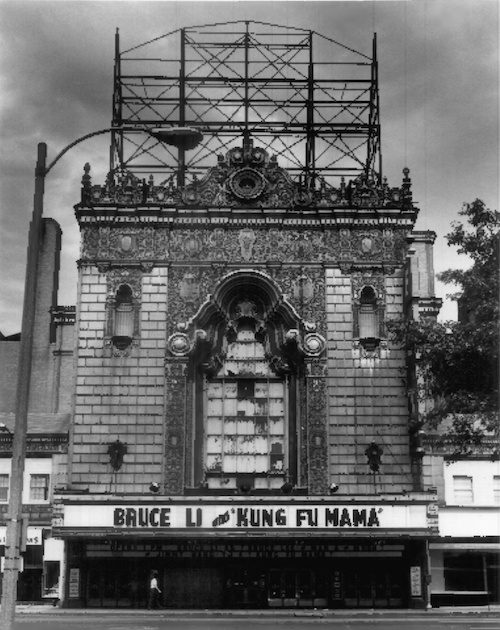
The Fox Theater was a mess at the time:
On a cold January morning in 1981 Leon and Mary Strauss first saw the Fox Theatre. With the aid of flashlights and one working light bulb, the Strausses discovered the hidden magic of the splendid theatre beneath the dirt and grime of 52 years. It was love at first sight and the rest is St. Louis history. Banding together as Fox Associates, Leon Strauss, Robert Baudendistel, Dennis McDaniel and Harvey Harris privately purchased the movie palace from the Arthur family. With Mary Strauss as director of restoration, there began a one year, $2 million plus restoration program under the aegis of Pantheon Construction Company. (Fox Theater)
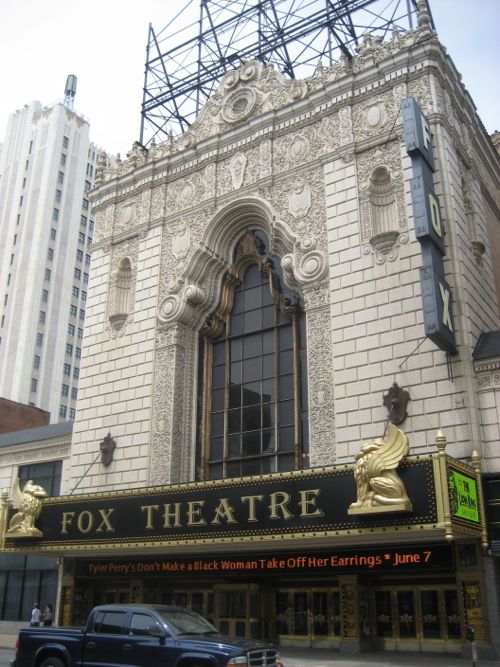
Some saw the great potential of midtown but others saw vacant buildings instead of the expansive grass so common in the suburbs. Saint Louis University President Lawrence Biondi was one of those who didn’t get it then and still doesn’t today.
Since his inauguration in 1987, Father Biondi has led Saint Louis University through a remarkable era of transformation and achievement. In addition to modernizing the campus and helping revitalize the surrounding Midtown neighborhood, Father Biondi has committed vast University resources to academics, student scholarships and financial aid, faculty research and state-of-the-art technology. (Saint Louis University)
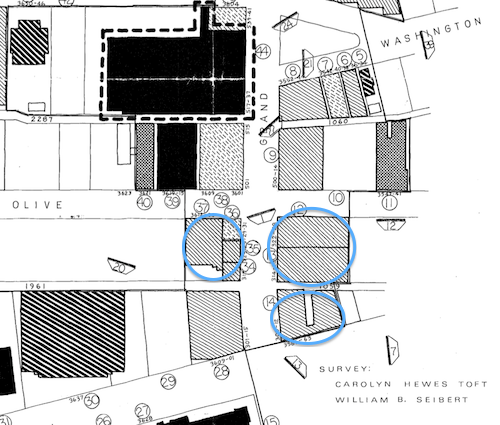
North of Olive St thankfully was beyond Biondi’s grasp but south of Olive St didn’t stand a chance. Six buildings listed in 1977 as having “neighborhood significance” where “demolition would be a major cultural loss” are gone. A seventh had “architectural merit — demolition would diminish the integrity of the neighborhood.”
Sadly this concentration of urban buildings was razed, the land is now parking and grass.
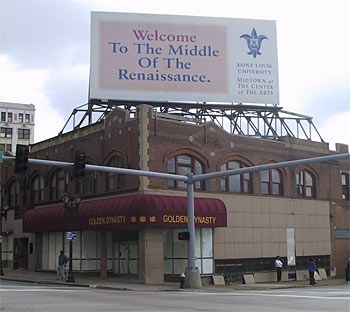
The Marina building stood on the NE corner of Grand & Lindell (aerial) for decades, from the National Register nomination:
The 1907 red brick and terra cotta Marina building at the northeast corner of Grand and Lindell has been subjected to similar alterations. The oldest commercial structure in the district, the pattern of arched window openings at second floor level draw the eye and define one corner of the major intersection of the district.Â
This building would have been a great anchor for that corner had it been rehabbed. Sure it was an eyesore with the bad storefronts that had been built over the years.
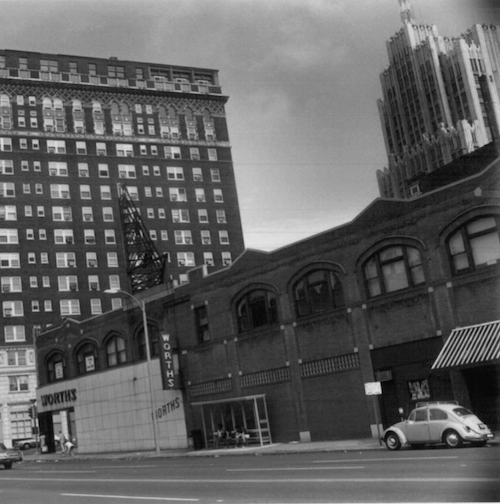
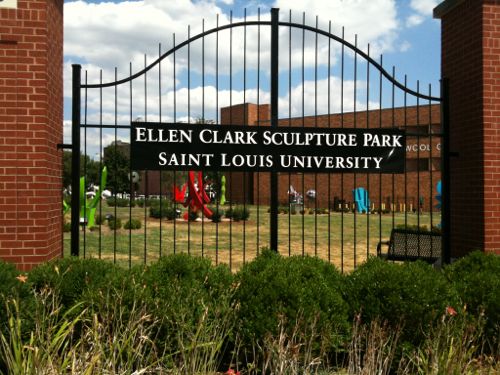
The southeast corner was also urban but not included in the historic district because of unfortunate  alterations to the corner structure:
On the southwest [sic] corner of the same intersection, SLU bought a bank building (that was a historic structure hidden under a layer of plain stucco) and demolished it for a lifeless plaza and fountain. (VanishingSTL)
I remember that bank — I opened my first checking account there in 1990. Midtown was great — was.
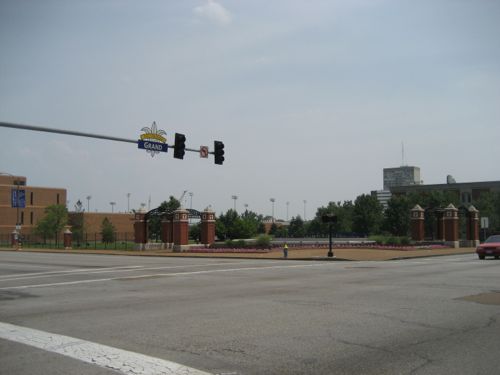
In an urban setting grass, trees & water can’t substitute for the massing a building gives by defining the urban space.
Some act like demolition is the only answer to a tired urban area. A few blocks north was just as seedy but there buildings were saved and renovated. The now celebrated Washington Ave loft district was a ghost town of old warehouses — Biondi’s solution would have been parking lots & grass. Demolition was the failed 1950s “urban renewal” solution.
Biondi is a current day Robert Moses, the sooner he retires the sooner we can begin to reurbanize midtown and undo the damage he’s inflicted on this section of St. Louis.  The poll is in the right sidebar (not visible on the mobile layout).
– Steve Patterson
New tag line – Be Suburban. Be Biondi.
New tag line – Be Suburban. Be Biondi.
We need to compile a database of all the buildings that were swept away for green space around SLU.Â
Man I actually saw Kung Fu Mama in the 1970’s at the Fox. That was the last time I was there until 2007.
We need to compile a database of all the buildings that were swept away for green space around SLU.
This could be done throughout St. Louis. SLU’s original location was downtown. Then they moved to Midtown. Demolition and rebuilding is part of the history of cities. If an architect and an owner have an idea to build a new, expanded building on the site of an older, smaller building, that how change happens. That’s how every major city got its skyline.
In an architecturally signigicant urban district, there is a great difference between demolition for re-purpose and demolition for grassy lots and parking.
Man I actually saw Kung Fu Mama in the 1970’s at the Fox. That was the last time I was there until 2007.
I grew up in the area, and I remember the area when it was vibrant, I had my first account in that bank also. The bigger problem is the politicians giving in to whatever he wants. Now the old Pevely Dairy is going to be on that list of buildings that Biondi has demolished because he threatens to move to the
county. Unbelievable!
I grew up in the area, and I remember the area when it was vibrant, I had my first account in that bank also. The bigger problem is the politicians giving in to whatever he wants. Now the old Pevely Dairy is going to be on that list of buildings that Biondi has demolished because he threatens to move to the
county. Unbelievable!
From dictionary.com:Â Push Poll:Â “an opinion poll done with loaded questions or offering negative information to sway the opinions of those polled”.
From dictionary.com: Push Poll: “an opinion poll done with loaded questions or offering negative information to sway the opinions of those polled”.
From the same site I got “push poll (noun) a seemingly unbiased telephone survey that is actually conducted by supporters of a particular candidate and disseminates negative information about an opponent.” Nothing unbiased here — I think Biondi has done great harm to St. Louis in his 25 years as SLU president. It will take 25-40 years to undo the damage he’s done to Midtown.
Your poll asks a simple, straight-forward question and provides an acceptable range of answers. Your narrative is obviously biased. Is your goal to get a somewhat scientific sample of what people think on the question? Or, is your goal to generate poll results to justify your current position? You can’t have it both ways. And if your goal is to justify your position, why bother crafting an apparently-neutral poll? Why not just stipulate that SLU is doing the wrong thing, then poll people on how to rectify the situation?
Three years ago, I worked with a group of construction professionals to develop an outline spec for a 9-story building in LA. The owner was construction-savy and decided a design-build approach. After three sessions, we learned that the then-current architect would be replaced by another architect The owner offered no apologies or explanation. The project was successful.
I totally share your disappointment. While I am truly glad for the university’s success I wish it was led by someone with better taste. I think it’s unfair to blame politicians on this, the University has the means, no one else stepped up, and development is the measure of success.
From the same site I got “push poll (noun) a seemingly unbiased telephone survey that is actually conducted by supporters of a particular candidate and disseminates negative information about an opponent.” Nothing unbiased here — I think Biondi has done great harm to St. Louis in his 25 years as SLU president. It will take 25-40 years to undo the damage he’s done to Midtown.
Your poll asks a simple, straight-forward question and provides an acceptable range of answers. Your narrative is obviously biased. Is your goal to get a somewhat scientific sample of what people think on the question? Or, is your goal to generate poll results to justify your current position? You can’t have it both ways. And if your goal is to justify your position, why bother crafting an apparently-neutral poll? Why not just stipulate that SLU is doing the wrong thing, then poll people on how to rectify the situation?
Very typical of St. Louis policy reviews. Â We compare what is to what might have been, and then complain about what others have done in the absence of an alternative. Â We romanticize possible scenarios, then make villains of those different from our vision. Â Another question: What would have happened to Midtown if SLU had moved out of the area 40 years ago? Â Could the case be made that popular projects such as the Moolah Theater would have never happened had it not been for the presence of SLU? Â Â
Very typical of St. Louis policy reviews. We compare what is to what might have been, and then complain about what others have done in the absence of an alternative. We romanticize possible scenarios, then make villains of those different from our vision. Another question: What would have happened to Midtown if SLU had moved out of the area 40 years ago? Could the case be made that popular projects such as the Moolah Theater would have never happened had it not been for the presence of SLU?
No, we compare what is to what has been accomplished in other parts of the city, and in other cities, when alternatives are actually explored instead of dismissed. We don’t need to romanticize anything, and we don’t need to waste time concocting hypothetical situations. We have examples: look around at the healthiest and most vibrant neighborhoods in the city, in every case they have retained the majority of their dense, historic building stock. This “absence of an alternative” BS could have been said about the CWE, Soulard, Washington Ave, Benton Park, The Loop — many of the city’s most-prized neighborhoods.
The cases you describe of preserved historic neighborhoods happened because of the hard work of the people living and/or working there. For decades, most of Midtown has been devoid of such critical mass, other than for SLU and a few other institutions. Today, Midtown is where it is thanks largely to the efforts of those institutions.
Soulard hardly had critical mass when people started rehabbing it in the 70s. it was a slum with a 50% vacancy rate, and city “leaders” had designated it as blighted and marked it for wholesale demolition. It had even been gashed in half by the highway, just as Midtown is gashed by the train yard. moreover, people DO live and/or work in Midtown. and more people COULD live there if SLU would stop demolishing homes and buildings that could be converted to residential (like the Metropolitan and Pevely). how are people supposed to live in fountains and sculpture parks?
http://vanishingstl.blogspot.com/2011/07/slu-med-plows-down-blocks-of-nearby.html
If people wanted to live in the Pevely building, I suspect the developer wouldn’t have backed off their plans. Let’s not pretend there was demand for a bunch of 100-year old brick bungalows, either.
well, you suspect wrong. do you honestly believe the Pevely development fell through because there was no interest? Yacky didn’t just decide to “back off” his plans, THE ECONOMY TANKED. DEVELOPMENTS FELL THROUGH EVERYWHERE. NOBODY COULD GET LOANS. developers do their homework. why would a developer from Minneapolis be rehabbing the Metropolitan building if there’s no interest? probably because they think they’re going to lose a lot of money by creating artists lofts IN THE CITY’S ARTS DISTRICT, ADJACENT TO A UNIVERSITY. what a terrible spot for residential! why, nobody would want to live there! as for pretending, I don’t have to because, LIKE I KEEP SAYING BUT YOU ALL KEEP IGNORING, the healthiest neighborhoods in Saint Louis have retained the majority of their supposedly undesirable 100-year-old brick buildings. know what that means? it means there’s demand for them.
Comparing the renovation and reuse of individual residential, commercial and industrial structures with the evolution of a large institutional campus is comparing apples and oranges. The same allegations being leveled against SLU can be leveled against Ameren, Wells Fargo, Ralston Purina, the Archdiocese, etc, etc. Large entities increasing their physical footprint will inevitably change any neighborhood. Whether it’s for the better or the worse will always be a topic for intellectual discussion, colored by personal agendas, personal preferences, 20/20 hindsight and selective memories.
The two images Steve provides show a building in obvious decline, from an apparent five-and-dime in 1977 to a vacant chinese restaurant in 2007. The images also show a sturdy, two-story brick building that had been remodelled, badly, more than once, and adorned with an oversized rooftop sign. I get it, the current grass and fence ain’t great, but if anyone proposed recreating this same structure today, as a new building, they would be vilified for bad taste, at the very least.
Every building has a useful life. The “if it had been rehabbed” canard is being made in a vaccuum. What would have renovations cost? Was there a market for the space? Even today, this stretch of Grand seems to be struggling, populated primarily by non-profits and governmental entities. Our fundamental challenge isn’t that SLU is trying to build a suburban-scale campus, it’s that we’ve lost half our population and half our jobs in the city over the past 50 years, and there simply is no longer a functional need for many of our old buildings. (And if you think this is bad, just take a trip out to Baden or the Wellston Loop.)
“Comparing the renovation and reuse of individual residential, commercial
and industrial structures with the evolution of a large institutional
campus is comparing apples and oranges.”
i’m not comparing the two. i’m saying that the “evolution” of SLU’s campus is destroying opportunities for renovation and reuse of individual residential, commercial and industrial structures by those who aren’t affiliated with SLU, contrary to what has worked elsewhere.
“I get it, the current grass and fence ain’t great, but if anyone
proposed recreating this same structure today, as a new building, they
would be vilified for bad taste, at the very least.”
i think that’s a completely unsubstantiated statement. i’m pretty sure if someone proposed to build a solid brick building with that kind of architectural detail (i’m talking about in its original condition, not after all the remuddling) people would be overjoyed. at worst they might be indifferent. look at the new version of the Union Club on Jefferson. i didn’t hear too many complaints about that one (except with regard to the cheap-looking non-brick treatments on the sides, and the fact that it didn’t quite recapture the details of the original well enough).
“Every building has a useful life. The ‘if it had been rehabbed’ canard
is being made in a vaccuum. What would have renovations cost? Was
there a market for the space?”
SLU flat out refused to consider any alternatives to demolition. local architects and designers held a charrette to work up possible reuse plans and present examples of similar adaptive reuses from around the country. the vacuum was 100% created by SLU. and if there were no market for the space, i doubt that Yacky would have would have gone to the trouble of getting Pevely listed on the national historic register and drawing up plans for renovation before the economy collapsed. i also doubt that Dominium would be renovating the Metropolitan into artist apartments right now if there were no demand. SLU med students have attested to the need for more student housing near the med school. Pevely would have been a prime candidate for this.
“I’m not comparing the two. I’m saying that the “evolution” of SLU’s campus is destroying opportunities for renovation and reuse of individual residential, commercial and industrial structures by those who aren’t affiliated with SLU, contrary to what has worked elsewhere” here in the city, I assume.
Yes. That’s precisely the nature of a large campus. One owner controls everything. It doesn’t matter if it’s SLU, Wash. U, UMSL, SIUE, Webster, CU, DU, KU, K. State, Texas, Harvard or Yale. The town-gown conflict is never ending. The difference with SLU is that the adjoining property is, pardon the pun, dirt cheap. If SLU wants or needs more land, they just go out and buy it! There are few constraints to implementing a non-dense, non-urban plan, not financial, not physical and not governmental. If you want or expect a dense, urban campus, along the lines of a Columbia, Loyola of Chicago or Northwestern, the only way to get that would be to see a tenfold increase in property values, both on campus and on adjoining parcels.
“SLU flat out refused to consider any alternatives to demolition.” An unsubstantiated statement, if I ever heard one (embrace would be a better word choice). Were you involved in SLU’s internal planning efforts? Do you have access to their programmatic planning requirements? SLU may not have been receptive to unsolicited, 11th hour plans, after they’ve already decided to request a demolition permit, and they probably were thinking all along that the Pevely complex needed to be demolished, but the costs and implications of demolition would have necessarily had to have been been included as a part of the overall project.
“SLU med students have attested to the need for more student housing near the med school. Pevely would have been a prime candidate for this.” Assuming that med school students could have been / be convinced to live on this isolated corner. I agree, there’s likely a need for more housing. I agree, the Pevely complex would make some cool lofts. But, as with everything else in real estate, it all boils down to location. This is obviously worth more to SLU as bare dirt than it is to any developers outside of SLU. (If I were a SLU med student, I’d be more interested many other established areas within easy commuting distance.)
“here in the city, I assume.”
and in other cities.
” If you want or expect a dense, urban campus, along the lines of a
Columbia, Loyola of Chicago or Northwestern, the only way to get that
would be to see a tenfold increase in property values, both on campus
and on adjoining parcels.”
even if property values end up increasing because of SLU’s suburban development, that kind of density won’t be possible due to their land-use. and Biondi has as much as said that he prefers a suburban campus.
“An unsubstantiated statement, if I ever heard one (embrace would be a better word choice).”
no, substantiated by the fact that, if they had actually considered alternative uses in any sort of detail, or considered alternative sites, or considered a more urban form and found those things to be infeasible, it would have made their lives much easier to relate those findings to the public and the preservation board. instead, all we got was “the floor plates are too small for the state-of-the-art offices we need”, which begs the obvious observation, “but, you’re not actually BUILDING anything where Pevely stands. it’s going to be a DRIVEWAY.”
“…and they
probably were thinking all along that the Pevely complex needed to be
demolished…”
i.e. they never considered any alternatives.
“Assuming that med school students could have been / be convinced to live on this isolated corner.”
yes, i’m sure it would have been difficult to convince med students on their rotations (in other words, they spend the majority of their time in the hospital) to live directly across the street from said hospital, a few blocks from a brand-new Metrolink station, and on one of the busiest transit corridors in the city.
“This is obviously worth more to SLU as bare dirt than it is to any developers outside of SLU.”
AGAIN, you ignore that in the 3 short years the building was vacant, one developer attempted to transform it into residential (and AGAIN, the economy went sour) and a language immersion school attempted to purchase it but was rejected. compared to other buildings in STL that have sat for years before being rehabbed, 3 years is nothing.
Midtown Alley has been developing over the last decade arguable independent of SLU, and on some levels in spite of SLU’s intervention.
And prior to it being “Midtown Alley”, it was the Locust Business District with people caring for the future of the area. Soulard Restoration Group was an early provider of civic leadership in Soulard. The work to preserve and improve neighborhoods in STL has gone on for a long time. No one has answered the “what if” question about what might have happened to Midtown had SLU left for the suburbs 40 years ago. Its possible the Fox might never have been saved and the Symphony moved to Ladue.
“And prior to it being ‘Midtown Alley’, it was the Locust Business
District with people caring for the future of the area. Soulard
Restoration Group was an early provider of civic leadership in Soulard.
The work to preserve and improve neighborhoods in STL has gone on for a
long time.”
I think you just answered your own “what if” question. What does any of this have to do with SLU? basically you just agreed that people have been working on these neighborhoods for a long time regardless of SLU. the majority of the Locust Ave businesses, with a few recent exceptions (one restaurant and a couple of clubs), don’t depend on SLU for their clientele. i’m not saying that some of them don’t benefit from SLU’s presence, but you want to argue that nothing could succeed here if not for SLU, which is demonstrably false. As for the Moolah, it’s close enough to the CWE to draw patrons from there (and it does). The Fox draws patrons from all over the region. Why is it more valid for you to speculate that these things could not exist without SLU, than it is for me to argue that they could?
Rick, I actually agree with you. I think SLU’s continued presence has undeniably benefited Midtown. I don’t think that a lot of the positive projects that everybody is proud of such as the renovation of the Continental Life Bldg., the Coronado, the Moolah, the Pulitzer and Contemporary Art Museum would’ve happened if SLU (and more importantly its student and employee populations) were not firmly planted in Midtown. Even the example that I mentioned before in Midtown Alley, which I believe has operated and been successful on its own merits, could likely not have attracted such quality tenants if business owners did not see the market made available by SLU’s population. That being said, I don’t think anyone with a knowledge of urban design and planning can say that SLU’s consistent demolition of structures with quality urban design for replacement with grassy lots, fences, and parking has been good for Midtown. Actions such as that make it impossible to create an active and lively streetlife. I’ll argue that it hasn’t been good for SLU either. I think they’d be doing much better if they were able to truly market themselves as in the middle of a bustling, exciting urban district, which many of their practices have discouraged. Even if their presence has brought net positives to the neighborhood, that doesn’t mean their actions haven’t also had negative consequences. And I think that its definitely within the purview of the public- and its students and alumni, which Steve and I are- to critique that which will help to bring about positive change for the city and our alma mater.
All of this is highly academic. Is that the point? There’s no real money involved…just high-priced opinions. Want to go someplace less academic and lower rent? There are plenty of those places around town that would die for the kind of investment SLU is making in its area.
I don’t know what you mean. It wouldn’t cost SLU a cent to not buy historic buildings just to tear them down. I’m not saying they should rehab every building around them. They simply shouldn’t tear down so much around them. SLU would be better off and Midtown would be better off. That’s not highly academic.
It’s a simple matter of perception. You’re correct, it would cost SLU nothing, short term, to do nothing. The problem is that SLU apparently believes that they need both more land and that they need to build new facilities, in a certain style, to stay competetive in the battle to attract new students. It’s no different than if you didn’t like what your neighbors were doing or how they were maintaining their property. You certainly wouldn’t pay them $200,000 to see them go away, but you might pay $100,000. And if, in a down market, if you could buy them out for $20,000 or even $10,000, and you have the resources to do so, why wouldn’t you jump at the opportunity? And once you own it, do you fix up the dog of a property? Rent it out and hope that you get good tenants? Flip it and hope the cycle doesn’t start all over again? Or, just tear it down, giving you a bigger yard and more off-street parking? Or, more likely, a shiny new addition to what you already own? Sure, moving somewhere bigger and nicer is always an option, but so is staying in a convenient location.
“look around at the healthiest and most vibrant neighborhoods in the
city, in every case they have retained the majority of their dense,
historic building stock.”
You’re confusing cause and effect. In unhealthy neighborhoods people do not have the resources to repair and uphold old buildings, while anyone who does have the resources leaves the neighborhood ASAP. Thus, old buildings decay and eventually must be demolished.
interesting. so a slum with 50% vacancy, which is now a desirable, rehabbed neighborhood with an 85% occupancy rate, was completely rehabbed by the poor people living there? you’re just confused.
the more i read your comment the more ridiculous it is. fact: Soulard still stands (it hasn’t been demolished). fact: it was a slum in the 70s with 50% vacancy. by your logic, either the people who lived there had the means to rehab an entire neighborhood (contrary to your definition of an unhealthy neighborhood, which it absolutely was — go google some pictures of Soulard in the 70s) or people with resources moved into the neighborhood and rehabbed it (what actually happened, but which you for some reason refuse to acknowledge).
i’m sorry, let me rephrase:
by your logic, either the people who lived in the 50%-occupied slum-Soulard had the means to rehab the entire neighborhood, or Soulard was demolished because those who lived there did not have the means, and those with the resources left. neither is true. Soulard still stands and it’s a shining example of neighborhood revitalization. the fact is, people with resources came from outside of the neighborhood, moved into the neighborhood, and saved it. thus, old buildings can be rehabbed and do not need to be demolished, and the most sought-after neighborhoods in saint louis are those in which this historic density has been retained, unlike midtown.
As bad as Soulard may have once been, it was never as bad, or for as long, as the neighborhoods that have been demolished in many parts of the north side and similar places.
neither was Midtown. there is no comparison between Midtown and neighborhoods like St. Louis Place, the Ville, and Carr Square. one reason that Soulard-like redevelopment can’t happen in those places is that they’re prairies. More than half the original structures have been lost. Midtown isn’t prairie yet, but SLU’s working on it.
Actually, a lot of Midtown, especially east of Grand, was demolished. That’s was the western reach of Mill Creek Valley, a poor black area. Wan’t Lafayette Town in the same area? Also demolished.
Laclede Town…I’m sorry. Not caffeinated yet.
I totally share your disappointment. While I am truly glad for the university’s success I wish it was led by someone with better taste. I think it’s unfair to blame politicians on this, the University has the means, no one else stepped up, and development is the measure of success.
No, we compare what is to what has been accomplished in other parts of the city, and in other cities, when alternatives are actually explored instead of dismissed. We don’t need to romanticize anything, and we don’t need to waste time concocting hypothetical situations. We have examples: look around at the healthiest and most vibrant neighborhoods in the city, in every case they have retained the majority of their dense, historic building stock. This “absence of an alternative” BS could have been said about the CWE, Soulard, Washington Ave, Benton Park, The Loop — many of the city’s most-prized neighborhoods.
At the end of the day, SLU should lay out a public master plan for the community. Be honest about what they want, where they want to go, and what the future might hold. Heck, you can read about Webster U master plan for Webster Groves in the PD today – it gives a pretty good account on what they want, where they want to go (increase student pop by 2000, mostly undergrads), and what the future might hold (demo the strip mall they own in favor of mixed use but back off on plans for north of Lockwood as per residents concerns/desires). BJC/Wash U has a public display within their complex, and so on.
At the end of the day, SLU should lay out a public master plan for the community. Be honest about what they want, where they want to go, and what the future might hold. Heck, you can read about Webster U master plan for Webster Groves in the PD today – it gives a pretty good account on what they want, where they want to go (increase student pop by 2000, mostly undergrads), and what the future might hold (demo the strip mall they own in favor of mixed use but back off on plans for north of Lockwood as per residents concerns/desires). BJC/Wash U has a public display within their complex, and so on.
Or do so jointly with Harris Stowe. Both universities are anchors for the Midtown/Lucas Heights areas.
The cases you describe of preserved historic neighborhoods happened because of the hard work of the people living and/or working there. Â For decades, most of Midtown has been devoid of such critical mass, other than for SLU and a few other institutions. Â Today, Midtown is where it is thanks largely to the efforts of those institutions. Â Â
This could be done throughout St. Louis. Â SLU’s original location was downtown. Â Then they moved to Midtown. Â Demolition and rebuilding is part of the history of cities. Â If an architect and an owner have an idea to build a new, expanded building on the site of an older, smaller building, that how change happens. Â That’s how every major city got its skyline. Â Â
Or do so jointly with Harris Stowe. Â Both universities are anchors for the Midtown/Lucas Heights areas.
In an architecturally signigicant urban district, there is a great difference between demolition for re-purpose and demolition for grassy lots and parking.
Soulard hardly had critical mass when people started rehabbing it in the 70s. it was a slum with a 50% vacancy rate, and city “leaders” had designated it as blighted and marked it for wholesale demolition. It had even been gashed in half by the highway, just as Midtown is gashed by the train yard. moreover, people DO live and/or work in Midtown. and more people COULD live there if SLU would stop demolishing homes and buildings that could be converted to residential (like the Metropolitan and Pevely). how are people supposed to live in fountains and sculpture parks?
http://vanishingstl.blogspot.com/2011/07/slu-med-plows-down-blocks-of-nearby.html
Midtown Alley has been developing over the last decade arguable independent of SLU, and on some levels in spite of SLU’s intervention.
And prior to it being “Midtown Alley”, it was the Locust Business District with people caring for the future of the area. Â Soulard Restoration Group was an early provider of civic leadership in Soulard. Â The work to preserve and improve neighborhoods in STL has gone on for a long time. Â No one has answered the “what if” question about what might have happened to Midtown had SLU left for the suburbs 40 years ago. Â Its possible the Fox might never have been saved and the Symphony moved to Ladue. Â Â
If people wanted to live in the Pevely building, I suspect the developer wouldn’t have backed off their plans. Let’s not pretend there was demand for a bunch of 100-year old brick bungalows, either.
well, you suspect wrong. do you honestly believe the Pevely development fell through because there was no interest? Yacky didn’t just decide to “back off” his plans, THE ECONOMY TANKED. DEVELOPMENTS FELL THROUGH EVERYWHERE. NOBODY COULD GET LOANS. developers do their homework. why would a developer from Minneapolis be rehabbing the Metropolitan building if there’s no interest? probably because they think they’re going to lose a lot of money by creating artists lofts IN THE CITY’S ARTS DISTRICT, ADJACENT TO A UNIVERSITY. what a terrible spot for residential! why, nobody would want to live there! as for pretending, I don’t have to because, LIKE I KEEP SAYING BUT YOU ALL KEEP IGNORING, the healthiest neighborhoods in Saint Louis have retained the majority of their supposedly undesirable 100-year-old brick buildings. know what that means? it means there’s demand for them.
“And prior to it being ‘Midtown Alley’, it was the Locust Business
District with people caring for the future of the area. Â Soulard
Restoration Group was an early provider of civic leadership in Soulard.
 The work to preserve and improve neighborhoods in STL has gone on for a
long time.”
I think you just answered your own “what if” question. What does any of this have to do with SLU? basically you just agreed that people have been working on these neighborhoods for a long time regardless of SLU. the majority of the Locust Ave businesses, with a few recent exceptions (one restaurant and a couple of clubs), don’t depend on SLU for their clientele. i’m not saying that some of them don’t benefit from SLU’s presence, but you want to argue that nothing could succeed here if not for SLU, which is demonstrably false. As for the Moolah, it’s close enough to the CWE to draw patrons from there (and it does). The Fox draws patrons from all over the region. Why is it more valid for you to speculate that these things could not exist without SLU, than it is for me to argue that they could?
Comparing the renovation and reuse of individual residential, commercial and industrial structures with the evolution of a large institutional campus is comparing apples and oranges. The same allegations being leveled against SLU can be leveled against Ameren, Wells Fargo, Ralston Purina, the Archdiocese, etc, etc. Large entities increasing their physical footprint will inevitably change any neighborhood. Whether it’s for the better or the worse will always be a topic for intellectual discussion, colored by personal agendas, personal preferences, 20/20 hindsight and selective memories.Â
The two images Steve provides show a building in obvious decline, from an apparent five-and-dime in 1977 to a vacant chinese restaurant in 2007. The images also show a sturdy, two-story brick building that had been remodelled, badly, more than once, and adorned with an oversized rooftop sign. I get it, the current grass and fence ain’t great, but if anyone proposed recreating this same structure today, as a new building, they would be vilified for bad taste, at the very least.Â
Every building has a useful life. The “if it had been rehabbed” canard is being made in a vaccuum. What would have renovations cost? Was there a market for the space? Even today, this stretch of Grand seems to be struggling, populated primarily by non-profits and governmental entities. Our fundamental challenge isn’t that SLU is trying to build a suburban-scale campus, it’s that we’ve lost half our population and half our jobs in the city over the past 50 years, and there simply is no longer a functional need for many of our old buildings. (And if you think this is bad, just take a trip out to Baden or the Wellston Loop.)
“Comparing the renovation and reuse of individual residential, commercial
and industrial structures with the evolution of a large institutional
campus is comparing apples and oranges.”
i’m not comparing the two. i’m saying that the “evolution” of SLU’s campus is destroying opportunities for renovation and reuse of individual residential, commercial and industrial structures by those who aren’t affiliated with SLU, contrary to what has worked elsewhere.
“I get it, the current grass and fence ain’t great, but if anyone
proposed recreating this same structure today, as a new building, they
would be vilified for bad taste, at the very least.”
i think that’s a completely unsubstantiated statement. i’m pretty sure if someone proposed to build a solid brick building with that kind of architectural detail (i’m talking about in its original condition, not after all the remuddling) people would be overjoyed. at worst they might be indifferent. look at the new version of the Union Club on Jefferson. i didn’t hear too many complaints about that one (except with regard to the cheap-looking non-brick treatments on the sides, and the fact that it didn’t quite recapture the details of the original well enough).
“Every building has a useful life. The ‘if it had been rehabbed’ canard
is being made in a vaccuum. What would have renovations cost? Was
there a market for the space?”
SLU flat out refused to consider any alternatives to demolition. local architects and designers held a charrette to work up possible reuse plans and present examples of similar adaptive reuses from around the country. the vacuum was 100% created by SLU. and if there were no market for the space, i doubt that Yacky would have would have gone to the trouble of getting Pevely listed on the national historic register and drawing up plans for renovation before the economy collapsed. i also doubt that Dominium would be renovating the Metropolitan into artist apartments right now if there were no demand. SLU med students have attested to the need for more student housing near the med school. Pevely would have been a prime candidate for this.
 Rick, I actually agree with you. I think SLU’s continued presence has undeniably benefited Midtown. I don’t think that a lot of the positive projects that everybody is proud of such as the renovation of the Continental Life Bldg., the Coronado, the Moolah, the Pulitzer and Contemporary Art Museum would’ve happened if SLU (and more importantly its student and employee populations) were not firmly planted in Midtown. Even the example that I mentioned before in Midtown Alley, which I believe has operated and been successful on its own merits, could likely not have attracted such quality tenants if business owners did not see the market made available by SLU’s population. That being said, I don’t think anyone with a knowledge of urban design and planning can say that SLU’s consistent demolition of structures with quality urban design for replacement with grassy lots, fences, and parking has been good for Midtown. Actions such as that make it impossible to create an active and lively streetlife. I’ll argue that it hasn’t been good for SLU either. I think they’d be doing much better if they were able to truly market themselves as in the middle of a bustling, exciting urban district, which many of their practices have discouraged. Even if their presence has brought net positives to the neighborhood, that doesn’t mean their actions haven’t also had negative consequences. And I think that its definitely within the purview of the public- and its students and alumni, which Steve and I are- to critique that which will help to bring about positive change for the city and our alma mater.
All of this is highly academic. Â Is that the point? Â There’s no real money involved…just high-priced opinions. Â Want to go someplace less academic and lower rent? Â There are plenty of those places around town that would die for the kind of investment SLU is making in its area. Â Â Â
I’ll never forget the news article one time about how SLU and Harris-Stowe’s leaders lamented the lack of contact between the two campuses. Jeez, could it be there’s nothing but vacant land in between the two campuses????
I’ll never forget the news article one time about how SLU and Harris-Stowe’s leaders lamented the lack of contact between the two campuses. Jeez, could it be there’s nothing but vacant land in between the two campuses????
After the opening of Chaifetz Arena, the only separation between Harris Stowe and SLU is a single 2 land street, Compton Ave.
Yes, technically, but the arena is so dead most of the time that no one crosses the street, which by the way, is four lanes right in front of the arena. I should know since I live on Compton.
“I’m not comparing the two. I’m saying that the “evolution” of SLU’s campus is destroying opportunities for renovation and reuse of individual residential, commercial and industrial structures by those who aren’t affiliated with SLU, contrary to what has worked elsewhere” here in the city, I assume.
Yes. That’s precisely the nature of a large campus. One owner controls everything. It doesn’t matter if it’s SLU, Wash. U, UMSL, SIUE, Webster, CU, DU, KU, K. State, Texas, Harvard or Yale. The town-gown conflict is never ending. The difference with SLU is that the adjoining property is, pardon the pun, dirt cheap. If SLU wants or needs more land, they just go out and buy it! There are few constraints to implementing a non-dense, non-urban plan, not financial, not physical and not governmental. If you want or expect a dense, urban campus, along the lines of a Columbia, Loyola of Chicago or Northwestern, the only way to get that would be to see a tenfold increase in property values, both on campus and on adjoining parcels.
“SLU flat out refused to consider any alternatives to demolition.” An unsubstantiated statement, if I ever heard one (embrace would be a better word choice). Were you involved in SLU’s internal planning efforts? Do you have access to their programmatic planning requirements? SLU may not have been receptive to unsolicited, 11th hour plans, after they’ve already decided to request a demolition permit, and they probably were thinking all along that the Pevely complex needed to be demolished, but the costs and implications of demolition would have necessarily had to have been been included as a part of the overall project.
“SLU med students have attested to the need for more student housing near the med school. Pevely would have been a prime candidate for this.” Assuming that med school students could have been / be convinced to live on this isolated corner. I agree, there’s likely a need for more housing. I agree, the Pevely complex would make some cool lofts. But, as with everything else in real estate, it all boils down to location. This is obviously worth more to SLU as bare dirt than it is to any developers outside of SLU. (If I were a SLU med student, I’d be more interested many other established areas within easy commuting distance.)
 I don’t know what you mean. It wouldn’t cost SLU a cent to not buy historic buildings just to tear them down. I’m not saying they should rehab every building around them. They simply shouldn’t tear down so much around them. SLU would be better off and Midtown would be better off. That’s not highly academic.
“look around at the healthiest and most vibrant neighborhoods in the
city, in every case they have retained the majority of their dense,
historic building stock.”
You’re confusing cause and effect. In unhealthy neighborhoods people do not have the resources to repair and uphold old buildings, while anyone who does have the resources leaves the neighborhood ASAP. Thus, old buildings decay and eventually must be demolished.
It’s a simple matter of perception. You’re correct, it would cost SLU nothing, short term, to do nothing. The problem is that SLU apparently believes that they need both more land and that they need to build new facilities, in a certain style, to stay competetive in the battle to attract new students. It’s no different than if you didn’t like what your neighbors were doing or how they were maintaining their property. You certainly wouldn’t pay them $200,000 to see them go away, but you might pay $100,000. And if, in a down market, if you could buy them out for $20,000 or even $10,000, and you have the resources to do so, why wouldn’t you jump at the opportunity? And once you own it, do you fix up the dog of a property? Rent it out and hope that you get good tenants? Flip it and hope the cycle doesn’t start all over again? Or, just tear it down, giving you a bigger yard and more off-street parking? Or, more likely, a shiny new addition to what you already own? Sure, moving somewhere bigger and nicer is always an option, but so is staying in a convenient location.
It is easy to hate on SLU for all the demos in Midtown; but one important note is that without the existence and growth of SLU many historic buildings would have never been saved. The Coronodo, The Continental, the Warehouse of Fixtures building, the metropolitan, and Midtown Alley as a whole. The SLU campus was a joke before the likes of Biondi and Reinhart; both men changed the face of SLU and subsequently the Midtown area.
It is easy to hate on SLU for all the demos in Midtown; but one important note is that without the existence and growth of SLU many historic buildings would have never been saved. The Coronodo, The Continental, the Warehouse of Fixtures building, the metropolitan, and Midtown Alley as a whole. The SLU campus was a joke before the likes of Biondi and Reinhart; both men changed the face of SLU and subsequently the Midtown area.
No, not Midtown Alley as a whole.
SLU has saved 5 buildings (?) and torn down how many others? Dozens + one listed on the Historic Register? Not sure if that’s really a winning track record for SLU in the preservation department.
Well, it didn’t take long for someone to give Biondi credit for Midtown Alley. The actual savior of Midtown Alley, Jassen Johnson said that SLU has been nothing but a spoiled, pissy obstacle to his efforts at revitalizing the area.
Three years ago, I worked with a group of construction professionals to develop an outline spec for a 9-story building in LA. The owner was construction-savy and decided a design-build approach. After three sessions, we learned that the then-current architect would be replaced by another architect The owner offered no apologies or explanation. The project was successful.
 No, not Midtown Alley as a whole.
SLU has saved 5 buildings (?) and torn down how many others? Dozens + one listed on the Historic Register? Not sure if that’s really a winning track record for SLU in the preservation department.
I believe it was 2008 that SLU published a calendar with comparison pictures around their campus from 1970’s and today. NONE of the people commenting on here would have dared walked/lived in Mid-Town back then.
I believe it was 2008 that SLU published a calendar with comparison pictures around their campus from 1970’s and today. NONE of the people commenting on here would have dared walked/lived in Mid-Town back then.
Oh yes it was so bad back then that the ONLY viable solution is to raze everything, plant grass and put up fences. Please.
I have lived in bombed crime infested areas all over the United States, and I am sure I would have walked around the area.
Steve…Every post you make about SLU or Fr. Biondi is about them being the evil empire. Just because Fr. Biondi wears black does not make him Darth Vader. What got you so pissed off at SLU? Did they actually make you work and think for your degree????
Steve…Every post you make about SLU or Fr. Biondi is about them being the evil empire. Just because Fr. Biondi wears black does not make him Darth Vader. What got you so pissed off at SLU? Did they actually make you work and think for your degree????
Oh yes it was so bad back then that the ONLY viable solution is to raze everything, plant grass and put up fences. Please.
I attended SLU from 1970 to 1974. I lived in Laclede Town my junior and senior years in college. Many a night I walked or rode my bike home from Piux XII libary to my apartment on Ewing Avenue. I also worked evenings at 3800 Lindell, which was occupied by IBM at the time.  I was never afraid for my safety because there were always people about, either on campus or walking up Lawton Place in Laclede Town. Would I do that same walk today? Absolutely not. Why: Because after 5:00PM, the entire stretch of land from what used to be Channing Avenue to Ewing is totally deserted most nights, the perfect setting for a crime. The last time I was in St. Louis, on a beautiful summer afternoon, the entire area was completely deserted with no pedestrians in sight and little, if any vehicular traffic. What is wrong with this picture?Â
The City of St. Louis SLU conspired to get rid of Laclede Town, and once again both institutions were extremely short sighted. Having lived there and visited all sections, Park, Town, East and West,  all 1000+ of those apartments could have been rehabbed and adapted to today’s modern standards and once again made a viable, walkable urban communhity. But once again, the slash and burn attitudes of SLU and the complete dysfunction at St. Louis City Hall prevailed and what you have today is the veritable no man’s land 2/3 of the time. And don’t tell me AG Edwards couldn’t have expanded the way it did if Laclede Town was still there. God knows there’s is still enough vacant, underutilized land in that area with plenty of room for AG Edwards and a lot of other companies to grow and expand.  This slash and burn tactic is now being used to isolate the medical center from the greater city.
I expressed my feelings about this destruction of the city to Biondi via email, and surprisingly, he responded. Not surprisingly, he was a total, arrogant tool in his response, basically telling me I didn’t know what I was talking about. I have news for Biondi and his supporters in STL: if he were at St. Joe’s here in Philly, or Fordham in NYC, he’d wouldn’t be allowed to do a fraction of the things he has done in STL. If Biondi is upset about the grief he’s getting in STL, he’d be seething in rage if he tried that crap in Wynnewood where St. Joe’s is located.  He’d need an asbestos suit for the firestorm of flack he’d get.    Â
I attended SLU from 1970 to 1974. I lived in Laclede Town my junior and senior years in college. Many a night I walked or rode my bike home from Piux XII libary to my apartment on Ewing Avenue. I also worked evenings at 3800 Lindell, which was occupied by IBM at the time. I was never afraid for my safety because there were always people about, either on campus or walking up Lawton Place in Laclede Town. Would I do that same walk today? Absolutely not. Why: Because after 5:00PM, the entire stretch of land from what used to be Channing Avenue to Ewing is totally deserted most nights, the perfect setting for a crime. The last time I was in St. Louis, on a beautiful summer afternoon, the entire area was completely deserted with no pedestrians in sight and little, if any vehicular traffic. What is wrong with this picture?
The City of St. Louis SLU conspired to get rid of Laclede Town, and once again both institutions were extremely short sighted. Having lived there and visited all sections, Park, Town, East and West, all 1000+ of those apartments could have been rehabbed and adapted to today’s modern standards and once again made a viable, walkable urban communhity. But once again, the slash and burn attitudes of SLU and the complete dysfunction at St. Louis City Hall prevailed and what you have today is the veritable no man’s land 2/3 of the time. And don’t tell me AG Edwards couldn’t have expanded the way it did if Laclede Town was still there. God knows there’s is still enough vacant, underutilized land in that area with plenty of room for AG Edwards and a lot of other companies to grow and expand. This slash and burn tactic is now being used to isolate the medical center from the greater city.
I expressed my feelings about this destruction of the city to Biondi via email, and surprisingly, he responded. Not surprisingly, he was a total, arrogant tool in his response, basically telling me I didn’t know what I was talking about. I have news for Biondi and his supporters in STL: if he were at St. Joe’s here in Philly, or Fordham in NYC, he’d wouldn’t be allowed to do a fraction of the things he has done in STL. If Biondi is upset about the grief he’s getting in STL, he’d be seething in rage if he tried that crap in Wynnewood where St. Joe’s is located. He’d need an asbestos suit for the firestorm of flack he’d get.
After the opening of Chaifetz Arena, the only separation between Harris Stowe and SLU is a single 2 land street, Compton Ave.Â
 “here in the city, I assume.”
and in other cities.
” If you want or expect a dense, urban campus, along the lines of a
Columbia, Loyola of Chicago or Northwestern, the only way to get that
would be to see a tenfold increase in property values, both on campus
and on adjoining parcels.”
even if property values end up increasing because of SLU’s suburban development, that kind of density won’t be possible due to their land-use. and Biondi has as much as said that he prefers a suburban campus.
“An unsubstantiated statement, if I ever heard one (embrace would be a better word choice).”
no, substantiated by the fact that, if they had actually considered alternative uses in any sort of detail, or considered alternative sites, or considered a more urban form and found those things to be infeasible, it would have made their lives much easier to relate those findings to the public and the preservation board. instead, all we got was “the floor plates are too small for the state-of-the-art offices we need”, which begs the obvious observation, “but, you’re not actually BUILDING anything where Pevely stands. it’s going to be a DRIVEWAY.”
“…and they
probably were thinking all along that the Pevely complex needed to be
demolished…”
i.e. they never considered any alternatives.
“Assuming that med school students could have been / be convinced to live on this isolated corner.”
yes, i’m sure it would have been difficult to convince med students on their rotations (in other words, they spend the majority of their time in the hospital) to live directly across the street from said hospital, a few blocks from a brand-new Metrolink station, and on one of the busiest transit corridors in the city.
“This is obviously worth more to SLU as bare dirt than it is to any developers outside of SLU.”
AGAIN, you ignore that in the 3 short years the building was vacant, one developer attempted to transform it into residential (and AGAIN, the economy went sour) and a language immersion school attempted to purchase it but was rejected. compared to other buildings in STL that have sat for years before being rehabbed, 3 years is nothing.
I am a recent graduate of SLU and currently attend the School of Medicine. I come from a very small town and SLU’s urban campus was a huge shock to me. My freshman year I lived in Reinert Hall and walking to and fro from class/library/the bsc was terrifying after dark. The campus Department of Safety was/is fantastic yet there was some kind of crime on or around campus every week. My senior year I lived in on-campus apartments and we had a flurry of break ins where students’ property was stolen. The Grand Arts district is great but no SLU student would ever walk there by themselves after dark. The Fox, BBBS building, the Symphony are fantastic but inbetween are rundown building holding who know what. I do not speak for Fr Biondi or the SLU community but as a single, solitary student.Â
The deserted streets on beautiful days, crime in and around SLU, and tracts of empty buildings in midtown, I believe, is from a lack of development and not the “conspiracy” by SLU to become a “suburban” campus and become completely disjointed from the surrounding city. I have only been here a few years so when I drive down Grand I remember the cop cars outside of the Shell and Del Taco because of yet another hold-up. SLU buys the land around the campus because it is an educational institution aimed to better the academic experience of its students. Before the sculpture park on the corner of Grand and Lindell, that land was not being put to any use. It was probably pushing people away from Midtown rather than attracting them. Now, it is a green area where families, kids, and dogs go to play. Other developers have a chance to buy land in Midtown and do whatever they want with it but these “other developers” aren’t here today. How long do we leave these buildings dying and decrepit? In the wait for the “other developers” that will beautifully integrate St Louis City history and modern architecture in a financially practical manner, we have SLU trying to do SOMETHING rather than just leaving these areas to crime and urban decay. I drive by the Pevely building everyday on my way to SLU’s medical campus and it is a beautiful building. I wish I had lived during a time when the building was functional but I live here now, 2012. It is a rundown building used by the homeless on cold nights. SLU is proposing this building be turned into an outpatient center and doctor’s offices, something that can only benefit the surrounding community. However, the new building can only help the St Louis City community. What if the medical campus expands? Why must it be a bad thing? The Doisy building is a fantastic addition to S Grand area. I do not agree with how the Pevely building matter is being handled and wish it happened another way. In the future I hope SLU and the City can come up with construction plans that appeal to those who want to preserve historic sites, the urban city AND those who want SLU to grow as an educational institution.
SLU’s plans may not appeal to everyone but they are much better than crumbling buildings and deserted strips of land that are so attractive to crime. If we want MIdtown to become a vibrant place, someone has to BEGIN the process. Please do not portray SLU to be some evil force bent on destroying Midtown and Fr Biondi as some puppetmaster forcing everyone to bend to his will. The goals of SLU and the City of St Louis are not mutually exclusive and only when each side is open to the other’s ideas can Midtown become the beautiful, dynamic place we all want it to be.Â
I am a recent graduate of SLU and currently attend the School of Medicine. I come from a very small town and SLU’s urban campus was a huge shock to me. My freshman year I lived in Reinert Hall and walking to and fro from class/library/the bsc was terrifying after dark. The campus Department of Safety was/is fantastic yet there was some kind of crime on or around campus every week. My senior year I lived in on-campus apartments and we had a flurry of break ins where students’ property was stolen. The Grand Arts district is great but no SLU student would ever walk there by themselves after dark. The Fox, BBBS building, the Symphony are fantastic but inbetween are rundown building holding who know what. I do not speak for Fr Biondi or the SLU community but as a single, solitary student.
The deserted streets on beautiful days, crime in and around SLU, and tracts of empty buildings in midtown, I believe, is from a lack of development and not the “conspiracy” by SLU to become a “suburban” campus and become completely disjointed from the surrounding city. I have only been here a few years so when I drive down Grand I remember the cop cars outside of the Shell and Del Taco because of yet another hold-up. SLU buys the land around the campus because it is an educational institution aimed to better the academic experience of its students. Before the sculpture park on the corner of Grand and Lindell, that land was not being put to any use. It was probably pushing people away from Midtown rather than attracting them. Now, it is a green area where families, kids, and dogs go to play. Other developers have a chance to buy land in Midtown and do whatever they want with it but these “other developers” aren’t here today. How long do we leave these buildings dying and decrepit? In the wait for the “other developers” that will beautifully integrate St Louis City history and modern architecture in a financially practical manner, we have SLU trying to do SOMETHING rather than just leaving these areas to crime and urban decay. I drive by the Pevely building everyday on my way to SLU’s medical campus and it is a beautiful building. I wish I had lived during a time when the building was functional but I live here now, 2012. It is a rundown building used by the homeless on cold nights. SLU is proposing this building be turned into an outpatient center and doctor’s offices, something that can only benefit the surrounding community. However, the new building can only help the St Louis City community. What if the medical campus expands? Why must it be a bad thing? The Doisy building is a fantastic addition to S Grand area. I do not agree with how the Pevely building matter is being handled and wish it happened another way. In the future I hope SLU and the City can come up with construction plans that appeal to those who want to preserve historic sites, the urban city AND those who want SLU to grow as an educational institution.
SLU’s plans may not appeal to everyone but they are much better than crumbling buildings and deserted strips of land that are so attractive to crime. If we want MIdtown to become a vibrant place, someone has to BEGIN the process. Please do not portray SLU to be some evil force bent on destroying Midtown and Fr Biondi as some puppetmaster forcing everyone to bend to his will. The goals of SLU and the City of St Louis are not mutually exclusive and only when each side is open to the other’s ideas can Midtown become the beautiful, dynamic place we all want it to be.
“Now, it is a green area where families, kids, and dogs go to play.”
This is the funniest thing I’ve read this month. Please, the next time you see families and kids and dogs playing in SLU’s fenced-in green areas, send me a picture.
so, you are a SLU student NOW, and there is lots of crime because the streets are deserted and the buildings are either empty or gone. If you had bothered to read what former students/residents had written above — you know, about how there used to be street activity and people used to walk around and ride their bikes — you might put 2 and 2 together and conclude that demolition leads to vacant, depopulated, crime-ridden streets.
obviously you all have chosen to ignore developments by people not affiliated with SLU (locust business district, grand center, the metropolitan building, and yes, even Pevely would have been developed if not for the recession), ignore the fact that SLU snaps up land as soon as it becomes available, bulldozes everything on site and sits on it tax-free so nobody else can buy it, and simply insist that nothing could possibly exist without SLU (despite examples to the contrary). so be it. Midtown, in all its vacant, grassy glory, now belongs to SLU. all hail SLU!
In the spirit of “Reverend” Biondi’s Fascist tendencies, perhaps it should be SLU uber alles. Or, in keeping with the Italian origins of fascism, ‘Me ne frego’: I don’t give a damn!
I guess you should have gone to college at Maryville University.
 “Now, it is a green area where families, kids, and dogs go to play.”
This is the funniest thing I’ve read this month. Please, the next time you see families and kids and dogs playing in SLU’s fenced-in green areas, send me a picture.
so, you are a SLU student NOW, and there is lots of crime because the streets are deserted and the buildings are either empty or gone. If you had bothered to read what former students/residents had written above — you know, about how there used to be street activity and people used to walk around and ride their bikes — you might put 2 and 2 together and conclude that demolition leads to vacant, depopulated, crime-ridden streets.
obviously you all have chosen to ignore developments by people not affiliated with SLU (locust business district, grand center, the metropolitan building, and yes, even Pevely would have been developed if not for the recession), ignore the fact that SLU snaps up land as soon as it becomes available, bulldozes everything on site and sits on it tax-free so nobody else can buy it, and simply insist that nothing could possibly exist without SLU (despite examples to the contrary). so be it. Midtown, in all its vacant, grassy glory, now belongs to SLU. all hail SLU!
interesting. so a slum with 50% vacancy, which is now a desirable, rehabbed neighborhood with an 85% occupancy rate, was completely rehabbed by the poor people living there? you’re just confused.
the more i read your comment the more ridiculous it is. fact: Soulard still stands (it hasn’t been demolished). fact: it was a slum in the 70s with 50% vacancy. by your logic, either the people who lived there had the means to rehab an entire neighborhood (contrary to your definition of an unhealthy neighborhood, which it absolutely was — go google some pictures of Soulard in the 70s) or people with resources moved into the neighborhood and rehabbed it (what actually happened, but which you for some reason refuse to acknowledge).
 i’m sorry, let me rephrase:
by your logic, either the people who lived in the 50%-occupied slum-Soulard had the means to rehab the entire neighborhood, or Soulard was demolished because those who lived there did not have the means, and those with the resources left. neither is true. Soulard still stands and it’s a shining example of neighborhood revitalization. the fact is, people with resources came from outside of the neighborhood, moved into the neighborhood, and saved it. thus, old buildings can be rehabbed and do not need to be demolished, and the most sought-after neighborhoods in saint louis are those in which this historic density has been retained, unlike midtown.
It disturbs me that Biondi and SLU doesnt care that it they have a huge image problem with the urban educated middle class – the very people that should (and do) support SLU and importantly as well the city around SLU. Boy, he needs to go sooner than later.
It disturbs me that Biondi and SLU doesnt care that it they have a huge image problem with the urban educated middle class – the very people that should (and do) support SLU and importantly as well the city around SLU. Boy, he needs to go sooner than later.
Let’s all repeat the mantra now. SLU has a problem, SLU has a problem, SLU has a problem. It’s real, it’s big, and it’s because of Biondi. This IS NOT something limited to a few urban nerds online.
Let’s all repeat the mantra now. SLU has a problem, SLU has a problem, SLU has a problem. It’s real, it’s big, and it’s because of Biondi. This IS NOT something limited to a few urban nerds online.
Washington U announced 80 million investment in the loop. They are going to tear down some historic apartment buildings and replace them mixed used buildings with commercial on the first floor. They also included the local populace in discussions. It is everything Biondi didn’t do. The bottom line is that Biondi is a loser, an arrogant loser, throwing his weight around without any concern over the future of the city, the welfare of his students or any other concerns for humanity. As I said before, if Biondi was a Reverend, if he was a spiritual holy man, he would have build bridges with the community. Instead his take it or leave it approach it the trait of a self serving, egocentric individual. Certainly he is religious in name only. The fact a secular institution, Wash U. does a much better job of engaging the public and proposing modern, up to date plans that the public embraces says much about the failure and arrogance of Biondi and the Catholic Church.
What’s more the proposed project at Chouteau and Grand will be outdated the minute it is completed. It is anti urban, not making use of the heavily transit, walking orientated surrounding environment. Only an idiot could come up with this shit. Of course I must include our City government, who continue overseeing the decline of the City. The outcome of this project does not bode well for the Paul McKee episode on the Northside if anything ever really happens there. If the City cannot take command of the situation to ensure the huge public investment in light rail is complemented with suitable urban planning, then it is unlikely they will do justice on the Northside. They are useless. I guess the goal is, along with characters like Biondi, to oversee the continual decline of St. Louis City.
The great cities of the world, Paris, Rome, New York(and many more) are walking and transit orientated societies that balance the environment with the automobile. A much different approach the the mediocre Biondi history of tearing down urban building and replacing them either with nothing or with projects that belong in the far suburbs somewhere. (The sculpture park on Grand and Lindell is a huge joke) If he wants to take SLU out to the suburbs, good riddance. My feeling is Midtown would be hugely successful without him, more of a Soulard, Lafayette Square, West End type of approach, although Biondi has done much damage. The City does not need to kiss the ass of anyone, Biondi, McKee or anyone else. The time is coming that the people living in far suburbs are the ones that are going to be behind the eight ball and look like fools with their auto orientated lifestyles. I guess everyone is missing oil, oil shortages, oil pollution, oil wars, global warming and the poison of oil. Yeah I guess that is just my imagination. We need to be building better cities. Biondi is the antithesis of better cities. Unfortunately the Mayor and the Board of Alderman are as bad as Biondi. There is no civic leadership, it is time to clean house in my view.
Washington U announced 80 million investment in the loop. They are going to tear down some historic apartment buildings and replace them mixed used buildings with commercial on the first floor. They also included the local populace in discussions. It is everything Biondi didn’t do. The bottom line is that Biondi is a loser, an arrogant loser, throwing his weight around without any concern over the future of the city, the welfare of his students or any other concerns for humanity. As I said before, if Biondi was a Reverend, if he was a spiritual holy man, he would have build bridges with the community. Instead his take it or leave it approach it the trait of a self serving, egocentric individual. Certainly he is religious in name only. The fact a secular institution, Wash U. does a much better job of engaging the public and proposing modern, up to date plans that the public embraces says much about the failure and arrogance of Biondi and the Catholic Church.
What’s more the proposed project at Chouteau and Grand will be outdated the minute it is completed. It is anti urban, not making use of the heavily transit, walking orientated surrounding environment. Only an idiot could come up with this shit. Of course I must include our City government, who continue overseeing the decline of the City. The outcome of this project does not bode well for the Paul McKee episode on the Northside if anything ever really happens there. If the City cannot take command of the situation to ensure the huge public investment in light rail is complemented with suitable urban planning, then it is unlikely they will do justice on the Northside. They are useless. I guess the goal is, along with characters like Biondi, to oversee the continual decline of St. Louis City.
The great cities of the world, Paris, Rome, New York(and many more) are walking and transit orientated societies that balance the environment with the automobile. A much different approach the the mediocre Biondi history of tearing down urban building and replacing them either with nothing or with projects that belong in the far suburbs somewhere. (The sculpture park on Grand and Lindell is a huge joke) If he wants to take SLU out to the suburbs, good riddance. My feeling is Midtown would be hugely successful without him, more of a Soulard, Lafayette Square, West End type of approach, although Biondi has done much damage. The City does not need to kiss the ass of anyone, Biondi, McKee or anyone else. The time is coming that the people living in far suburbs are the ones that are going to be behind the eight ball and look like fools with their auto orientated lifestyles. I guess everyone is missing oil, oil shortages, oil pollution, oil wars, global warming and the poison of oil. Yeah I guess that is just my imagination. We need to be building better cities. Biondi is the antithesis of better cities. Unfortunately the Mayor and the Board of Alderman are as bad as Biondi. There is no civic leadership, it is time to clean house in my view.
One bus every 10 minutes, maximum, is not “heavily transit oriented”.
There is also a light rail station just down the street on the Grand Ave Bridge connecting with the Airport, Galleria etc. The point is that if you do not complement transit with appropriate urban planning the it harms the success of transit. By designing the Doisy Center and the new medical center to be exclusively auto orientated it devalues huge public investments in mass transit. not to mention in making it more difficult to make the city a walkable environment by creating parking and open space wastelands. (The Doisy Center is not parkland, even the fountain on Lindell and Grand is a unused joke of a space, not to mention the ridiculous sculpture garden across the street)
Again, check it out, the great cities of the world balance walking, transit and the automobile. Check out classical city planning also. Biondi is basically giving the finger to the City and to the people of St. Louis.
So I guess you, like Biondi have a problem with balance, is that it?
Exactly, I don’t have a problem with demolition, as long as it is replaced with something that makes the neighborhood better.
We’ll see how pro-Wash U. this group is when the old buildings are leveled and they start renting out their new retail space to chains…. and only chains will be able to afford the rents WU will charge. Local businesses won’t have a chance. And traffic???? Oh sure the extra 200 or 300 people (to start) I’m sure will be more than willing to walk everywhere because they are young, urban, and chic!!! Yeah, right.
I do remember SLU in the late 70’s and 80’s…and it was NOT safe.Â
And none of this would be happening now if Pevely had been a wise steward…where is the outroar as I posted earlier at Pevely for abandoning the City?????? At least the new medical building will bring added professional jobs, traffic…pedes and auto, and development to the corner.
What are you going to do in a few years when Deloge tower needs to be rebuilt? Be screaming about saving something that has long outlived it’s usefulness and cannot be adapted to current medical needs? And don’t be surprised if Fr. B builds a new hospital to go along with the research center and medical building….I believe he is in the process to seperate the SLU/Tenet identity.Â
We’ll see how pro-Wash U. this group is when the old buildings are leveled and they start renting out their new retail space to chains…. and only chains will be able to afford the rents WU will charge. Local businesses won’t have a chance. And traffic???? Oh sure the extra 200 or 300 people (to start) I’m sure will be more than willing to walk everywhere because they are young, urban, and chic!!! Yeah, right.
I do remember SLU in the late 70’s and 80’s…and it was NOT safe.
And none of this would be happening now if Pevely had been a wise steward…where is the outroar as I posted earlier at Pevely for abandoning the City?????? At least the new medical building will bring added professional jobs, traffic…pedes and auto, and development to the corner.
What are you going to do in a few years when Deloge tower needs to be rebuilt? Be screaming about saving something that has long outlived it’s usefulness and cannot be adapted to current medical needs? And don’t be surprised if Fr. B builds a new hospital to go along with the research center and medical building….I believe he is in the process to seperate the SLU/Tenet identity.
The Loop is already full of chains. A good mix of chains and local independent shops is the mark of a strong retail district. I would consider that to be good news for the Loop and St. Louis.
And again, comparing this WashU project to SLU’s development practices is comparing apples to oranges. WashU tears down and replaces with urban-form buildings that will enhance the vitality of the street and will make sense in their urban context. In addition to the apartments they’re tearing down, they’re also building on a currently vacant lot in the middle of the Loop. SLU tears down urban-form buildings and replaces them with grass, parking, and suburban structures. Look to the Livery Stables on Locust as an example of what SLU would’ve done. There is no reason SLU can’t follow WashU’s example.
Finally, I think EVERYONE on here would welcome SLU building a new hospital, regardless of its form, as long as it’s located on some of SLU’s acres and acres of existing vacant greenspace. If they decided to tear down Desloge, there will be another fight. Hopefully that one would have different results though.
I would prefer rehabbed buildings full of chains over abandoned buildings.
I’m 64 and remember the area well, saying it was not safe must mean you didn’t come into the city at all, Soulard, Lafayette Square and the West End were hardly in better shape at the time. I felt safe, I even remember wandering through the derelict Fox Theater, standing wide open in those days. The space above the ornate ceiling is amazing.
You sound like you are afraid of your own shadow. Nor are we talking about Pevely Corporation, we are talking about the extremely poor decision making of Biondi. As I point out above Wash U. shows how it is done. You are projecting your negative views saying only chains will be able to afford the commercial space. At least there is commercial space for locals to compete for, unlike Biondi and his hysterical, self serving agenda.
Biondi is nothing more than a greedy gangster supported by the useless City Government that lack the balls to stand up to even the dumbest morons that happen to have access to money.
Biondi’s plan would be laughed out of most city halls in the world. These are cities that put the concerns of the public over self serving developers.
It is absurd we even have to be talking about this, Biondi has so many other options that it is clear his underlying hate of the public drives his agenda. It can be nothing else. He certainly isn’t a peacemaker, a leader, a holy man or anything positive, face it, he is a jerk.
The Loop is already full of chains. A good mix of chains and local independent shops is the mark of a strong retail district. I would consider that to be good news for the Loop and St. Louis.
And again, comparing this WashU project to SLU’s development practices is comparing apples to oranges. WashU tears down and replaces with urban-form buildings that will enhance the vitality of the street and will make sense in their urban context. In addition to the apartments they’re tearing down, they’re also building on a currently vacant lot in the middle of the Loop. SLU tears down urban-form buildings and replaces them with grass, parking, and suburban structures. Look to the Livery Stables on Locust as an example of what SLU would’ve done. There is no reason SLU can’t follow WashU’s example.
Finally, I think EVERYONE on here would welcome SLU building a new hospital, regardless of its form, as long as it’s located on some of SLU’s acres and acres of existing vacant greenspace. If they decided to tear down Desloge, there will be another fight. Hopefully that one would have different results though.
As bad as Soulard may have once been, it was never as bad, or for as long, as the neighborhoods that have been demolished in many parts of the north side and similar places.
 One bus every 10 minutes, maximum, is not “heavily transit oriented”.
 In the spirit of “Reverend” Biondi’s Fascist tendencies, perhaps it should be SLU uber alles. Or, in keeping with the Italian origins of fascism, ‘Me ne frego’: I don’t give a damn!
neither was Midtown. there is no comparison between Midtown and neighborhoods like St. Louis Place, the Ville, and Carr Square. one reason that Soulard-like redevelopment can’t happen in those places is that they’re prairies. More than half the original structures have been lost. Midtown isn’t prairie yet, but SLU’s working on it.
 Yes, technically, but the arena is so dead most of the time that no one crosses the street, which by the way, is four lanes right in front of the arena. I should know since I live on Compton.
 Well, it didn’t take long for someone to give Biondi credit for Midtown Alley. The actual savior of Midtown Alley, Jassen Johnson said that SLU has been nothing but a spoiled, pissy obstacle to his efforts at revitalizing the area.
 I have lived in bombed crime infested areas all over the United States, and I am sure I would have walked around the area.
 I guess you should have gone to college at Maryville University.
 Exactly, I don’t have a problem with demolition, as long as it is replaced with something that makes the neighborhood better.
 I would prefer rehabbed buildings full of chains over abandoned buildings.
 There is also a light rail station just down the street on the Grand Ave Bridge connecting with the Airport, Galleria etc. The point is that if you do not complement transit with appropriate urban planning the it harms the success of transit. By designing the Doisy Center and the new medical center to be exclusively auto orientated it devalues huge public investments in mass transit. not to mention in making it more difficult to make the city a walkable environment by creating parking and open space wastelands. (The Doisy Center is not parkland, even the fountain on Lindell and Grand is a unused joke of a space, not to mention the ridiculous sculpture garden across the street)
Again, check it out, the great cities of the world balance walking, transit and the automobile. Check out classical city planning also. Biondi is basically giving the finger to the City and to the people of St. Louis.
So I guess you, like Biondi have a problem with balance, is that it?
 I’m 64 and remember the area well, saying it was not safe must mean you didn’t come into the city at all, Soulard, Lafayette Square and the West End were hardly in better shape at the time. I felt safe, I even remember wandering through the derelict Fox Theater, standing wide open in those days. The space above the ornate ceiling is amazing.
You sound like you are afraid of your own shadow. Nor are we talking about Pevely Corporation, we are talking about the extremely poor decision making of Biondi. As I point out above Wash U. shows how it is done. You are projecting your negative views saying only chains will be able to afford the commercial space. At least there is commercial space for locals to compete for, unlike Biondi and his hysterical, self serving agenda.
Biondi is nothing more than a greedy gangster supported by the useless City Government that lack the balls to stand up to even the dumbest morons that happen to have access to money.
Biondi’s plan would be laughed out of most city halls in the world. These are cities that put the concerns of the public over self serving developers.
It is absurd we even have to be talking about this, Biondi has so many other options that it is clear his underlying hate of the public drives his agenda. It can be nothing else. He certainly isn’t a peacemaker, a leader, a holy man or anything positive, face it, he is a jerk.
At the time we were rehabbing two houses in Laff Sq. and lived in Soulard.
Face it, you just don’t like “the evil empire” aka Darth Biondi. (sarcasim intended).
At the time we were rehabbing two houses in Laff Sq. and lived in Soulard.
Face it, you just don’t like “the evil empire” aka Darth Biondi. (sarcasim intended).
Actually, a lot of Midtown, especially east of Grand, was demolished. Â That’s was the western reach of Mill Creek Valley, a poor black area. Â Wan’t Lafayette Town in the same area? Â Also demolished.
Laclede Town…I’m sorry. Â Not caffeinated yet.
I went to SLU 55-57. Lived on North Grand near Sportsman’s Park, before it was Busch 1. It was a real city then. Took the Grand Streetcar to Lindell for classes; ate at the deli (Carneigies?) on Olive just west of Grand; would stop at a huge billards parlor over the deli and shoot a game or two for relaxation; would stop in a little bar east of grand on Lindell for a beer or two before taking the streetcar back to my apartment; would take the streetcar back to Washington, grab the Delmar bus to Stix, Baer & Fuller (became Dillards; then the hotel/apartments) to sell women’s shoes. A bus or streetcar came every couple of minutes so REAL public transportation existed.
After graduating, went across Grand to work at IBM on the South East corner of Grand/Lindell. Loved going to the Fox; the Missouri; the Shubert; the St. Lous; the Empress movie theaters in the 5 block area whenever we felt like it. The Melbourne hotel had a great bar loaded with after work guys and gals.
It was no different from my neighborhood as a kid, an apartment at Delmar and Kingshighway. Look at the area now. Hiroshima Flats. There were at least 5 hotels in a four block radius and they were packed. I could go on, but you get the picture.
The picture is … this was a city. People lived in the city day and night. They didn’t come into the city. We WERE the city. Of course we had 800,000 people IN the city then. Now it’s 350,000. That alone explains the lack of people. We also do not people willing to invest in the city. Take the “Bottle District” and “Ballpark Village”. Perfect examples. When we quit thinking in terms of Ladue, Clayton, etc. and think ST. LOUIS, it will continue to be a difficult battle to get back to what we were.
I went to SLU 55-57. Lived on North Grand near Sportsman’s Park, before it was Busch 1. It was a real city then. Took the Grand Streetcar to Lindell for classes; ate at the deli (Carneigies?) on Olive just west of Grand; would stop at a huge billards parlor over the deli and shoot a game or two for relaxation; would stop in a little bar east of grand on Lindell for a beer or two before taking the streetcar back to my apartment; would take the streetcar back to Washington, grab the Delmar bus to Stix, Baer & Fuller (became Dillards; then the hotel/apartments) to sell women’s shoes. A bus or streetcar came every couple of minutes so REAL public transportation existed.
After graduating, went across Grand to work at IBM on the South East corner of Grand/Lindell. Loved going to the Fox; the Missouri; the Shubert; the St. Lous; the Empress movie theaters in the 5 block area whenever we felt like it. The Melbourne hotel had a great bar loaded with after work guys and gals.
It was no different from my neighborhood as a kid, an apartment at Delmar and Kingshighway. Look at the area now. Hiroshima Flats. There were at least 5 hotels in a four block radius and they were packed. I could go on, but you get the picture.
The picture is … this was a city. People lived in the city day and night. They didn’t come into the city. We WERE the city. Of course we had 800,000 people IN the city then. Now it’s 350,000. That alone explains the lack of people. We also do not people willing to invest in the city. Take the “Bottle District” and “Ballpark Village”. Perfect examples. When we quit thinking in terms of Ladue, Clayton, etc. and think ST. LOUIS, it will continue to be a difficult battle to get back to what we were.
Father Biondi is pursuing urban-phobic policies that were in vogue in the 1960’s, and that were abandoned 20 years ago by every successful city in the world. It is heartbreaking that he has been allowed to do what he’s done. His name will be cursed for decades as people sadly look back on how a beautiful, crucially important area of the city was turned into St. Louis’ latest embarrassment. Thanks for creating the St. Louis Centre of the new millenium, Father Biondi.